


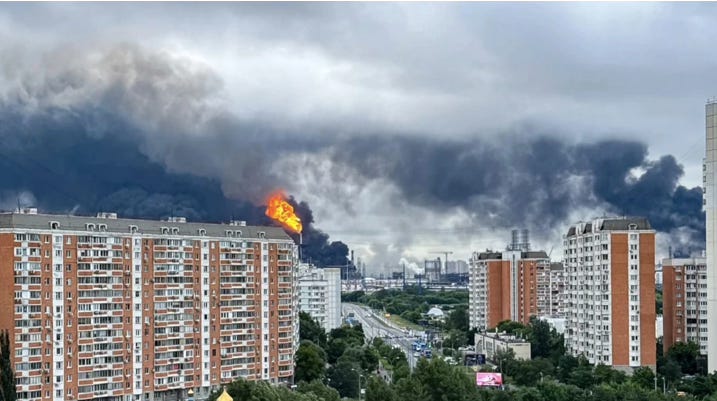
(A Russian refinery burns on the outskirts of Moscow. Over the past 100-plus days, Ukraine has struck at least 24 out of Russia’s 34 major oil refining facilities, driving oil processing in Russia to its lowest level since 2005)
What happened to the more stable world we assumed had emerged after 1989-91? Multilateralism and the rules-based order are foundering, not because of inherent flaws, but because their beneficiaries have not defended them.
At a deeper level, allies have still not responded to the wave of large-scale aggression building for over a quarter century.
The main purpose of the United Nations, as spelled out in article 1 of its Charter, is “to maintain international peace and security, and to that end: to take effective collective measures for the prevention and removal of threats to the peace, and for the suppression of acts of aggression or other breaches of the peace (…).”
Yet when Russia invaded Ukraine in 2014, we did little. When Iran scaled up its proxy wars in Syria, Yemen and Gaza, we ducked. We let the Taliban retake Afghanistan. Many still hope Russia can be bought off with just part of Ukraine.
These acts of aggression are not limited to large-scale conventional wars. They now include political and information warfare aimed at preventing democracies from taking decisive action, pushing them into isolationism or redirecting them to do active harm, as the current US Administration has done and Orban did in Hungary, to the alliances on which our multilateral system is built.
Why have we not taken action to stop this?
In some cases, our citizens did not see these threats coming.
