


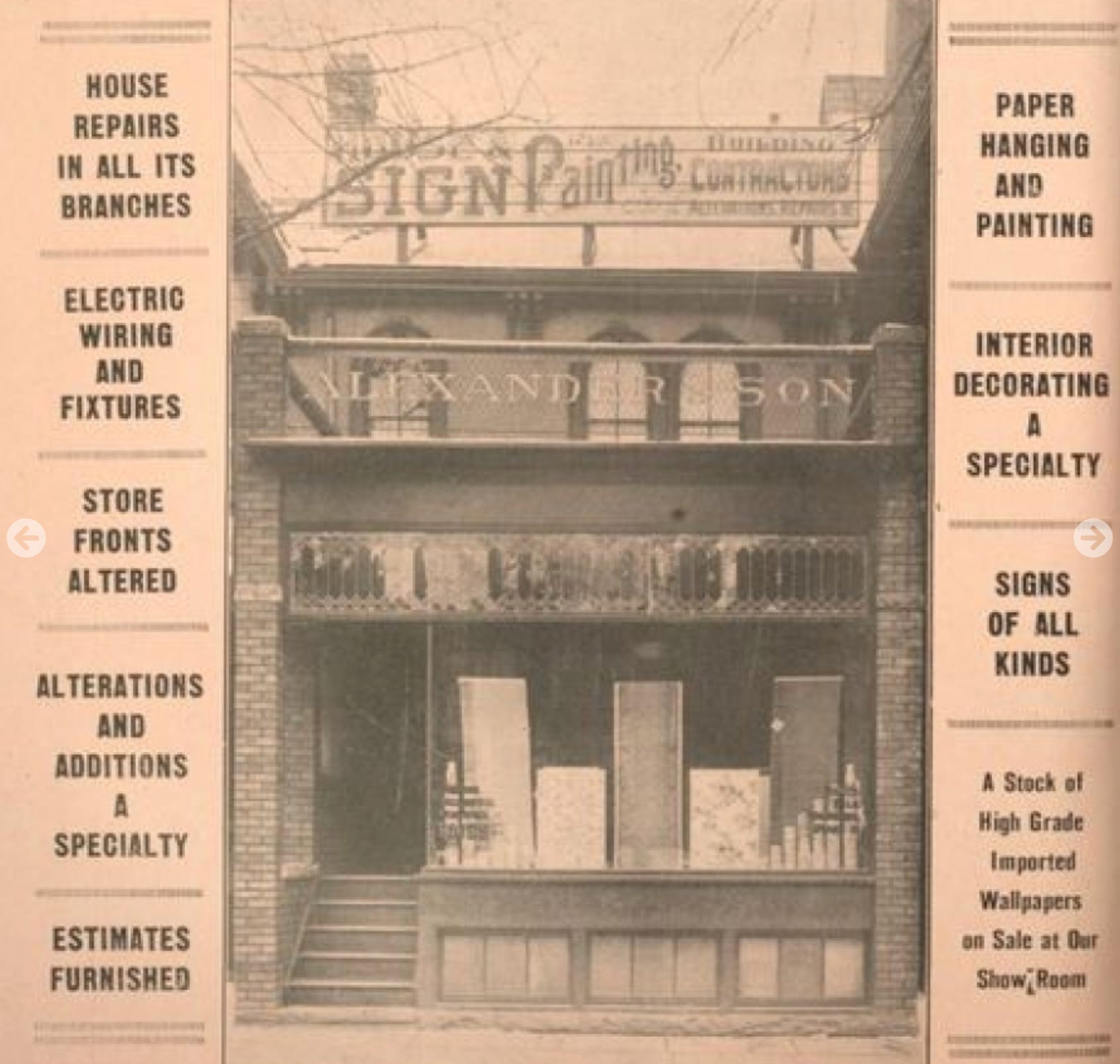
(457 Church was home to Alexander & Son, a Toronto contractor, painting services firm and hardware store that started business in 1873)
Toronto is a microcosm of the world. Every one of us has a story of migration, of dwelling and working in this city, of the lives it shaped, including our own.
My first direct ancestor to come to Toronto was Henry Stewart Alexander (1836-93), painter. He and his wife immigrated from county Armagh, Ireland with two young children around 1856. He first appears in a city directory for 1860, living at 243 Elizabeth Street in The Ward, just north of today’s City Hall.
In the 1860s, his shop as a painter and glazier was on Sayer and Duke streets — now Chestnut and Adelaide. By 1873, he had founded — together with his son John, born in 1853 — a painting, sign and building firm known as Alexander & Son.
By 1886, Alexander & Son was at 76 Jarvis street, the first alphabetically of nearly 100 individual painters and painting firms in the Toronto directory.
Life in nineteenth century Toronto could be treacherous. Henry Stewart Alexander died on January 7th, 1893 “from the effects of a heavy fall from a trolly car.”
By the time my grandfather was born in 1905, his family lived in a now-demolished house on Bedford road south of Davenport. Among his friends and neighbours were the Billes brothers. According to family legend, when they invited him to join the venture that would become Canadian Tire, he declined.
From 1916 until 1959, Alexander & Son was based at 457 Church Street. The firm later moved to Queen Street East, discontinuing business later in the 1960s.
My grandfather made a career outside painting and building — as salesman for the Moore Business Form Company, which started as Grip Printing and Publishing.
Our Alexander family started to migrate to Toronto long before 1856. Henry Stewart had two siblings who settled in early Simcoe county. Four more uncles came to Canada: two arrived in 1820 and were among the early pioneers of Mono township and Barrie. Two more – a cabinet-maker and a carpenter -- settled in Toronto.
These Alexanders came from Loughgall in Armagh. Their parents and grandparents were born in Stirling, Logie or Clackmannan in Scotland, just north of the Firth of Forth. They came to Ireland in the mid-1790s in search of farmland.
In Toronto, their stories inter-mingled with those of other immigrants or children of immigrants. My grandfather’s mother, Margaret Amy Newlove, grew up on a farm in Etobicoke. My grandmother’s parents are buried in Scarborough.
They sacrificed. My great grandfather was the band sergeant in the 48th Highlanders. He was the eldest of ten brothers. The second youngest trained the Queen’s Own Rifles before D-Day. The youngest was wounded in the First World War and commanded a battalion of the Queen’s Own in the 1920s.
Why am I telling this story? For me, each family narrative is a reminder of the change and continuity that shaped Toronto, or York as it was known before 1834, from the time it was carved out of the forest to be a new capital in the 1790s.
We all have stories of what brought us or our ancestors here — of successes and failures that have shaped Toronto. These are stories of jobs and education, hardship and prosperity, depression and expansion, war and peace.
We adapted to new circumstances. We depended on strong firms and industries to spark enterprise and innovation. Most of the time we benefited from relatively good government, representative institutions and the rule of law.
‘None of this can be taken for granted. The promise of Toronto has been in need of renewal in every generations.
To become the metropolis we are today, this city needed imagination and vision, artists and entrepreneurs — people who saw the future clearly enough to build viaducts, water plants and exhibitions. We founded symphony orchestras, art galleries, food terminals, exhibitions and stock exchanges that were often ahead of their time.
That level of ambition made Toronto an economic engine for all of Canada and — for a time — one of the best and most liveable cities anywhere.
We can live up to that billing again — but not by leaving things to drift, chance ad complacency. Beyond the nuts and bolts of running the city of Toronto better — of ensuring it works for everyone — we need to work out what our next destinations should be and turn all our energies to getting there.