


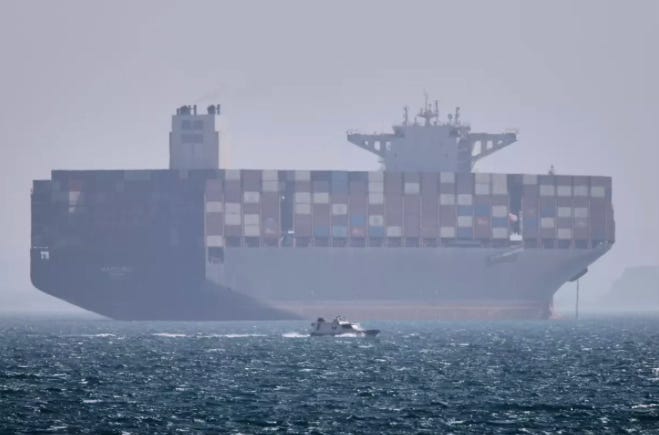
(A cargo ship in the strait of Hormuz [Amirhosein Khorgooi / Associated Press])
After 90-plus days of war, what impact have the US and Israeli air campaign and continuing naval blockade of Iranian ports had on the Khomeinist regime?
From the start, our view at The Diehard Optimist has been that allied policy in response to decades of Iranian aggression has been far too weak and incoherent.
We held this view long before the US and Israel began their June 2025 air strikes or the air and naval campaign launched on February 28th, 2026. Our view last summer was that the 2015 Joint Comprehensive Plan of Action (JCPOA) had failed to end Iran’s proxy wars or its nuclear ambitions – and that Trump’s first term repudiation of JCPOA had created a void which Tehran exploited by scaling up regional aggression and enrichment of nuclear materials.
When the larger joint air campaign began on February 28th, we were skeptical about Trump’s ability to see it through to a successful conclusion – largely because of his failure to bring allies on board; his indifference to freedom, human rights and the rule of law; and his closeness with Russia, Iran’s long-time strategic ally.
As far back as 2017 I have been calling on allies “immediately to implement political and economic sanctions against relevant state entities in Iran, Pakistan, Russia and other state sponsors of terrorism and violent extremism.”
With Assad waging genocidal war on his own people, at that time with Iranian and Russian backing, I also suggested in early 2017 that: “All available international air power should be employed to target and destroy Jabhat Fateh al-Sham, the Islamic State of Iraq and the Levant (ISIL), Hezbollah, the Iranian Revolutionary Guard Corps (IRGC) and other terrorist groups in Syria.”
Obviously, neither of those things — sanctions or air strikes to stop Assad —happened in 2017 or at any point during Trump’s first term or under Biden.
As a result, Iran’s axis of resistance continued to gather steam, culminating in the October 7th, 2023 Hamas terrorist attacks against Israel.
Israel’s military operations since that time have cut back the military capabilities of the axis to perhaps one-third of their peak levels.
Hezbollah retains tens of thousands of fighters in Lebanon, with an arsenal of 20,000 or so rockets and missiles. But their leadership ranks have been decimated and Assad’s fall cut Iran’s land bridge to Lebanon via Syria.
Terrorist networks supported by Iran in Yemen for well over a decade remain active, but have kept attacks below a threshold that would attract renewed Saudi or UAE military engagement. Iran-backed Shia militias in Iraq have been mostly integrated into state structures, prioritizing political influence over kinetic attacks. Hamas has lost most of its leadership, and is no longer capable of mounting major attacks.
Yet so long as the Khomeinist IRGC remains in power in Iran, the prospect of revived Iranian threats to Gaza, Iraq, Lebanon, Yemen or other states will remain.
So what has the US-Israeli campaign achieved to date?
First, Iranian missile, ballistic missile and nuclear weapons programmes have been severely degraded. It would take Iran several years, without external support, to develop a deployable nuclear weapon. Iran’s arsenal of existing missiles and its capacity to produce new ones has been roughly cut in half.
Second, the regime has lost many of its top leaders, including ayatollah Khamenei. But no serious armed opposition has emerged inside Iran and the regime’s repressive capabilities on the ground across the country remain robust.
Third, the regime has not given up its nuclear ambitions. Large stockpiles of uranium enriched to various grades remain untouched by US and Israeli strikes at facilities beneath Pickaxe Mountain and elsewhere.
