


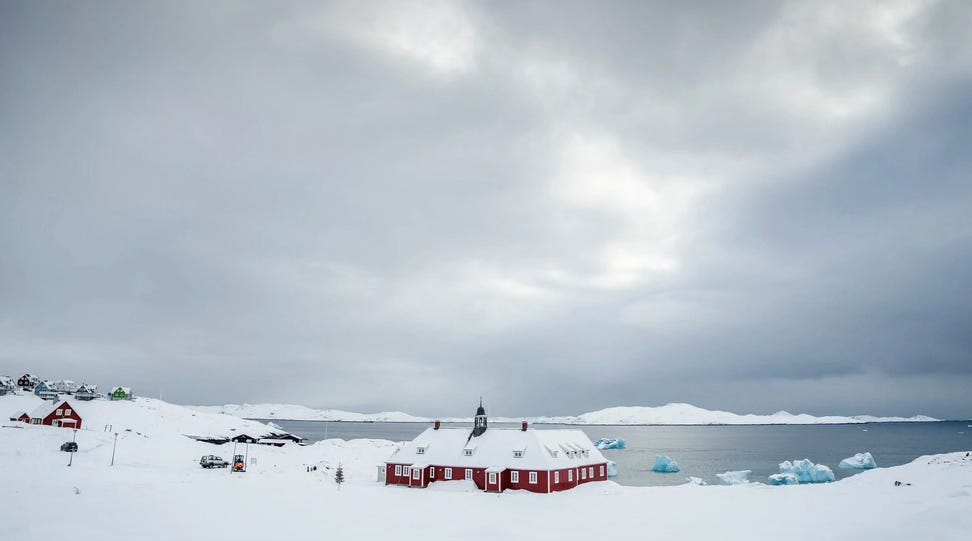
(Mads Claus Rasmussen/Ritzau Scanpix/AFP in ‘Trump seizing Greenland could start off a chain reaction’ in The Atlantic, January 5th, 2025)
To understand recent events in Venezuela, look no further than Russia’s playbook. The Maduro drama is a textbook ploy to divert our gaze away from Ukraine.
Moscow has a long, reprehensible track record of engineering suffering in one place to free its hand in another. Remember the 2014-15 European migration crisis, which undercut allied will to act in Afghanistan, Libya or Syria? Consider Moscow’s long partnership with Iran and its axis of resistance proxies.
The KGB Lexicon defines active measures — the term they have used to describe the core element of their global strategy since the 1960s — as “measures aimed at exerting useful influence on aspects of the political life of a target country which are of interest, its foreign policy, the solution of international problems, misleading the adversary, undermining and weakening his positions, the disruption of his hostile plans, and the achievement of other aims.”
By misleading its adversaries, Moscow seeks to bolster its main effort. “Active operations” are synonymous with active measures, but “on a somewhat larger scale.” They involve long planning horizons and careful camouflage to escape detection. In many cases, the primary goal is to divert, misdirect or mislead. When Moscow is pursuing one goal, which today is war in Ukraine, their doctrine holds it to be a worthwhile investment to ensure adversaries are focused on other matters.
In 2021, when the Kremlin was contemplating a full-scale invasion, they were cheered by the abrupt US/NATO withdrawal from Afghanistan and Taliban takeover, which sapped allied credibility and distracted democratic publics.
After the October 7th Hamas terrorist attacks on Israel, which Russia quietly championed alongside its ally Iran, Moscow was delighted to see Ukraine displaced from front pages — to be replaced by Israel’s multi-front war of self-defence.
After years of preparation, Moscow is now promoting a resurrected Monroe Doctrine. They want Washington to embrace ‘aggressive realism’ in its own hemisphere in order to diminish US involvement in Europe still further.
By advocating a renewed ‘sphere of influence’ for America in its own backyard, Moscow hopes to give itself a blank cheque for the same kind of impunity in Europe, starting with a reconquered Ukraine.
These intentions are not camouflaged. They were loudly proclaimed by Russian fascist ideologue Aleksandr Dugin in his 2025 book entitled The Trump Revolution. A chapter on ‘Trumpism as an ideology’ includes the following passage:
“The key shift here is the transition from a globalist perspective to an America-centric and expansionist approach. One of the clearest examples of this shift are Trump’s statements about annexing Canada as the 51st state, purchasing Greenland, reclaiming control over the Panama Canal, and renaming the Gulf of Mexico to the ‘Gulf of America.’ These are all hallmarks of aggressive realism in international relations and, moreover, a return to the Monroe Doctrine after a century of dominance by Woodrow Wilson’s doctrine. The Monroe Doctrine of the 19th century prioritized U.S. control over North America, and to some extent South America, aiming to weaken and eliminate European influence in the Western Hemisphere. In contrast, Wilson’s Doctrine, articulated after World War One, became the roadmap for American globalists, shifting the focus from the U.S. as a national state to its mission of spreading liberal democracy worldwide and maintaining its structures on a global scale. Under this framework, America itself was secondary to its international mission. During the Great Depression, the U.S. temporarily abandoned Wilsonianism, but after World War Two, it returned in full force. In recent decades, this doctrine has dominated. Under Wilsonianism, the ownership of Canada, Greenland, or the Panama Canal was irrelevant, as all were governed by liberal-democratic regimes controlled by the globalist elite. Today, however, Trump is radically shifting this focus. The U.S. as a nation-state once again ‘matters,’ and it now demands obedience — not to the World Government (which Trump is effectively dismantling) — but to Washington, the U.S., and Trump himself, as the charismatic leader of the new ‘High’ era. A map of the U.S. with 51 states (including Puerto Rico), Greenland, and the Panama Canal vividly illustrates this pivot from Wilsonianism back to the Monroe Doctrine.”
While enabling US decapitation of the Maduro regime, Dugin and Russia are betting a repressive Venezuelan autocracy will continue to serve Moscow’s long-term interests, not only there, but also in Cuba, Nicaragua and other parts of the Caribbean, as well as the rest of South and Central America.
At the same time, the Kremlin is essentially reminding MAGA and Trump that, in the board game Risk, Greenland is part of North America.
In other words, Russia is promoting US aggression in a refurbished American sphere of influence as a way to sustain and even escalate its own aggression in Ukraine and elsewhere. As one summary of Dugin’s arguments puts it: “If you wish to control the territories in your sphere — Canada, the Panama Canal, Greenland — then we likewise seek to control our security zone — Ukraine.”
While Moscow now openly proclaims this goal, it has cajoled and coaxed Trump and MAGA to embrace such a policy by more discrete means, over many years. This has been an active operation of the first order. Dave Troy has recently summarized these moves on his America 2.0 Substack.
In 2017, cosmetics heir Ron Lauder floated the idea of a Greenland takeover to Trump. In 2019, Moscow forged a letter to Senator Tom Cotton signalling (falsely) that Greenland might be open to a change in ownership. That same year, Trump advisor Fiona Hill testified that Moscow saw Venezuela as a quid pro quo for Ukraine: under such an arrangement, the US would gain a free hand in the one in return for giving Russia a free hand in the other. In 2020, Russian nationalist Zhirinovsky echoed this framing. If Trump had won that year, Maduro might have been removed and Russia might have launched its full-scale invasion of Ukraine much earlier.
For Moscow, misdirection is much-needed magic: it mitigates outside pressure and smooths the path to conquest. By focusing US and allied attention on Venezuela, Russia hopes to clear the way for more of its own aggression in Europe and beyond. The US has signalled and hinted that Greenland, Colombia, Mexico and Canada may also be on the receiving end of military operations to ensure we remain preoccupied with these threats — and never give Ukraine the decisive support it needs.
Moscow’s fingerprints may be all over MAGA’s newfound hemispheric belligerence, but its role still flies under the radar. Edward Luce today acknowledged ‘Greenland may be next’ but did not mention Russia once.
In Russian, the word for a magic trick is фокус (focus), meaning illusion or sleight of hand. Moscow’s active operations magic aims to divert allied focus from Ukraine.
It has worked. For the last several days, the world has been consumed by US actions against Venezuela and threats against Greenland — just as the 36-member coalition of the willing meets in Paris to discuss crucial support for Ukraine.
The protests of brave Iranians go ignored. China’s menacing exercises around Taiwan are downplayed. Russia’s role in enabling Maduro’s ouster goes unchronicled.
