


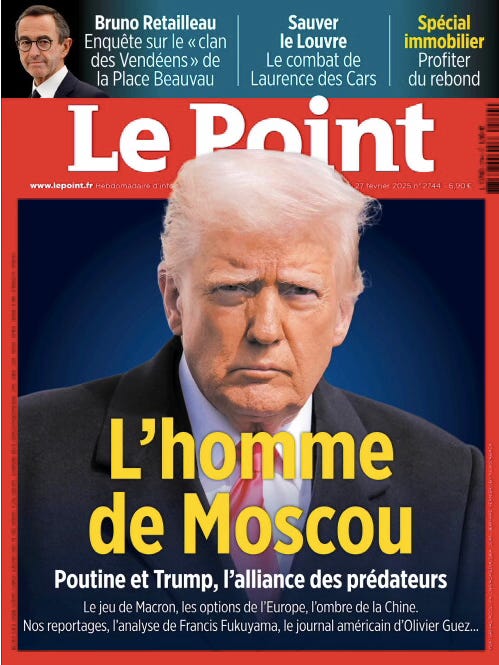
(The cover of French news magazine Le Point on February 27th, 2025)
Since the Cold War ended in 1988-91, the United States has made countless strategic mistakes that ran counter to its national interest. But no country has been on the receiving end of as many American betrayals as Ukraine.
For over 40 years, the Soviet Union was Washington’s principal adversary — counter-punching from Afghanistan to Angola, fuelling proxy wars in Korea and Vietnam, and supporting autocrats worldwide, from Nigeria to Cuba.
When the Soviet Union dissolved, allied policy should have aimed to prevent the reconstitution of an empire centred on Moscow. Instead, while former members of the Warsaw Pact and the Baltic States were welcomed into the EU and NATO, the countries that had been Soviet republics — Ukraine, Moldova, Georgia, Belarus, Azerbaijan, Armenia and five more in Central Asia — languished in a strategic grey zone. In the absence of concerted efforts to integrate them into Euro-Atlantic structures, Moscow retained a strategic hold on each of them.
Why should we have acted? It was clear from the start of Yeltsin’s presidency that Russians considered the loss of their empire a tragic mistake. It was equally clear that Belarusians, Georgians, Ukrainians and others aspired to be truly sovereign nations, free of relentless Russification, KGB repression and Red Army jackboots.
Ukraine was an obvious candidate for greater focus. As Zbigniew Brzezinski wrote in ‘The Premature Partnership’ — published in Foreign Affairs on March 1st, 1994 — “The crucial issue here, one that might well come to a dramatic head in the course of 1994, is the future stability and independence of Ukraine. It cannot be stressed strongly enough that without Ukraine, Russia ceases to be an empire, but with Ukraine suborned and then subordinated, Russia automatically becomes an empire.”
As Brzezinski intimated, Ukraine was already in crisis. In local elections, Crimea had elected a pro-Russian quisling. Economic collapse appeared imminent. Moscow was fanning fears of ‘loose nukes’ to disarm Ukraine. In the ‘battle of the Leonids’ — presidential elections that ran to a second round on July 10th — Moscow’s preferred oligarch-friendly candidate Leonid Kuchma defeated party apparatchik-turned-nationalist Leonid Kravchuk, who had embraced independence.
In those days of near-euphoria over The End of History and Russia’s prospective transition to ‘democracy and a market economy,’ there was little truly strategic focus on Ukraine. Very few policy-makers — and almost no political leaders — understood that the course Ukraine took would set the terms for Russia’s imperial revanchism, which was already smouldering in Moscow’s fascist street press.
If Ukraine became a successful market-driven economy with a reformed government, democratic institutions and strong allies, Russia would be unlikely to attack. But if Ukraine succumbed to Moscow’s venal blandishments and remained in geo-strategic limbo between Europe and Russia, conflict would be likely.
Those who denied Ukraine the support it deserved in the 1990s were dismissive of the prospect of future wars. They ignored the lesson Brzezinski had reformulated in his 1997 book The Grand Chessboard: American Primacy and Its Geostrategic Imperatives: “Ukraine, a new and important space on the Eurasian chessboard, is a geopolitical pivot because its very existence as an independent country helps to transform Russia. Without Ukraine, Russia ceases to be a Eurasian empire.”
Even in the early 1990s, Moscow had designs on Ukraine. Russia’s foreign minister Andrei Kozyrev, long considered a reformer, told Rossiskaya Gazeta in 1993 that: "Anyhow, everything will get back to its old place.” Kuchma laid the groundwork for Ukraine’s cosy industrial cronyism, sponsored by Moscow, whose heyday lasted for a decade. Moscow’s ‘liberal’ mayor Yuriy Luzhkov began musing in the mid-1990s about Sevastopol’s return to Russian sovereignty.
Long before the apartment bombing-backed rise of Putin and Patrushev, Russian attitudes towards Ukraine ranged from indifference to outright hostility. Russian chauvinists never hid their hatred of a sovereign Ukraine, which they often express with Biblical intensity. Yet instead of treating Ukraine and the other countries released from the ‘prison of nations’ as fully sovereign states, entitled to determine their own fates, allied political leaders and policy-makers saw Russia’s continuing domination of its neighbours as more or less inevitable. As Brzezinski put it in 1994: “The underlying and increasingly openly stated consensus behind the policy appears to be that the economic and military integration of the once-Soviet states under Moscow’s political direction would prompt the reemergence of Russia as a mighty supranational state and a truly global power.”
This policy ‘consensus’ has been disastrous. In the same year Brzezinski was advocating strategic focus on Ukraine to end Russian imperialism, Aleksandr Dugin — the closest Putin and Patrushev have to an Alfred Rosenberg — wrote The Foundations of Geopolitics, his blueprint for Russian fascism: “Ukraine as a state has no geopolitical meaning, no particular cultural import or universal significance, no geographic uniqueness, no ethnic exclusiveness, [and] its certain territorial ambitions represent an enormous danger for all of Eurasia and, without resolving the Ukrainian problem, it is in general senseless to speak about continental politics.”
For fascist Russia, ‘resolving the Ukrainian problem’ means destroying Ukraine as a sovereign state. It means erasing distinct and independent Ukrainian culture, foreign policy identity, institutions and language. Yet instead of bolstering Ukraine’s defences and integrating it more rapidly into allied structures, the US has been pushing it away for 34 long years. Here are just seven quick examples:
1. With hard-liners about to attempt a coup against Gorbachev which triggered the Verkhovna Rada’s declaration of Ukraine’s independence from the USSR just over three weeks’ later, President George H. W. Bush made a famously ill-judged speech, written by Condoleeza Rice, on August 1st, during his visit to Kyiv. In it, he cautioned against “suicidal nationalism.” His tone-deaf advice was quickly dubbed the ‘Chicken Kiev speech’ since it basically advised Ukrainians to knuckle under and accept that they would remain under Moscow’s thumb. Bush did not even deign to meet with Ukraine’s democratic pro-independence leaders.
2. When independence did happen, the US focused attention and resources on Russia — more or less ignoring Ukraine and the other new states. As Brzezinski wrote in his 1994 article: “At the July 1993 Group of Seven industrial nations summit, the United States prevailed in obtaining collective pledges of aid for Russia of $28 billion while largely ignoring the non-Russian states.”
3. In 1994, under strong pressure from Moscow, Bush and his team pressed Ukraine to give up their nuclear arsenal via the so-called Budapest Memorandum. In return, Ukraine received meaningless security assurances from Russia, the UK and US. When Russia invaded in 2014, the US, UK and NATO did nothing to stop them.
4. In the late 1990s and early 2000s, the US failed to pursue serious economic reform or military cooperation in Ukraine. As Brzezinski saw it, this strategy was driven by an “attractive idealistic optimism” which was pure folly. It fully expected that “the goal of containment of Soviet expansion is to be replaced by a partnership with a democratic Russia.” Even when the mirage of Russian democracy fully evaporated, US and NATO strategy did not materially change.
5. In 2007 and 2008, President George W. Bush proposed to offer NATO membership action plans (MAP) to Georgia and Ukraine. When this proposal was rebuffed at the April 2008 NATO Bucharest summit by German Chancellor Merkel and French President Sarkozy — under pressure from business leaders and indirectly from Moscow itself — Bush yielded. The summit declaration nevertheless pledged that Georgia and Ukraine “will become members of NATO.” Yet Putin attended the last day of the summit; Russia invaded Georgia four months’ later; and the alliance never reversed its decision, despite a pledge to review it in December.
6. Despite this aggression against Georgia, President Obama and Secretary of State Hillary Clinton launched a disastrous ‘reset’ with Moscow in 2009. They did not even attempt to deter Russia’s 2014 invasion of Crimea and parts of Donbas, and did very little to penalize Moscow for its illegal occupation, now in its twelfth year.
7. With massive Russian support, Trump won the 2016 election. He began to align US foreign policy with Moscow. He clashed with Zelenskyy in 2019 over the latter’s refusal to investigate Biden. Trump’s disastrous 2020 agreement with the Taliban, which Biden needlessly retained, led to the fall of Kabul in 2021 and a disorderly US and NATO retreat from Afghanistan. This show of weakness by both Washington and Brussels convinced the Kremlin the time was ripe to strike on a much larger scale in Ukraine. Even after the full-scale invasion in early 2022, Biden refused to provide Ukraine with heavy weapons or air power. In autumn 2023, congressional Republicans drastically reduced supplies of US arms and ammunition and Trump cut off US funding for such support altogether after returning to office in early 2025.
What would a sound policy in Ukraine have looked like? It would have scaled up economic and military cooperation much earlier. It would have complemented the Budapest Memorandum with concrete, large-scale measures to reform and strengthen Ukraine’s armed forces. It would have removed both Georgia and Ukraine from geopolitical grey zones long before Putin’s Russia was strong enough to invade. It would have identified a concrete pathway to NATO membership for both countries and deterred Russian aggression along the way. It would have penalized Russia heavily, via sanctions, for its first invasion of Georgia. It would have equipped Ukraine to defend its territory and airspace effectively long before Russia’s first invasion in 2014. It would have reduced Europe’s energy dependence on Russia much earlier — replacing it with Canadian, green, nuclear and other alternatives. In the face of a large-scale invasion, the US and NATO would have committed fully and unwaveringly to Ukraine’s victory and Russia’s defeat.
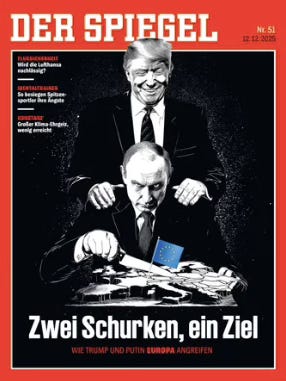
(The cover of the December 12th, 2025 number of Der Spiegel, which reads: ‘Two Rogues, One Goal’)
Instead, we have Trump — back in office thanks to massive, corrupt Russian backing — now attempting to surrender Ukrainian territory to fascist Russia; to weaken and discredit the EU and NATO; to promote authoritarian parties in many democracies and partner with dictatorships in many regions; and to create a Yalta-style ‘sphere of influence’ for fascist Moscow in Ukraine and other parts of Europe.
We should not be at all surprised. Trump capitulated to Moscow long ago — by 1987, when the Red Army was still laying waste to Afghanistan. His attempt to sell out Ukraine is as predictable as were his serial bankruptcies.
Make no mistake. If Ukraine or its allies swallow this poison, it will not be just another betrayal. A Trump-Moscow alliance is the very definition of a high-stakes, existential challenge to the fabric of international stability. We must not fail. If we do not stop him and his Kremlin sponsors — as Ukraine and its allies can collectively do — many democracies including Ukraine may literally cease to exist.
The many strategic mistakes made by allied governments with regard to Ukraine have brought us to this grave juncture. Repeating the mistakes of self-deterrence, failure to defend allies and wandering (even non-existent) strategic focus will not mitigate current threats. Further appeasement or procrastination would make them far worse, laying the groundwork for much more suffering, in an a even larger war.
Our next steps on Ukraine will test our commitment to international peace and security, international law and democracy itself. Now more than ever, we need to pursue “geopolitical pluralism” on Russia’s borders, as Brzezinski advocated over thirty years’ ago. It requires decisive action by a coalition for victory. Russia must remain in political and economic quarantine, without access to capital, without reliable partners, without technology, under strict embargo. Trump’s proposed capitulation should be called out for what it is — an abomination wrapped in a scam. Allies should instead focus on what is needed — support for Ukraine’s sovereignty and territorial integrity; military defeat of Russian fascist aggression in Ukraine and elsewhere in Europe; and making good on our commitment to collective self-defence among allies on a scale we have not seen since 1945.
We still have agency: let’s use it.