


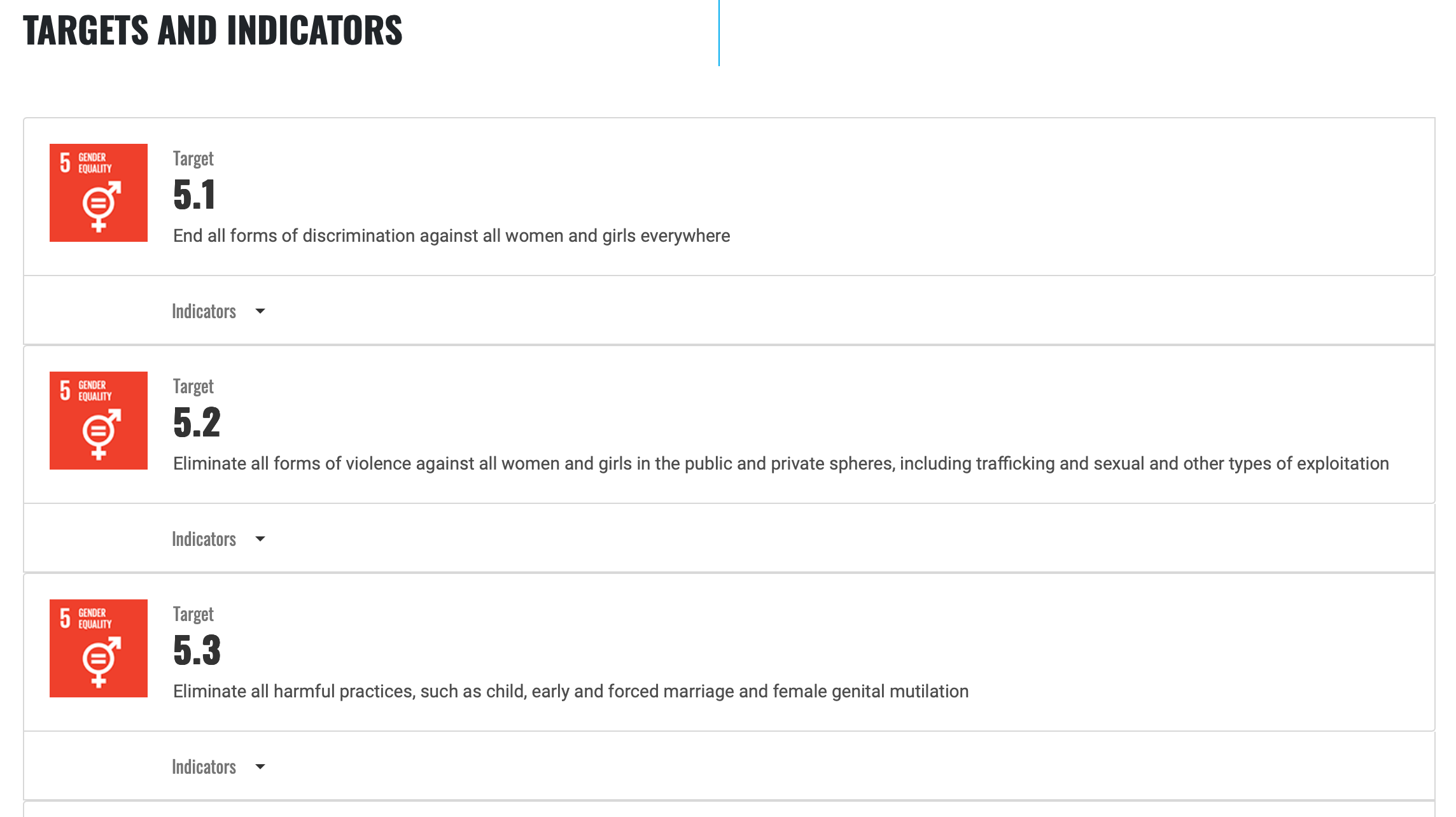
(Targets and indicators for UN Sustainable Development Goal five, gender equality)
Human progress is never a straight line. Only by learning from our mistakes do we regain the perspective needed to move forward — to make things truly better.
For over a decade, a number of misconceptions have been perpetuated in some quarters about legislation passed in 2015 to help Canada meet the UN Sustainable Development Goals (SDGs). Gender equality — more specifically the ambition to “achieve gender equality and empower all women and girls” — is the fifth of seventeen SDGs set by the United Nations in 2015. The intention of the whole international community was to meet all seventeen by 2030.
For gender equality, there are nine targets, each supported by measurable indicators. Target 5.3 aims to “eliminate all harmful practices, such as child, early and forced marriage and female genital mutilation.”
In 2015, as part of our national preparations to achieve the SDGs, Canada adopted federal legislation to ensure the fifth target was met here at home. The ‘Zero Tolerance for Barbaric Cultural Practices Act’ passed the House of Commons at final reading on June 16th, 2015 and received Royal Assent on June 18th, 2015.
It had this name because, during consultations across Canada that informed our legislative drafting, victims of child and forced marriage themselves used the term ‘barbaric’ to describe these practices. In fact, forced marriage is formally recognized as tantamount to slavery under the 1956 UN Supplementary Convention on the Abolition of Slavery, the Slave Trade, and Institutions and Practices Similar to Slavery.
The legislation used the word ‘cultural’ to signal these practices are often wrongly defended in the name of culture. In reality, they have nothing to do with culture — or ethnicity, identity, nationality or religion, for that matter. They are illegal in most countries and represent a profound injustice in every place where they occur.
Our legislation went beyond forced marriage. It amended Canada’s Civil Marriage Act to set sixteen as a minimum age for marriage. Believe it or not, there had been no federally legislated minimum age for marriage before this amendment.
We also included measures to strengthen the government’s ability to detect and prevent cases of polygamy, which has been illegal in Canada since 1890.
The House of Commons passed this bill by a vote of 182 to 84, with the Liberal and Conservative parties voting in favour. Only the NDP was against.
A few months later, with the election campaign underway, I was asked to do a campaign event about forced marriage. On October 2nd, 2015, we announced support to prevent forced marriage internationally, in countries where it is more prevalent, and a dedicated hotline for victims of forced marriage — on the model of the Canadian human trafficking hotline, which has existed in its present form since 2019 but which had available in other forms for many years prior to 2015.
Other countries had taken action to detect and prevent forced marriage. The United Kingdom has had a dedicated Forced Marriage Unit — jointly led by the Foreign and Home Offices, with an associated helpline — continuously since 2005. Australia has a national service for victims of forced marriage and other crimes.
So what went wrong?
I later learned from people who had been directly involved that this announcement had not been fully agreed with the campaign team. The French language leaders’ debate was set to take place that same evening, October 2nd. As a result, the campaign team decided to stop all communications related to forced marriage in order to calm the waters of media and social media in advance of this major televised debate — the last among leaders during the lengthy 2015 campaign.
So just as our announcement was being brutally misrepresented online as (i) directed against Muslims, (ii) a ‘snitch line’ to denounce neighbours, and (iii) an attack on culture — all patently false claims — the campaign machinery meant to refute or respond to such false claims fell silent.
As a result, many of these misconceptions went unanswered. They continue to lodge in obscure corners of the public mind even today.
In the meantime, the SDGs are further than ever from being achieved. The relative optimism about human development of 2015 has disappeared. War, poverty, COVID and aid cuts have put most goals seemingly out of reach.
SDG five, under the banner of ‘gender equality’, is assessed as being critically off track. Far from eliminating violence against women, the world now has eighteen percent of women and girls aged 15 to 49 reporting an experience of physical or sexual violence from a partner over a twelve-month period.
The number of Canadian women who self-reported being sexually assaulted in the previous twelve months remains alarmingly high.
Women’s reproductive rights are under threat in the United States. The ultra-misogynist Taliban are back in power in Afghanistan. On the world’s current pace, it will take 140 years to achieve equality for women in leadership roles and over 260 years to achieve equality in rights before the law.
Canada does not even know whether we have made progress towards ending forced marriage — because we simply do not collect the data required to measure it.
This is the tragedy of the 2015 election: an initiative to protect the rights of women was recast as an attack on them.
Since that time, the entire human rights agenda has seemingly gone into freefall.
Far from championing SDGs, most major democracies including Canada have cut their aid budgets. Hate speech and disinformation have exploded online and in our streets. Transnational repression continues with impunity. Jewish Canadians and Jewish institutions in Toronto, Montreal and elsewhere are literally under siege — subjected to a continuous barrage of threats, discrimination, calls to hate-fuelled violence and actual acts of violence.
Since 2015, the number of people living in extreme poverty — defined since 2025 as less than $3 per day — has risen by over 100 million to roughly 830 million. As a result, ten percent of the world’s population still lives in such indigence. The number displaced by conflict or persecution has doubled since 2015 to around 120 million.
The environment, biodiversity on land and in the seas, forest cover, ecosystems and climate action are all under threat, as are democracy and the rule of law.
My commitment to re-galvanizing Canadian action never wavered. In 2016, I published an article in The National Post together with human rights advocate Aruna Papp on ‘Taking action against forced marriage’. We detailed cases of coerced and underage marriage in Canada and decried stalled progress since 2015.
We must not ignore these disturbing trends — from forced marriage and gender inequality to backsliding on human rights and escalation of full-scale wars.
In a city like Toronto, unhoused people deserve far better. Refugees resettled here should not be in our streets. Veterans should not face mental health challenges alone. Children should not go hungry because the rent has gone up.
We need to learn lessons from our failure to advance gender equality over the past decade. We need to understand clearly why we failed to prevent long genocidal conflicts in Syria that forced millions to flee as refugees, or the return of the dead hand of the Taliban to power in Afghanistan. We need to see clearly how all of this led to Russia’s full-scale invasion of Ukraine and Iran’s escalating proxy wars against Israel, Lebanon, Yemen and other states.
The Cambridge Dictionary defines barbaric as an adjective meaning “extremely cruel, brutal, or lacking civilizing influences. It implies a lack of culture, refinement, or human empathy.”
In my view, forced marriage and other modern forms of slavery still qualify for this epithet. Our turn away from the human rights agenda and the SDGs over the past decade or more has been equally brutal.
The 2015 election was not lost because of an initiative to end forced marriage. We lost because NDP support drained away to Trudeau.
But these injustices are now more urgent. The women of Afghanistan are waiting to hear when we will remember their plight. Women (and a few men) who are victims of forced marriage want to know when their nightmare will end. Thousands of unhoused people and many victims of intimate partner violence in Toronto — including the family of 26-year-old Navneet Kaur of Toronto, killed on July 24, allegedly by her partner — want to know why more was not done.
In a democracy, it is cruel to misrepresent the aims of one’s political rivals in defamatory or incendiary ways. Dropping the ball on human rights, gender equality and the growing impunity of aggressors has been far more brutal.
Amid slackening commitments worldwide to development, human rights and the rule of law, we in today’s Toronto need to show how much better we can do.