


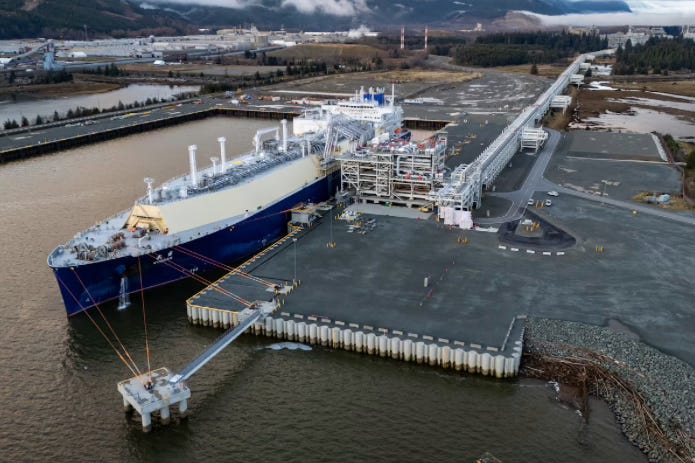
(A tanker at the LNG Canada facility in Kitimat, BC in November 2025)
Canada is a country of many strengths. Yet one of our principal failings has always been complacency. We’ve been in a lengthy phase of it. Is it starting to end?
I’m afraid it’s still too soon to tell.
In its latest form, Canada’s complacency has been on our radar since April 24th, when Jen Gerson of The Line wrote an excellent piece on ‘The cost of Canadian complacency’. While her diagnosis was eloquent, she avoided specifics.
I would like to outline two particularly egregious cases from the past decade.
The first relates to energy.
The two biggest shocks to the global economy since 2014 have come from states that are major energy suppliers. Russia has produced as much as eleven million barrels of petroleum per day and was Europe’s top supplier of natural gas. Iran was exporting as much as two million barrels of oil per day as recently as early this year.
Yet both countries have made it their habit and indeed stated policy to invade, occupy and destroy other countries. Russia has been engaged in an escalating war of aggression in Ukraine for twelve long, bloody years. Moscow has taken the side of despotism and brutality in countless other states. Iran’s proxies have literally wrecked Gaza, Lebanon, Syria, Yemen and a good part of Iraq. Yet both Russia and Iran have done all this while remaining major energy suppliers.
It seems obvious that the international response to Russian and Iranian aggression — which in the case of the latter still includes a standing threat to destroy the state of Israel — should have been to exclude these belligerents from global energy trade. Indeed, under article 41 of chapter seven of the United Nations Charter, which provides for a range of “actions with respect to threats to the peace, breaches of the peace and acts of aggression” it is explicitly stated that “measures not involving the use of armed force (…) may include complete or partial interruption of economic relations and of rail, sea, air, postal, telegraphic, radio, and other means of communication, and the severance of diplomatic relations.”
By continuing to buy oil and gas more or less normally from Iran and Russia long after they had engaged in these flagrant acts of aggression, allies and member states of the UN generally have effectively been ignoring basic provisions of the Charter.
Now imagine a different scenario. Consider a chain of events by which Canada had set out, with genuine national conviction, in 2014, immediately after Russia’s first invasion of Ukrainian Crimea and Donbas, to double Canadian oil production and put Canada in a position to replace up to half of Russian petroleum exports. Imagine if we had decided to become a major LNG exporter, as Australia and the US have done. When Russia’s large-scale invasion of Ukraine happened in 2022 and Iran’s proxy Hamas attacked Israel in 2023, Canada would have been in a position to reduce the world’s energy dependence on both aggressor states.
With surging Canadian supply, Europe, the US and other allies might have been confident enough to embargo Russian and Iranian oil and gas exports much earlier, depriving those regimes of the economic oxygen they needed to keep up the fight in Gaza, Lebanon, Syria and Ukraine.
Such a policy could have saved countless lives and made Canadians richer.
Instead we find ourselves in a situation where most of our relatively limited energy sales to buyers outside of North America still pass through the US, which purchases Canadian oil and gas at a discount. Since 2014 we have increased our oil production by barely one million barrels per day. Our gas production rose from about 15 billion cubic feet per day (bcf/d) in 2014 to about 18 billion bcf/d now. We shipped our first LNG just last year and still have only modest oil export capacity on Canada’s west coast, with no pipeline to the east even planned.
As a result, Canadians are poorer. Russia continues to export about seven million barrels of oil per day, without much of a discount. Iran was still exporting up to two million barrels per day up to April 13th, 2026, when the current US naval blockade of Iranian ports began. How long will it continue? We just don’t know.
Canada’s failure to become an energy superpower and swing global supplier as Russian and Iranian aggression increased was a choice, not a circumstance imposed by external factors, lack of available resources or logistical infeasibility.
The main vehicle for or agent of this choice to be less affluent, while leaving democratic allies vulnerable to less reliable and less scrupulous sources of supply, was of course Justin Trudeau, whose government was elected with a majority in 2015 and re-elected with minorities in 2019 and 2021. It remained in office until 2025 thanks to a supply and confidence agreement that lasted until late 2024 with the NDP — itself fiercely opposed to expanding Canada’s oil and gas industries.
Canada’s failure to launch in the energy sector is linked to the second specific form of Canadian complacency I would like to mention: indifference to foreign interference.
China remains engaged in brutal and pervasive forms of transnational repression in Canada, as Terry Glavin, Sam Cooper and others continue to report.
Russia seeks to influence Canada through continuous active measures, including by placing propaganda films in Canadian festivals, whipping up pro-separatist sentiment in Alberta and promoting extremism in almost every major form online.
Iran’s Islamic Revolutionary Guard Corps (IRGC) and its recruited proxies continue to promote Anti-Semitism, including attacks on and harassment of Canadian synagogues and other Jewish Canadian communities and institutions.
Pakistan’s Inter Services Intelligence (ISI) has long been the primary global sponsor of the extremist Khalistan movement, which also promotes violence.
These acute forms of foreign interference have not gone unnoticed in Canada. We even had a Public Inquiry into Foreign Interference in Federal Electoral Processes and Democratic Institutions, which was established on September 7th, 2023 and issued its final report on January 31st, 2025. But its proceedings were never credible, its recommendations were thin, and its legacy has sunk almost without a trace.
