


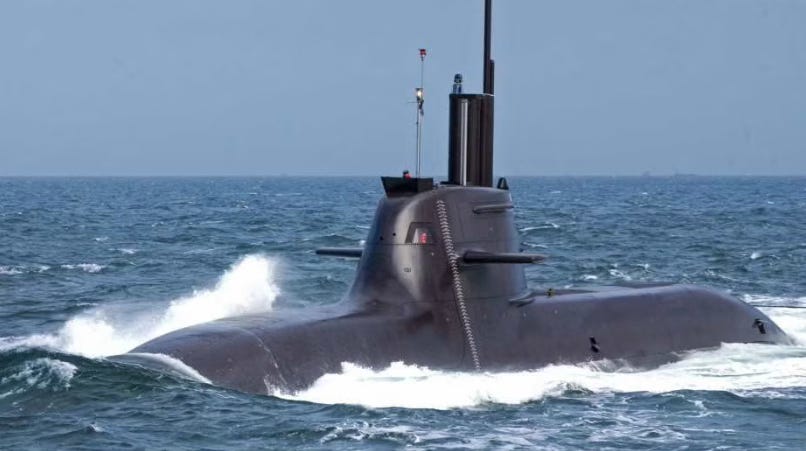
(Thyssen-Krupp Marine Systems type 212 submarine [Kongsberg])
This month Canada faces its first large-scale military procurement decision following yet another decade of darkness, when very little was achieved. Which submarines should we acquire to meet our current strategic requirements?
This is an opportunity to acquire a first-rate core capability — after more than a century of fragmented, politicized outcomes for our underwater fleet. After all, Canada’s first submarines were bought in 1914, not by Ottawa, but by BC under premier McBride in response to a German U-boat scare in the Pacific. Despite building a massive surface fleet during the Second World War, Canada spent that conflict mostly crewing and commanding British submarines.
In the postwar era, distinguished naval officer Vice Admiral Harry DeWolf proposed, as chief of the naval staff for the Royal Canadian Navy (RCN), that Canada acquire a nuclear-powered submarine fleet. His proposal was declined in 1960 on grounds of very high cost and US reluctance to share nuclear technology.
DeWolf pivoted his support to a Canadian surface fleet specializing in anti-submarine warfare (ASW). Canada nevertheless acquired three British Oberon-class diesel-powered submarines in the 1960s, as well as four Victoria-class boats starting in 1998. During the Cold War Canada bought two US Navy submarines.
On June 6th, 1987 the government released a white paper calling for ten to twelve Canada-class nuclear-powered attack submarines. In a speech to the United Nations in December 1988, Soviet communist party general secretary Gorbachev announced unilateral troop reductions in Eastern Europe and an end to the interventionist Brezhnev doctrine. The second proposal for nuclear-powered Canadian submarines was cancelled in the April 1989 budget due to rising deficits, the end of the Cold War and shifting priorities — a ‘peace dividend’, as it was then termed.
Today’s Canadian patrol submarine programme represents a substantial opportunity to launch a capability that will serve Canada’s long-term strategic interests. It was encouraging to learn on October 30th, 2025 that RCN commander Vice Admiral Angus Topshee considered both short-listed designs to be “excellent” — and suitable to meet Canada’s requirements.
Now we need to decide which submarine’s military capabilities are superior in order to get on with the hard and urgent task of commissioning a fleet of up to twelve new vessels. Four factors should make the choice very clear.
In terms of stealth, specialized features including a diamond-shaped, non-magnetic hull for active sonar defeat, as well as fuel-cell quietness, make the German-made ThyssenKrupp Marine Systems (TKMS) type 212 among the stealthiest diesel-electric/air independent propulsion (AIP) boats in the world, often matching or exceeding top nuclear-powered general-purpose attack submarines for low acoustic profile when moving slowly or submerged under battery power. The type 212A has been described as “undetectable by contemporary passive sonar”; the newer type 212CD, which Canada would be acquiring, is marketed as “quieter than snowfall.” The Korean-made KSS-III is simply less stealthy.
As for Arctic and high latitude conditions, the German-made type 212CD has been deliberately developed to meet Norwegian and German requirements for operations in the North Atlantic and Arctic. The 212CD’s non-magnetic steel, compact size, superior under-ice performance and ability to surface through thinner ice gives the TKMS design a ‘silent loitering’ profile the KSS-III cannot match. The 212CD has Kongsberg mine-avoidance/navigation sonars and echo sounders optimized for polar environments that enhance this hunter-killer role. It also has a longer continuous submerged time than the KSS-III due to more efficient fuel-cell AIP.
In performing anti-submarine warfare (ASW) tasks — a major focus for any expanded Canadian subsea fleet — the 212CD’s advanced sonar suite (including bow/conning tower arrays, large-aperture passive flank arrays and towed arrays, as well as the sonars and echo sounders mentioned above) make it a superior ‘ambush predator’. The German design also features integration, propulsion, endurance and weapons systems optimized for northern/Arctic choke-point operations, giving it clear advantages in this harsh environment, contributing further to mission success and survivability.
Finally, the 212CD has by definition superior interoperability with NATO and other allied forces. Korean builder Hanwha Ocean — formerly Daewoo Shipbuilding and Marine Engineering — has to date built or been responsible for 23 submarines; Hanwha has exported them only to Indonesia. Germany’s TKMS, by contrast, has built or supplied over 200 submarines over six decades to 27 navies, including Italy, Norway, Singapore, India, Turkey and South Korea.
Germany and Korea are Canada’s allies. In May 1952, a company of the Royal Canadian Regiment was deployed to Geoje island, near today’s Hanwha shipyard, to restore order in a prisoner of war camp; on May 2nd, 1945 the Canadian parachute battalion arrived just ahead of Soviet forces in Wismar, where TKMS builds submarines today. But a design co-developed by two NATO member states specifically for Arctic archipelago operations against Russia offers a wider range of built-in operational benefits for Canada and its allies.
Those still touting the Korean proposal tend to highlight its larger size and crew, blue-water reach and potential industrial benefits for Canada in other sectors, including automotive manufacturing. These points are not directly relevant to strategic military requirements. Indeed, many advocates of the Korean KSS-III design point to its vertical launch system (VLS), a feature of their bid that could provide six to ten cells for cruise or ballistic missiles. Yet this additional option is not a stipulation of the current Canadian patrol submarine programme. In fact, a superfluous VLS capability could detract from the fleet’s ‘stealthy hunter’ role.
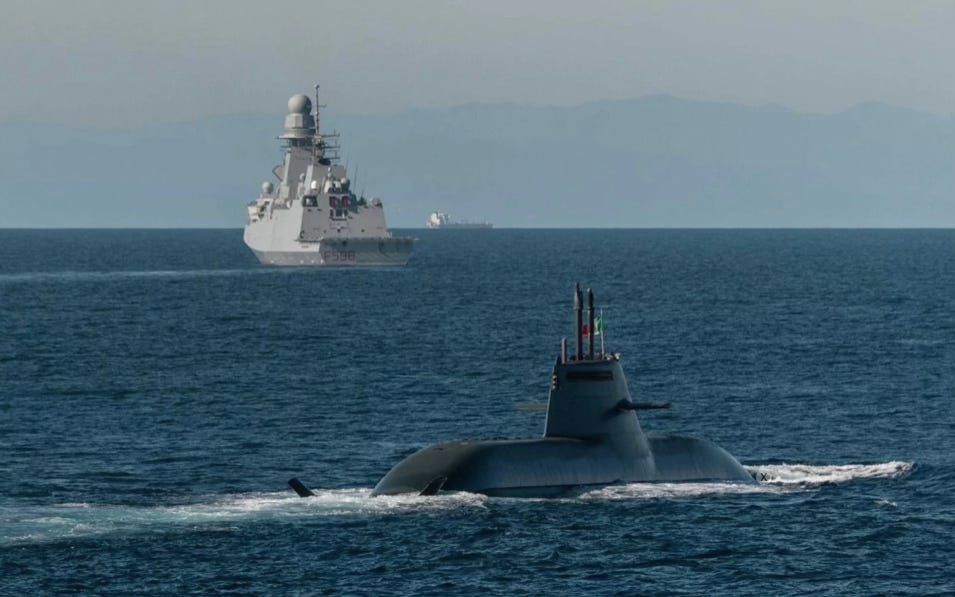
(NATO warships and submarines taking part in Dynamic Mongoose 2026, an ASW exercise off the coast of Norway)
One overriding consideration should seal the deal for the TKMS type 212CD design. With the return of US isolationism and impulsive unilateralism, which now often favours autocracies over allies, Europe is already bearing the main burden of military support for collective self-defence in Ukraine, as well as forward presence in the Baltic states, Romania, the Mediterranean and elsewhere. These allies are looking for signs — beyond the brigade we command in Latvia and recently increased military support for Ukraine — that Canada remains strategically committed to the defence of Euro-Atlantic space, especially as Russia’s grey zone war via sabotage, attacks on undersea infrastructure and hybrid operations continues to escalate.
In this context, a decision to procure a relatively untested Korean platform for Canada’s largest-ever submarine procurement would risk undermining the trust now underpinning the all-important coalition of the willing within NATO. By purchasing a proven capability from Europe’s leading economy, Canada would be paving the way towards deeper forms of defence industrial cooperation with the EU. We would also be enlarging a shared allied capability and enhancing NATO unity of effort. To miss this opportunity would be a blow both to our longer-term partnerships with EU and NATO members and to our reputation as a reliable ally.
In a febrile world of escalating conflicts, this decision must be guided by Canada’s urgent need for the right war-fighting capabilities and by alliance imperatives. On grounds of superior undetectability, operational seamlessness with allies, and ASW excellence, the German-made TKMS type 212CD ought to be Canada’s choice. Once this decision is made, we should return as our next long-term priority for Canada’s underwater fleet to nuclear-powered blue-water submarines, with VLS weapons and the ability to remain submerged indefinitely under Arctic ice.