


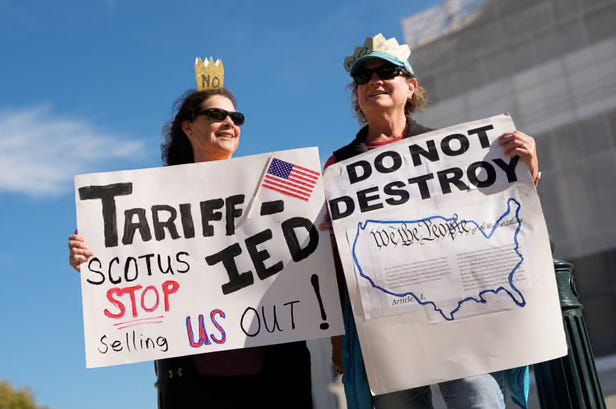
(Protesters outside the US Supreme Court on November 5th, 2025)
Is it safe to say that Trump – despite clearly autocratic inclinations and closeness with dictators that mean the US harm – will not topple, with Samson-like destructive force, the load-bearing pillars of his country’s democracy?
While no one should have any illusions about his capacity for mischief, the latest signs are that constitutional democracy in America will survive this onslaught.
Less than ten months ago, we devoted an essay (‘Fundamental Questions’ from August 27th, 2025) to seven potential vectors of democratic deterioration in the US. While there has been backsliding on these fronts, there are plenty of grounds today for arguing that the patient, while ailing, is no longer at risk of flat-lining.
It’s not just that Trump is wildly unpopular in his lame-duck stage as president: his most dangerous projects appear to have been thwarted or at least de-fanged.
Here’s why:
Mid-terms will definitely happen. Democrats are gaining traction on issues from affordability and public services to foreign policy and trade. Far from establishing a ‘managed democracy’ on the Kremlin model — whereby Russia’s rulers control both governing and opposition parties — Trump and his team have inspired an impressive range of political voices that zealously criticize and disparage him.
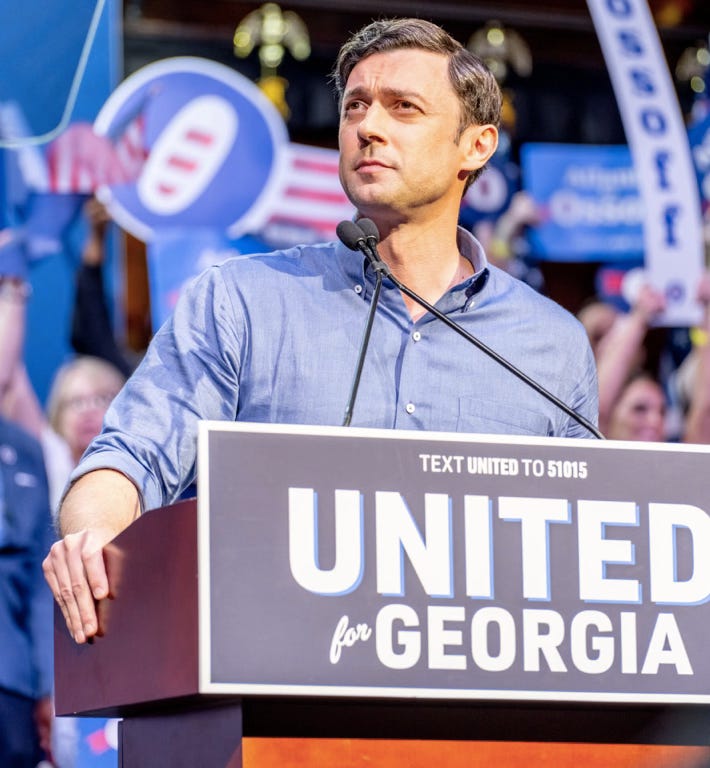
Democrats enjoy a five to seven-point lead over Republicans. They are projected to win back the House, though on current forecasts the GOP would retain the Senate. The list of potential 2028 Democratic candidates for president includes — beyond the usual suspects — impressive new names such as Senator Jon Ossoff of Georgia and Senator Raphael Warnock of the same state, as well as Governors Andy Beshear, Wes Moore and Gretchen Whitmer of Kentucky, Maryland and Michigan respectively. Any one of them would be a huge breath of fresh air.
As for independent media, the US now ranks 64th out of 180 countries in the Reporters Without Borders 2026 World Press Freedom Index — its lowest place ever, representing a drop of seven spots in only one year. The White House has continued to threaten media with massive lawsuits while using all the institutional clout at its disposal to engineer a restructuring of major media holdings that has bolstered the influence of right-leaning tech hyper-scalers.
Yet people still roundly criticize the president’s unhinged policies and excesses.
The same story applies to the rule of law. Even after threatening judges and law firms in unprecedented ways, Trump has nevertheless seen a steady stream of key rulings go against him — on issues from birthright citizenship and deportations to funding freezes, tariffs and even re-naming the Kennedy Centre.
Thanks to the wise positioning and principled action of Jerome Powell, the independence of the Federal Reserve has been bent but not broken.
The US has not become a police state – after the alleged killing of a civilian in Minneapolis on January 7th, 2026, triggering bipartisan backlash, proactive ICE enforcement tactics have become less prevalent and the number of overall arrests has declined slightly.
Despite appallingly perverse leadership at the FBI, Homeland Security, and as Director of National Intelligence, the US defence, intelligence and national security communities continue to fulfill their statutory mandates — albeit amid massive political obstacles. The CIA been particularly immune to disruption.
With regard to alliances, the US remains a member of NATO. While openly threatening not to uphold article five of the North Atlantic Treaty and withdrawing from many UN and other international agencies, funds and programmes, the US has sustained the main institutional frameworks of the postwar era — Bretton Woods, the WTO, NATO, Indo-Pacific alliances and the UN itself. They remain intact, even if the stuffing has been knocked out of many of them.
