


Last Saturday was Chekist’s Day in Moscow. While December 20th nominally marks the ‘professional anniversary’ of the faceless, mendacious legions who toil in the field of ‘state security’ across Russia and in missions abroad, it is actually the closest thing this Kremlin has to a holiday highlighting its core purposes. Chekist’s Day epitomizes what today’s fascist Russian regime is about.
In narrow terms, it marks the day Lenin founded the All-Russian Extraordinary Commission for Combating Counterrevolution and Sabotage (Всероссийская чрезвычайная комиссия по борьбе с контрреволюцией и саботажем) in 1917. In broader historical perspective, this was when Moscow dedicated itself to upending the established international order by stealth, subterfuge and war. Apart from brief pauses under Nazi occupation in 1941-44 and in 1991-95, when the old KGB was chaotically reorganized, they have never strayed from this path.
The Commission’s first chairman was Feliks Dzerzhinskiy, a Polish-born revolutionary who had spent years in exile, as well as in Tsarist prisons. Dzerzhinskiy was ruthless and fanatical, carrying out orders without question. From the start, his mandate was threefold — to win the civil war, destroy Bolshevism’s enemies and spread the communist revolution.
To do so, the VChK (ВЧK) instituted ‘organized terror’ as the coercive body on which the Bolsheviks relied to stay in power and defeat opponents. Known by its first three initials — ‘VChK’ — it came to be called the ‘Cheka’ and its officers were ‘Chekists’. Even after the VChK morphed into the GPU under the NKVD and (after the Soviet Union had been formed in 1922) into the OGPU directly under the Council of People’s Commissars, December 20th was widely known as ‘Chekist’s Day’.
The first apogee of Chekist repressive power was reached after Stalin integrated them in 1934 into the Soviet People’s Commissariat for Internal Affairs (NKVD), where grotesque villains such as Yagoda, Yezhov and Beria fought never-ending, nauseatingly internecine battles. After Stalin’s death, the NKVD was replaced by the KGB, which collapsed with the USSR in late 1991.
Yet Chekists retained enormous influence. President Boris Yeltsin issued a decree on December 20th, 1995 giving official status to the ‘day of the employee of the organs of state security of the Russian Federation’ (День работника органов безопасности Российской Федерации), which has been the official name for Chekist’s Day ever since. Russia’s Federal Security Service (FSB) was founded that same year and remains, with hundreds of thousands of employees, the KGB’s principal successor.
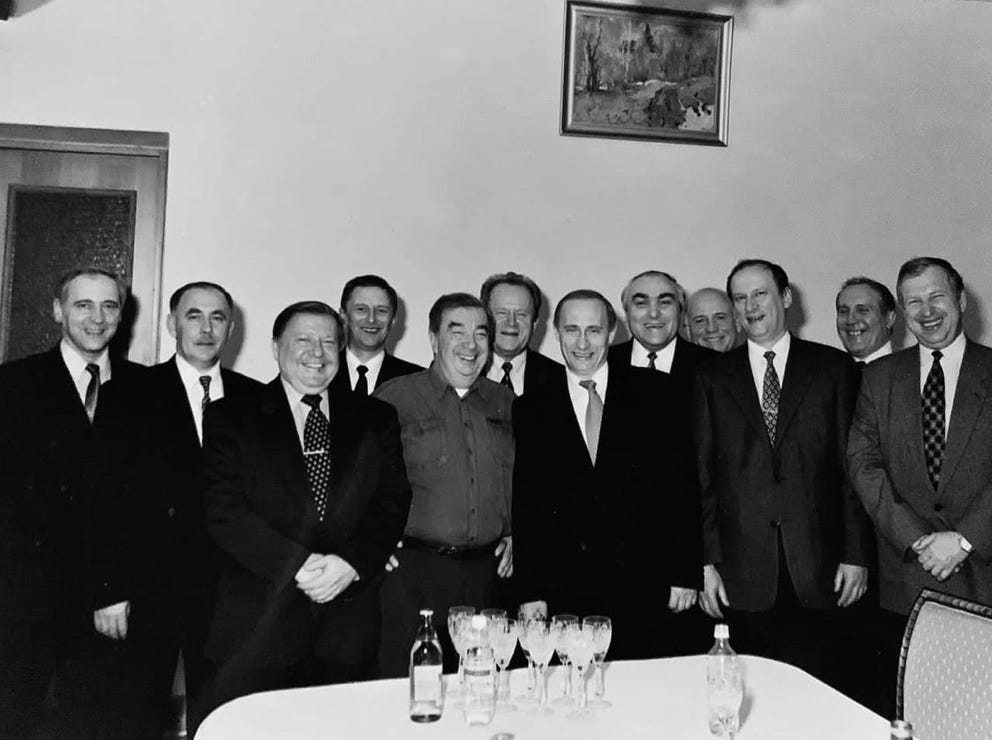
Only a few years later one of these employees became president. The photo above shows Vladimir Putin — still Russia’s prime minister at the time — celebrating Chekist’s Day on December 20th, 1999. Only eleven days’ later, Yeltsin resigned and made Putin acting president. The people shown in this photograph have been Russia’s actual and near-absolute rulers ever since.
They include Putin’s cronies from his days in the Leningrad KGB, including his notorious alter ego Nikolai Patrushev (third from the right), who took over as FSB director from Putin on August 9th, 1999. Also shown are Sergei Chemezov (fourth from the right), an influential Kremlin power-broker to this day, and Sergei Naryshkin (far left), who is still director of the External Intelligence Service (SVR), which operates independently of the FSB.
At the event depicted in this photo they are celebrating their dark professional bond with Yevgeny Primakov (fifth from the left), an Arabist who operated in the Middle East under journalistic cover. Primakov was born in Kyiv but grew up in Tbilisi. He later became an academician, head of the Institute of Oriental Studies of the USSR Academy of Sciences and director of the Institute of World Economy and International relations, since re-named in his honour.
Primakov was the SVR’s first director in 1992, when it was created out of the ruins of the KGB’s First Chief Directorate. Primakov was also foreign minister under Yeltsin. When this photo was taken, Primakov had only recently left the job of prime minister — on May 12th, 1999 — having served only eight months in that role. He is the only person in this group to have publicly voiced opposition to Russia’s 2014 invasion of Ukrainian Donbas. He died the next year.
In the photo, the vodka bottles have been carefully stowed away. All but Primakov are wearing shirts and ties. There is an air of quiet determination and restored discipline. This group is on its way to absolute power, but they do not yet fully have it.
Russia has always relied on harshly unscrupulous ‘secret services’ as core instruments of state power. In the first half of the nineteenth century, this apparatus cemented a Holy Alliance that championed absolute monarchy after Napoleon’s defeat. Up to 1917, clandestine Tsarist police infiltrated anarchist, nihilist and socialist groups, launching brutal disinformation campaigns, often to benefit one group over another. Vitriolic Anti-Semitic propaganda tracts produced by Tsarist secret police were instrumental in spreading belief in an international Jewish conspiracy.
After the Bolshevik revolution, the Soviet VChK, OGPU and NKVD focused on eliminating dissidents and recruiting believers in Marxism-Leninism worldwide. When Marxist sympathizers became scarce during the Cold War, the Soviet KGB under Andropov turned to active measures and proxy wars using a combination of subversion, co-option, information warfare and military action to influence the decision-making of allies and adversaries alike.
Putin’s generation of Chekists were deeply steeped in Andropov’s doctrines of active measures and hybrid warfare. This photo was taken just over three months after the last ‘apartment bomb’ went off in Volgodonsk, Russia, killing seventeen people and injuring 69. It was part of an FSB-led false flag operation to stage incidents of domestic terrorism that would be blamed on Chechen militants, triggering a war that would make the little-known Putin famous and popular across Russia. By Chekist’s Day in 1999, the siege of Grozny was well underway — part of a pattern that would repeat itself over the next quarter century with deadly regularity in Aleppo, Homs, Mariupol, Bakhmut and elsewhere across eastern Ukraine.
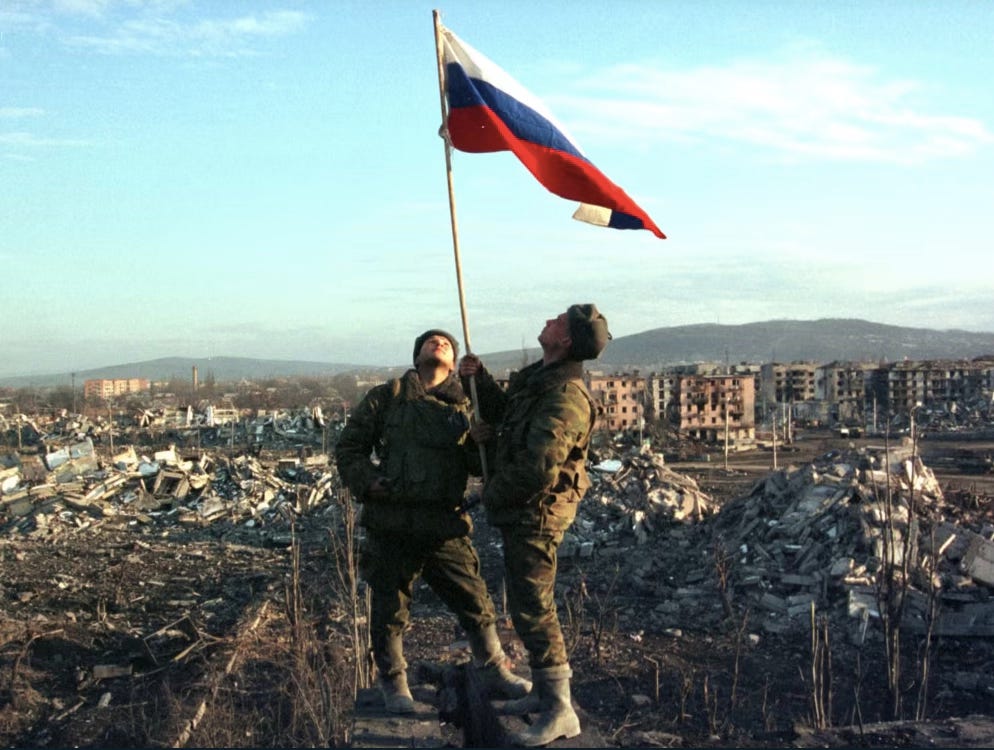
(Russian troops raise their flag in February 2000 over Grozny, the Chechen capital they had destroyed over the previous three months, as well as in 1994-95.)
Today’s Chekists combine authoritarian conservatism with imperialist nationalism. Thanks to pervasive, relentless domestic propaganda, the Russian population and most of the Russian diaspora abroad have been marinating in the juices of this dead-end ideology for a quarter century. Social media platforms have given their propaganda broad influence worldwide.
The result has been a spree of instability and subversion, without any Cold War-style defences or response. Today’s Chekists — like their KGB mentors — back autocratic regimes from Ethiopia, Iran and Mali to Cuba, Venezuela and Nicaragua. They fuel civil wars in Libya and Sudan. Despite recent setbacks, they still back radical proxies in Lebanon, Syria and Yemen. Directly and indirectly, they have been top state sponsors of European, Shia and Sunni terrorist groups since the 1960s.
Russia remains the world’s leading source of Anti-Semitism. The Kremlin encouraged Hamas and Iran to attack Israel on October 7th, 2023 — to divert world attention away from Ukraine. Yet in a speech to the Knesset earlier this month Israeli prime minister Netanyahu claimed that he speaks “with President Putin on a regular basis, and this personal relationship of many years serves our vital interests.”
Such paradoxes are common and ubiquitous, since Chekists’ stock in trade is lying, duplicity and dissimulation. They prey on human weakness, engage in blackmail and exploit financial and personal vulnerabilities. They attack, discredit and engage in character assassination of those who oppose them. Their responses are asymmetric — seeking to overwhelm an adversary’s defences. By reckless recourse to ceaseless violence — on battlefields in Ukraine, the Middle East and Africa, as well as against political opponents from London to Berlin — they sow fear.
They also engage in sabotage and prepare for war ‘behind enemy lines’ in dozens of countries. They do all of this, every day, in almost every democracy, as well as in dozens of other states. They consider themselves to be already at war with NATO; they consider all NATO allies to be hostile adversaries. But they are careful to calibrate their violence to remain below the threshold that would trigger a serious response. The result is a growing sense of chaos. After all, Moscow has been escalating its wars of aggression and active measures, with considerable and often growing impunity, for twenty-six years — ever since this photo was taken.
Moscow’s Chekists — the Kremlin, FSB, SVR and their military intelligence ‘cousins’ the GRU, together with their allies and proxies from China and Iran to North Korea and Serbia — are the leading clandestine source of instability in the world today. They are at war with Ukraine and all those who support Ukraine. They also go to enormous lengths to cover their tracks. They are determined to ensure their influence over Trump and other political forces in G7 countries goes mostly undetected and unopposed. So far, they have had considerable success in preventing concerted action to stop their political influence in major democracies from growing.
Besides Putin — out of the picture since late 2023 — none of the people in the photograph above is a household name anywhere outside Russia. When this picture was taken, they did not yet have fortune, influence or power. Today they control hundreds of billions of dollars, distort or tip the results of elections everywhere, and set much of the international conflict agenda.
They are classic fascists. They believe in repressive control, a cult of violence and territorial conquests to restore a mythical empire. They also have a revolutionary belief that if they corrupt enough politicians, subvert enough elections and attack enough soft targets, the rule of law and representative government will collapse everywhere. They truly think that every leader aspires to be a Stalin or a Putin — and that repressive fascism works better than democracy.
It’s an unhinged, self-destructive creed, relying on a dubious message, weak tools and increasingly faltering economy. But allies have not yet taken this threat seriously or made the basic moves required to defeat it and safeguard democracy.
Putin rode KGB values to power in Russia. For twenty-six years, he has used them to dreadful effect around the world. By weaponizing extremism and mass migration, by backing coups and proxy wars, he has made the world a much more dangerous place. For most of today’s refugees and displaced persons, the faces in this photo lit the fuses that sent them fleeing. The missteps of the US in Iraq cost hundreds of thousands of lives; Russia’s compulsive aggression has cost millions.
This Chekist forever war shows no sign of slackening. It still seeks to destroy Ukraine and democracy everywhere. While Trump remains in office, the Kremlin’s Chekists will continue to assume they are winning. In fact, they believe their active measures are succeeding on a scale Andropov could never have imagined. To defeat this nihilistic global threat, we need to see the deranged men behind the masks for who they were and who they and their successors are today. Every democracy, all allies and NATO itself need a full accounting of the harm they have done since 1999.
Well said. This is something that needs to be explained, over and over, until Western publics instinctively recognize their signature. I would love to repost it if you'd consider taking off the paywall.
I would (if you allowed me to repost it) expand on the point that anyone familiar with Putin's MO would think it highly likely that Putin encouraged the October 7 attack. But you do need to be familiar with that MO; otherwise, that sounds nutty. You need to know that he gives himself murderous presents on his birthday; that Hamas visited just before the attack; and that this is *exactly* the sort of thing they have done and would do. (The only point that makes me reluctant to say so as categorically as you do is the tight operational security Hamas practiced before the attack. They didn't even share their plans with Hezbollah--which is why they failed to outright destroy the Israeli state. There was a roughly six-hour window in which Israel was completely vulnerable. if Hezbollah had done what Hamas expected them to do, the story would have ended very differently.)
It looks to me as if Russia has had as much success in penetrating the Israeli defense establishment as it has our own. I don't see this discussed very often in the Israeli media: There's quite a ways to go in educating the Israeli public. Israel doesn't devote the same resources to thinking about Russia as it does their own neighborhood, and this shows. The Likud is proud of having a "cooperative" relationship with Putin, and easily manipulated by his blandishments that he understands the problem of jihadism. (How they could be so naïve about Russia when so many of them are *from* Russia, I'm not sure: I suspect some are not naïve at all, but mistakenly think they're the handlers in that relationship, not the handled.)
Israel has been courting Putin's allies in Europe--and in the US, for that matter--on the basis of an obviously flawed understanding of who they are. I'm wondering if the antisemitism that's bursting so exuberantly out of the American right these days might cause them to rethink the wisdom of that strategy. I hope so. It would be so good to see Israelis kick that disgraceful crew out and rejoin team liberal democracy.