

Farage & Boisdale
Populism's three painful lessons

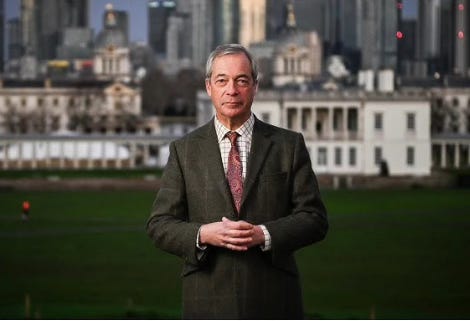
(Reform UK leader Nigel Farage delivering his New Year’s message for 2026)
For ten days I have pondered an FT Magazine interview with Britain’s Brexiteer-in-chief. A brilliant sketch, it was also unusually revealing. It illustrated how today’s populism harnesses real issues to quack fixes promoted by mischief-makers.
Let me explain. Financial Times columnist Henry Mance published his first interview with Nigel Farage – a ‘Lunch with the FT’ – nearly a decade ago, on April 8th, 2016. It ran just two months before the Brexit referendum.
In it, Farage was portrayed as the chain-smoking “son of an alcoholic Kent stock broker” who went to swishy Dulwich college, traded on the London Metals Exchange in the 1980s and became the country’s leading “Brussels-basher” in the 1990s.
Mance conveyed Farage’s bluff charm — a “blokish bloke” with a passion for “proper pubs, proper markets” and penchant for First World War battlefields.
In this year’s interview, which ran on March 13th, Farage claimed he was “not a populist” but a Cassandra warning of dangers. Such disingenuousness has a long provenance: Farage did not express public support for Trump or Marine Le Pen until after his team had won the Brexit vote. As for the Reform MP’s recent policy flip-flops, Mance said “fiscal detail has never been Farage’s strong point.”
Astonishingly, there was no probing of Brexit, its aftermath or growing real-world costs. The closest we come is Farage’s attribution of “Britain’s lack of dynamism” to the “marzipan layer” which Mance defines as “the upper-middle classes who are happy with the status quo and reluctant to push innovation.”
Cogent analysis this was not. As it has turned out, immunity to serious scrutiny has been a hallmark and feature, not bug, of Farage’s entire career.
When several dozen schoolmates reported to the Guardian that he had uttered “racist or anti-semitic abuse” at Dulwich, this episode was reduced to a throwaway line in the Mance interview. Farage’s claim that “The Taliban said they will accept Afghan refugees back from me” did not cause a ripple of controversy for the FT — presumably because Britain’s Labour Home Secretary had just banned study visas for Afghans and citizens of three other nationalities.
Farage was allowed to claim, unchallenged, that his first party (Ukip) was “radical old-school liberal” and Reform UK, his new party now with eight MPs including Farage at Westminster, is “a lot more communitaire: family, community, country.” By such laws of inversion, Benjamin Disraeli was a fire-breathing Marxist.
But this is how populism works.
Its political leaders use (in Farage’s case) calculated bonhomie or (in Trump’s case) soul-destroying celebrity to become, as they see it, firebrands championing causes that are otherwise lost — the disenfranchised, the overlooked, the Rust Belt factory worker in Ohio or the under-employed electrician in the Midlands.
Then they offer simplistic, naïve or dangerous policy solutions — Brexit, ICE, DOGE, Liberation Day tariffs, ‘stop the boats’, ‘send Afghans to the Taliban’.
The result is massive domestic harm, fraying of the rule of law and vaulting cynicism towards politicians. The latter curiously benefits Farage, whose party led mid-March UK surveys of voting intentions, because (as Mance delicately puts it) “not having been in government allowed him to wash his hands of the post-Brexit mess.”
Pardon me? By my reckoning, Farage, Boris Johnson and Dominic Cummings were the principal architects of this mess. Farage only ‘washed his hands’ because he was allowed to do so by journalists, politicians, businesspeople and citizens.
But once again, that’s the thing with populism. Pithy falsehoods go unchallenged. Disasters go unreckoned with. Viktor Orban is only facing potential defeat next month after 16 uninterrupted years (plus a four-year term 1998-2002) as prime minister of Hungary, where living standards have plummeted. Trump won a second term after paying for radical organizers to come to Washington DC to foment a violent insurrection in the Capitol. Even after the Brexit catastrophe, Farage is still seen by many as a leading candidate for prime minister.
This seems irrational. By almost every economic measure, Brexit and Trump’s sweeping tariffs were terrible policy, harmful to Britons and Americans. Trump’s trampling of constitutional norms damages the United States. Retrograde US and UK migration policy undermines both countries.
But sound policy proposals are effectively ignored because at least one third of the public has tuned out good ideas and tuned into populist quackery. Responsible policy-makers are often not up to the job of offering better alternatives or propose pale imitations of the populist fare. They are also not loud or confident enough: the din generated by populist foghorns drowns them out.
As a result, good policy goes ignored. Populism is dissected, repeated and amplified — but not by voters exercising their democratic or political rights. As Lauren Southern, the Canadian right-wing influencer named in US Department of Justice indictments tied to a Russian influence operation, put it in a recent interview: “I would argue that the vast majority of right-wing influencers now are paid for by foreign governments, interest groups, corporations.”
We could not agree more. Today’s problems are real — affordability, growth, trade, Russia, Iran, China. But the policy solutions predominating online are not the product of homegrown democratic deliberation. They are slogans pushed by foreign-funded bot armies, or externally-funded influencers like Southern.
This ecosystem also produces Nigel Farage. To Mance’s immense discredit, he seems not to have asked once about Russia — despite a vast and growing trove of damning evidence, surfacing even more visibly again this year, that Ukip, Brexit and Reform have been up to their eyeballs in Russian influence for twenty years.
The most brutal paradox of today’s populism is this: its ravages are less visible to the primary victims than to outsiders. For many Britons, Farage remains someone with whom they would gladly have a pint, as Mance implied in 2016. For foreigners stunned by the UK’s Brexit-induced self-harm, he is an obvious candidate for shunning. In this month’s interview, Farage expressed delight at having recently met Jordan Bardella, Le Pen’s placeman atop the National Rally, and frustration that visiting Canadian conservative leader Pierre Poilievre had pushed back the time of their meeting. (It was later cancelled.) Bardella is a fascist; Farage is very close to deserving that label. Both bask in Moscow’s continuous adulation. If Poilievre wishes to be taken seriously, he should know better than to meet with any of them.
Britain’s reckoning over Brexit, if it ever comes, still seems a long way off. Boisdale is named for its owner Ranald Macdonald, eldest son of the 24th captain and chief of — as the restaurant’s website puts it — “the Macdonalds of Clanranald, the largest and most anciently Royal of all the Highland clans.” A previous Ranald Macdonald, younger of Clanranald (son of the 17th chief), was one of the first major Highland leaders to back Prince Charles Edward Stuart’s rebellion in 1745. After the defeat at Culloden the prince spent seven to eight weeks — from late April to late June 1746 —on or near South Uist, though he did not stay at Boisdale itself
From the start of his Eurosceptic political career in 1993, Farage has understood branding. He has portrayed himself as a British Everyman, an irrepressible bulldog, defender of British identities, liberties, traditions and valour from the romantic Jacobite cause right through to the Somme and the Falklands.
Brexit was an exercise in nostalgia. It was also an economic disaster, fueled by a massive, continuing Russian influence operation. Erecting massive trade barriers with the UK’s main market was not a flash of brilliance or triumph of innovation. It is a still-swelling blot on Britain’s proud island story.
Contemporary populism has taught us three painful lessons. First, the dislocation and disorientation caused by globalization have been brutal for many. Second, solutions proposed by populists like Trump, Johnson and Farage have only done more harm. Third, a Greek chorus of malign influence and deliberate falsehood continues to make it very hard to debate effective solutions, or bring them into democratic focus.
Ultimately, Farage has absolutely no right to channel the defiance shown at Boisdale, the Battle of the Somme or the Blitz. He has zero achievements to his name — only damages owing. Slowly but surely, scrutiny is coming for populists everywhere: we all have an interest in seeing them held fully to account.
It’s not just his past that’s at issue, but the current operating model; particularly the pattern of elevating people who lack either competence or judgment.
The idea of someone like Zia Yusuf ending up anywhere near the Home Office should give those responsible for national security pause.
Chris, this is a sharp diagnosis of how populism operates — especially the gap between real grievances and the quality of the solutions offered. That gap matters.
But the harder question is why that space remains open. Populism does not just exploit failure; it feeds on it. Where institutions underperform or appear distant, simplified narratives gain traction almost by default.
The strategic risk is not only bad policy. It is erosion of trust — in expertise, media, and democratic process itself. Once that weakens, correction becomes much harder.
The answer, then, is not only to critique populism, but to outcompete it: clearer policy, stronger delivery, and credibility rebuilt where it has been lost.