


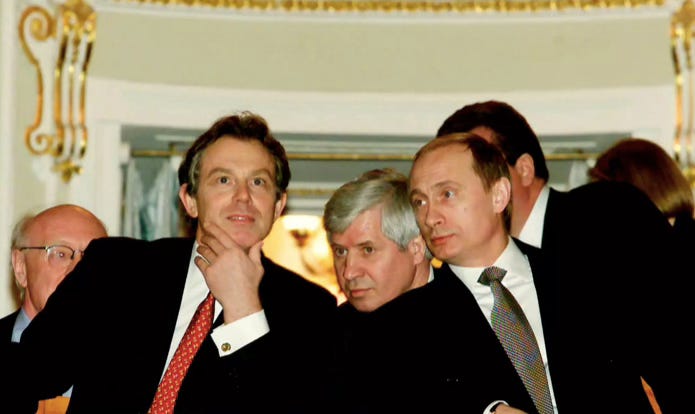
(British prime minister Tony Blair with Russian presidential candidate Vladimir Putin at the Mariinsky theatre in St. Petersburg on Saturday March 11th, 2000. The performance was a premiere of Prokofiev’s War and Peace, a four-hour opera adapted from Tolstoy’s novel that was directed by Mariinsky director Valeriy Gergiev, a Putin fanatic, later a fierce supporter of Russia’s genocidal invasions of Ukraine.)
Democracy has been backsliding for two decades. Large-scale conflicts are multiplying. International trade and energy markets are in crisis. Direct investment — beyond AI — is in a slump. How did we get here?
The roots of today’s malaise can be traced back to four major mistakes — all made at the very start of this century. All of today’s major threats — authoritarianism, aggression, economic nationalism — have their origins in 2000-01.
The first mistake was allied misreading of Vladimir Putin. President Bill Clinton had met him on September 12th, 1999 — when Putin was still only prime minister — at the APEC summit in Auckland, New Zealand. This was in the middle of the false-flag apartment building bombings, organized by Putin’s crony Patrushev, that terrorized Russia, were blamed by the Kremlin on Chechens, and propelled Putin to the presidency as a ruthless wartime leader.
It was Tony Blair who made the cardinal error. He accepted an invitation floated by, as senior MI6 officers later confirmed, a senior Russian intelligence official. As a result, Blair was in Russia on March 10-11th — just over two weeks before Russia’s March 26th presidential elections. He praised Putin effusively, calling him “impressive” and “highly intelligent” — someone who “wants to modernize his country.”
This helped Putin win. It also blunted allied criticism of Moscow’s genocidal war in Chechnya for which the UK provided significant military exports to Russia. Putin visited the UK in April, after his election victory, then again in 2001 and in 2003 for a state visit. In all, Putin came to the UK seven times as president — five times with Blair as prime minister and twice when Cameron was in office.
During Putin’s December 2001 visit Blair told Russian journalist Anna Politkovskaya — murdered in 2006 for her criticism of Russian atrocities in Chechnya — that: “It’s my job as Prime Minister to like Mr Putin.” Italy, France and Germany welcomed Putin as president even more often — eleven, seventeen and eighteen times, respectively, over only twelve years. Prior to Trump hosting Putin in Anchorage last summer, the Russian president’s last visits to G7 countries were to a G8 summit in the UK in 2013 and to the fall UN General Assembly in New York in 2015.
Needless to say, the damage done by Russia to international peace and stability was seriously exacerbated by this continuous failure of G7 leaders to: (i) see Putin for what he was; (ii) deter or respond decisively to genocidal wars and invasions in Chechnya, Georgia, Syria, Ukraine, Libya, Mali and elsewhere; or (iii) fully arm Ukraine.
The second major strategic mistake was allied failure to counter Iran’s proxy wars. When Israel withdrew from southern Lebanon on 2000, Iran’s Islamic Revolutionary Guard Corps (IRGC) doubled down on support for Hezbollah, which began to hijack the Lebanese state. In the wake of the failure of the Middle East Peace Process at Camp David, also in 2000, Arafat and the PLO became more dependent on terrorist groups Hamas and Palestinian Islamic Jihad (PIJ), both heavily backed by Iran.
They launched the second intifada. In response to George W. Bush’s ‘axis of evil’ speech, Iran formally launched its axis of resistance in 2002. At first, Iran’s proxy network comprised Hezbollah in Lebanon, Assad’s regime in Syria and Hamas/PIJ in the occupied territories. The US-led invasion of Iraq broke Sunni-dominated Baathist power but boosted Iran-backed Shia militias in Iraq, giving Tehran an even wider range of proxies to use to disrupt and influence events across the Middle East, culminating in the October 7th, 2023 terrorist attacks against Israel.
The third allied mistake was to welcome China into the WTO in late 2000. China did not meet WTO requirements for currency policy, rule of law, market access, transparency or non-discrimination. It still does not meet them. The hopes entertained by many in the 1990s that China would become an open society with free markets were never realized: in fact, the opposite has occurred. Instead China today is a repressive surveillance state with a top-down, mostly planned economy, which marginalizes entrepreneurs. China now relies on backward-looking mercantilist manipulation to expand exports, undervalue its currency and block imports — in effect, externalizing the costs of weak domestic demand. This approach is generating massive, untransparent levels of debt, which are unsustainable. As Michael Pettis has recently argued, this addiction to exports may end up bankrupting China. In the meantime, it has allowed the Chinese Communist Party to upgrade its military capabilities and extend its machinery of repression to support genocide at home, intimidation of dissidents worldwide, support for Russia’s war against Ukraine, weapons for Iran’s wars in the Middle East, and threats against Taiwan.
The fourth allied mistake was indifference towards the state structures enabling and hosting Al Qaida since it was founded in Peshawar, Pakistan in 1988. This relative lack of care continued after the attack on the US navy destroyer USS Cole on October 12th, 2000, when it was refuelling in Aden, Yemen, which followed bombings of US embassies in East Africa in 1998 that killed 224 people and injured over 4,500. The USS Cole incident came as the Clinton Administration was winding down ahead of November 7th US presidential elections. Ironically, the incoming Bush Administration did not adopt a strategy for countering Al Qaida until September 10th, 2001.
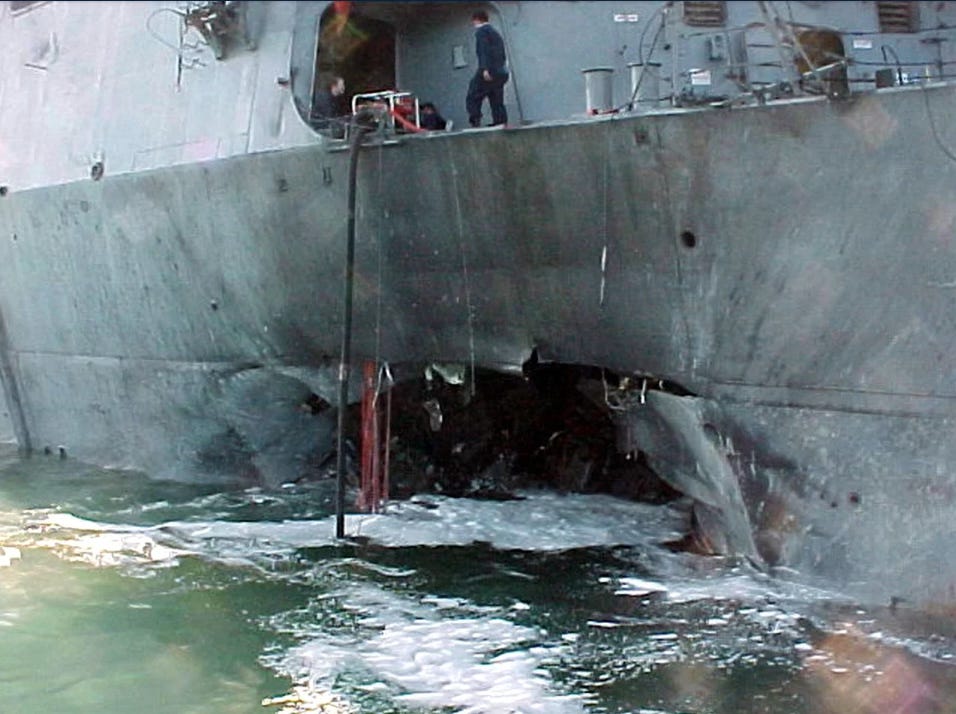
(Port side damage to the guided missile destroyer USS Cole as photographed on October 12th, 2000 [US Navy/AFP])
Disregard of Al Qaida was quickly replaced by neglect of Pakistan’s role. When the US responded to the 9/11 attacks, the military focus became Afghanistan — though Osama Bin Laden had crossed into Pakistan’s Kurram agency on December 16th, and remained there until killed by US special forces on May 1st, 2011. Al Qaida number two Ayman al-Zawahiri also fled to Pakistan early on, surviving to return to Taliban-held Kabul in 2021, where he was killed by a US strike in 2022. The failure to counter Pakistan’s systematic support for Al Qaida and the Taliban led to the failure of the US-led mission in Afghanistan and the Taliban’s return to power, with Pakistan’s full support, in 2021. The final phase of Pakistan’s military campaign in support of this objective began exactly five years’ ago today.
These mistakes had far-reaching consequences. Complacency towards Putin led to growing European and British energy dependence on Russia — the proceeds of which fuelled Moscow’s wars of conquest starting in 2008. Appeasement of Iran and Pakistan allowed terrorism to escalate into a worldwide threat, setting the stage for the emergence of ISIS and Al Qaida offshoots in many theatres. China’s manipulation of its economy to boost exports to achieve growth despite weak domestic demand led to global imbalances that still fuel populism.
These were not small miscalculations. They were strategic decisions, with disastrous outcomes. In 2018, former MI6 chief Sir Richard Dearlove, who had been in that office at the time of Blair’s visits, admitted — with considerable retrospective regret — that by orchestrating this visit the UK had been consciously aiming to help Putin win the election — as well as to promote the interests of oil giant BP. Many senior policy-makers knew that Pakistan and Iran were backing groups that killed NATO troops in Afghanistan and mounted terrorist attacks across Europe. But they were unwilling to confront this aggression. They believed such issues could be managed — until they no longer could. Generations of politicians and business leaders, especially in the US, defended commercial integration with China, while refusing to acknowledge any causal relationship between China’s inflated exports and the hardship, alienation and populism they engendered across OECD and many other economies.
The highest price of all for these mistakes was paid by Syrians, Ukrainians, Afghans, Palestinians and Israelis — as well as the citizens of dozens of other countries affected by Russian military adventures, Chinese support for autocrats or Iran’s reckless war-mongering. The UK has paid a very specific price, in the form of Brexit, for misjudging Putin and accommodating massive Russian oligarch influence over two decades. The US is still facing a reckoning in the form of Trump, whose obvious subservience to Moscow on many issues is still dismissed as a hoax by many Americans. The blows to US and NATO military prestige inflicted by Pakistan in Afghanistan; by Iran in Lebanon, Syria, Yemen and elsewhere; and by Russia in Syria, Libya and elsewhere have yet to be fully tallied. France, Germany, Italy and other states (including Canada) have also paid a high price for complacency in the face of escalating Russian, Chinese and Iranian hybrid attacks, which reshaped public opinion and damaged democracy.
The response to these four major mistakes was delayed by pervasive online disinformaton and polarization — mostly fuelled by China, Iran, Pakistan and Russia. In an essay published last September, we described today’s world as still paralyzed by the aftermath of these mistakes, with autocrats in the ascendant.
There are some signs that autocrats may finally be losing ground. US and Israeli military action against Iran has already curbed the capacity of the Khomeinist regime to sustain its proxy wars. But these gains could still be reversed, especially given Trump’s beholdenness to Iran’s main partner, Moscow. The solution now is for all allies to respond properly to aggression, as the US is doing with its naval blockade of Iran, and to sanction countries that sponsor aggression or distort their economies to achieve artificial and ultimately unsustainable trading advantages.