


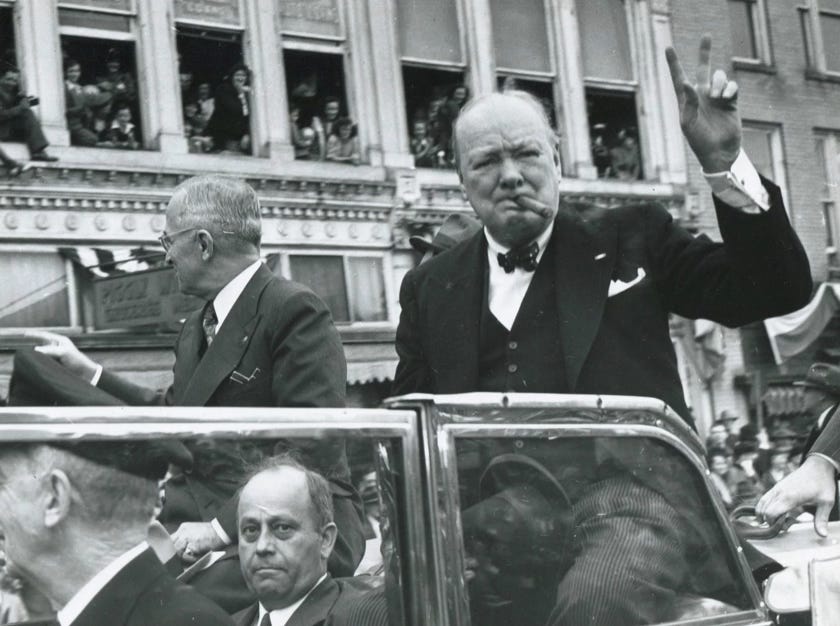
(Churchill and Truman in Fulton, Missouri in 1946)
A few days in St. Louis, Missouri have served as a timely reminder that in just over two weeks it will be the 80th anniversary of Churchill’s iron curtain speech, given on March 5th, 1946 at Westminster College in Fulton, Missouri — 100 miles west of here.
Churchill’s speech was about achieving a truly general peace. He had wanted the United Nations to be “a true temple of peace in which the shields of many nations can someday be hung up, and not merely a cockpit in a Tower of Babel.”
Despite the great victories in Europe and Asia of the previous year Churchill, who had resigned as prime minister on July 26th, 1945, believed international security was not yet on firm foundations. “Our supreme task and duty,” he said, “is to guard the homes of the common people from the horrors and miseries of another war.”
He went on to make points he had never made as prime minister. He warned that security was threatened by “two gaunt marauders, war and tyranny.”
He called for a United Nations “equipped with an international armed force” — able to act decisively against aggression.
He warned about the iron curtain “from Stettin in the Baltic to Trieste in the Adriatic” already enshrouding “all the capitals of the ancient states of Central and Eastern Europe” where Moscow aimed for totalitarian control.
He did not think the Soviet Union wanted open war. But he knew they were pursuing “the fruits of war and the indefinite expansion of their power and doctrines.” He was concerned about Italy and France, where communists were in the ascendant, and Germany, where the Red Army was laying permanent claim to a quarter of the country. He cited Manchuria, Persia and Turkey as areas of acute concern.
In this truly great speech by a matchless statesman, there was also a dash of disingenuousness. Churchill had done little to oppose Stalin’s ambitions in central Europe, especially at Yalta in February 1945. Churchill even negotiated the notorious ‘percentages agreement’ during his solo October 1944 summit with Stalin.
At Fulton Churchill said relatively hard things about Stalin and the USSR. Yet his old deference carried over into mentions of: (i) his “strong admiration and regard for (…) my wartime comrade, Marshal Stalin”; (ii) British “deep sympathy and goodwill (…) towards the peoples of all the Russias”; (iii) the “Russian need to be secure on her western frontiers”; and (iv) Britain’s “Twenty-Years Treaty of Collaboration and Mutual Assistance with Soviet Russia.”
Yet at the core of Churchill’s speech was a belief that peace could be secured on the basis of four elements: (a) an armed UN; (b) “the fraternal association of the English-speaking peoples”; (c) the unity of Europe; and (d) a “settlement” or “good understanding on all points with Russia.”
The key to achieving such a settlement was — Churchill fervently believed — “the secret knowledge or experience of the atomic bomb, which the United States, Great Britain, and Canada now share.”
Churchill saw this weapon bestowing on democracies an unparalleled strategic advantage — leverage and a window of opportunity to come to final terms with Moscow. As he put it: “I do not believe we should all have slept so soundly had the positions been reversed and if some Communist or neo-Fascist State monopolized, for the time being, these dread agencies.”
But by 1946 this brief advantage, if it ever existed, had already been lost. Stalin was confident he would soon match US nuclear capabilities. Gouzenko’s defection, about which Churchill had been informed in September 1945 but which only became public in February 1946, led to the arrest of British physicist and Soviet spy Alan Nunn May in London on the very day of Churchill’s Fulton speech.
The rest is history. The Soviet Union tested its first nuclear device in 1949, four years after the US, and a thermonuclear weapon in 1953, only ten months after the US.
As the Cold War was ending after 1965, the Soviet Union scaled up support for North Vietnam, terrorists and proxy wars. After 1975, it returned to open warfare by sending tens of thousands of Soviet troops and hundreds of thousands of Cuban troops to Angola; and hundreds of thousands of Soviet troops to Afghanistan.
The Soviet Union collapsed. But this active war continued in Armenia, Azerbaijan, Belarus, Chechnya, Georgia, Libya, Mali, Moldova, Sudan, Syria, Tajikistan and Ukraine. To prolific support for Islamic terrorism Moscow added new forms of cognitive and political warfare
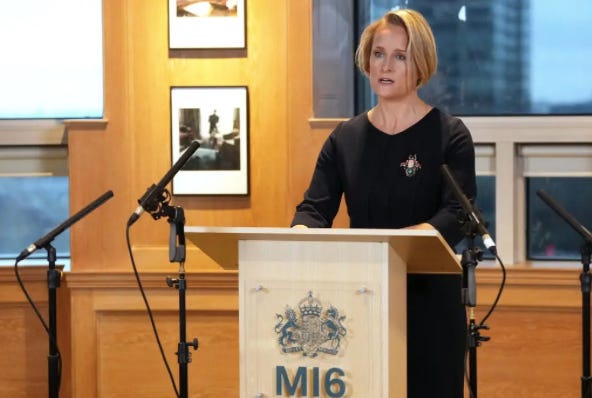
(Secret Intelligence Service Chief Blaise Metreweli delivers a speech on December 15th, 2025 [Pool photo/Kirsty Wigglesworth])
In an excellent December 15th speech by Blaise Metreweli, the new chief of the UK’s Secret Intelligence Service (SIS), she described a world that “is more dangerous and contested now than it has been for decades” — one where “conflict is evolving and trust eroding,” forcing states to operate “in a space between peace and war.”
Instead of providing the usual tour d’horizon of global threats, she opted to “focus on Putin’s Russia. We all continue to face the menace of an aggressive, expansionist and revisionist Russia, seeking to subjugate Ukraine and harass NATO.”
In detailing this menace, she did not mince words or pull punches: “Alongside the grinding war, Russia is testing us in the grey zone with tactics that are just below the threshold of war. It’s important to understand their attempts to bully, fearmonger and manipulate, because it affects us all.
I am talking about:
Cyberattacks on critical infrastructure.
Drones buzzing airports and bases.
Aggressive activity in our seas, above and below the waves.
State-sponsored arson and sabotage.
Propaganda and influence operations that crack open and exploit fractures within societies.”
In a sign of the times, the MI6 chief mentioned ‘Five Eyes partners’ but not the US.
She was clear about how disruptive this new threat already had been for our societies — for “(…) the world we are in – a world where terrorists plot against us, where our enemies fearmonger, bully and manipulate, and the front line is everywhere. Online, on our streets, in our supply chains, in the minds and on the screens of our citizens.”
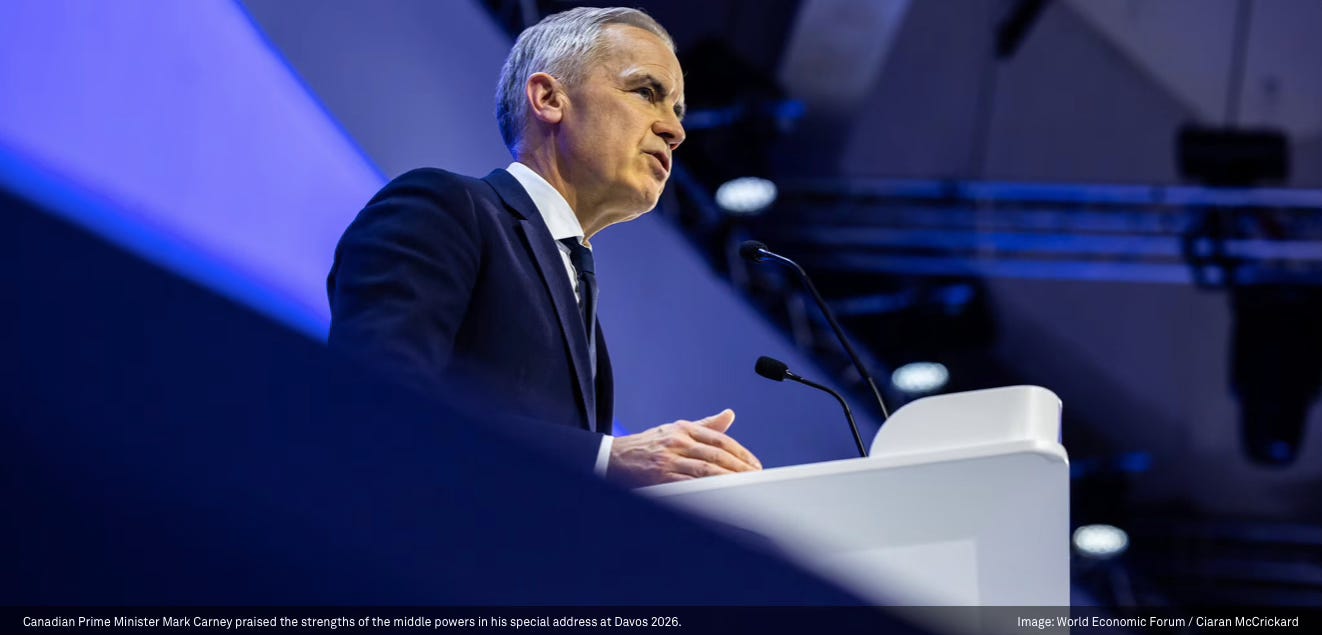
(Canadian prime minister Mark Carney at Davos on January 20th, 2026)
Just over a month later, in a now famous speech at Davos, Canadian prime minister Mark Carney also did not mention Russia or the US by name — referring to the latter only as “the large, main power.”
He has been criticized — unjustly, in my view — for using Havel’s ‘sign in the shop’ metaphor and for appearing to be willing to discard the rules-based order.
On the contrary, while he did say the rules-based order was fading and rupturing, he also stressed that “the power of legitimacy, integrity, and rules will remain strong — if we choose to wield it together.”
He was not calling on middle powers to join lawless geopolitical hunger games. He was making practical proposals for managing risks prudently and collectively, while building “a world of genuine cooperation” together.
By not mentioning the Trump Administration or Russia, Carney was indicting them in absentia. Their aggression and rapacity made it necessary to talk anew about: (i) “classic risk management” rooted in “shared standards” and “complementaries”; (ii) “variable geometry (…) based on common values and interests” to deal with trade, Ukraine, Arctic sovereignty, critical minerals and other issues; and (iii) “reducing the leverage that enables coercion.” Trump and Russia were the new front line running through defence, economic, political, security and trade issues.
The US is not at war with allies. But Washington’s disruptive policies were enabling Russian aggression, making it apt for Carney to say — channelling Havel — “Friends, it is time for companies and countries to take their signs down.”
Appeasement and hopeful thinking are not effective strategies. Carney was calling for them to be replaced by genuine collaboration on “creating institutions and agreements that function as described.”
To get there, we will need more “honesty about the world as it is” and “for middle powers to ‘live in truth.’”
We definitely need honesty about Russia’s track record.
Russia has been the main aggressor in Europe for over a century.
Breaking with long precedent, St. Petersburg formed over 1891-94 the Franco-Russian, or Dual, Alliance — which became the Triple Entente when Britain joined in 1904. Far from being innocent bystanders in 1914, Russia had been funding the Black Hand terrorists who organized the assassination of Archduke Franz Ferdinand. When Austria issued its ultimatum to Russia’s ally Serbia, Russian foreign minister Sazonov and the Russian general staff pushed for full mobilization.
When the Second World War broke out, Stalinist Russia was Nazi Germany’s ally. By 1945, the Soviet Union occupied all the countries and territories it had carved up with Hitler under the terms of the Molotov-Ribbentrop Pact. Moscow effectively succeeded Nazi Germany as central and eastern Europe’s occupying power.
During the Cold War (1945-75) and the active war that followed it, the Soviet Union, sought to weaken the US and its allies, dominate neighbours and win proxy wars. Post-Soviet fascist Russia sought to regain control of Georgia and Ukraine by force, while destabilizing, distorting and degrading politics in every major democracy.
In other words, a truthful account of European and global security, informed by respected historians of Central and Eastern Europe, must conclude that Russia has been and remains an active aggressor and strategic threat.
The ‘settlement’ or ‘understanding’ with Russia that Churchill was advocating never happened. When Yeltsin signed the Budapest Memorandum at the end of 1994, Russia was already planning to retake Ukraine — just as they still plan to break the EU, divide NATO and invade the Baltic states.
Russia’s war against Ukraine or plans for wider aggression are not America’s problem. Middle powers must see ending Russian aggression as their overarching imperative. As Danish prime minister Mette Frederiksen told the recent Munich Security conference: “There are still red lines on the weapons Ukraine can use to win this war. You cannot win a war with one hand tied behind your back. We need to give them the weapons to strike inside Russia.” (…) They still don’t have enough air defense. You cannot protect a country without it. We know exactly what must be delivered: unrestricted long-range weapons and, of course, NATO membership. If we had made that decision in Vilnius, the situation today would be completely different.
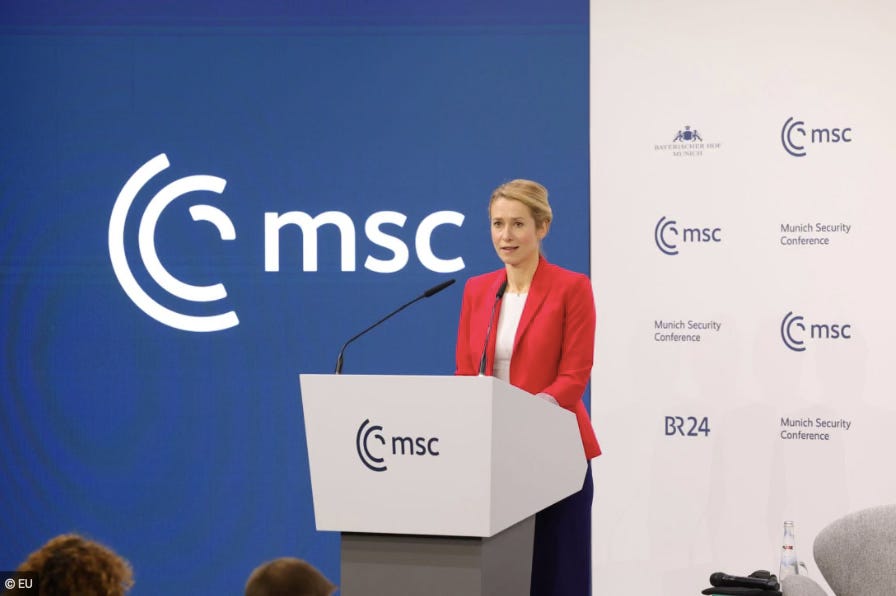
(European Commission vice president Kaja Kallas at Munich on February 15th, 2026)
Kaja Kallas, the EU High Representative for Foreign Affairs and Security Policy and Vice President of the European Commission, gave an excellent speech at Munich. She said: “(…) we know that Russia’s endgame is not the Donbas. Beyond Ukraine, Russia already seeks to cripple economies through cyberattacks, disrupt satellites, sabotage undersea cables, fracture alliances with disinformation, coerce countries by weaponizing oil and gas. And of course there is also the nuclear threat.”
She called for Europe to mobilize — to do more to defend Europe and secure its neighbourhood. She mentioned Canada and other like-minded partners such as India and Australia. She stressed the need for further EU enlargement.
She too failed to mention the United States.
In 1946, Churchill had said: “The United States stands at this time at the pinnacle of world power.” Today the United States presidency reaches a new nadir every week. It has coddled a war criminal and shamefully cut military support for an ally facing the most brutal aggression in Europe since 1945.
The new fight to defeat Russia must place the current US Administration in de facto quarantine. It must enable allies to act autonomously, in coalition without the US, while mobilizing independent voices in the US Congress, in states, cities, business and civil society. They need to take their signs out of the window.
Churchill spoke at Fulton about “the removal of all possibility of German aggression.” Our goal today must be Russia’s defeat in Ukraine, as well as the enduring removal of all possibility of Russia aggression.
It is outrageous that Russia, a country that has wrought so much havoc on the world since 1945, is a still permanent member of the United Nations security council — and that, out of over 500 tankers in Russia’s shadow fleet that fund their genocidal war, at least one third are today unflagged stateless vessels subject to boarding, inspection, seizure or other enforcement actions by warships of any state.
It is reprehensible that over only one week (February 8th-15th), Russia launched over 1,300 drones, 1,200 aerial bombs and 50 missiles against civilian residences and energy infrastructure across Ukraine — and that the proper response to this aggression is still drowned out by a sea of Russian disinformation and deflection.
If signs are no longer in windows, we must discard the wishful thinking of Churchill. We must end the appeasement that has left Russia’s aggression undefeated.
With US and Pakistani support, Afghans had defeated the Soviet occupation of their country by 1985. But it took Glasnost and Perestroika to finish off the Soviet Union.
No such reforms are on the way in today’s Russia. Under the weight of its own downfall, Russia in 1991 became a mirror image of Germany in 1918 — a nation defeated, with an embittered militarist core bent on reconquest.
In his Fulton speech, Churchill acknowledged that “up till the year 1933 or even 1935” a second world war might have been prevented.
He even said this: “There never was a war in history easier to prevent by timely action than the one which has just desolated such great areas of the globe. It could have been prevented in my belief without the firing of a single shot (…).”
In Russia’s case, such action might have been possible up to 2008, when the allied decision to extend NATO membership action plans to Georgia and Ukraine was reversed — under direct pressure from Putin himself — and Moscow invaded Georgia months later, facing no major consequences for doing so.
In the eighteen years since that time, Russia has been on the attack and Moscow’s appetite for conquest has only grown.
Churchill famously contrasted the somber mood of 1946, when the iron curtain was falling and the cold war beginning, with the atmosphere he had encountered as a member of the British delegation to Versailles in 1919 when there were “high hopes and unbounded confidence that the wars were over, and that the League of Nations would become all-powerful.”
The mood today is again somber. It is also confused. Most have not yet been told the honest truth about the threats their countries and way of life are facing.
Once the sign is gone from the window, the front line is no longer everywhere and the aggressor in Ukraine is defeated, then — only then — will there will be grounds for new confidence and restored trust.
But if we continue to potter complacently along without taking action, the consequences may be dire. “The dark ages may return,” as Churchill put it in 1946, and we may “have to go and try to learn again for a third time in a school of war, incomparably more rigorous than that from which we have just been released.”
Very enlightening Chris. Thank you.