


(This is the continuation of a speech given at the Royal Canadian Military Institute [RCMI] in Toronto on April 16th, 2026. Our previous essay gave the first part.)
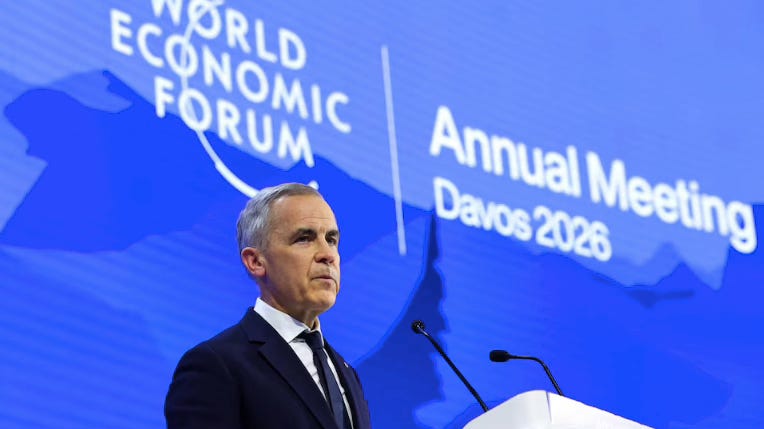
(Caandian prime minister Mark Carney speaking at Davos in January 2026)
Canadian Diplomatic Successes 2000-25
All through this quarter century starting in 2000, Canada was cashing in on a self-declared ‘peace dividend’. With the brief exception of Afghanistan between 2003 and 2014, Canada reduced its strategic footprint.
By 2025, the regular force of Canada’s military — which had numbered 69,000 service members in 2000 — had fallen to 66,000. Canada had fewer full embassies and consulates general around the world. After recent cuts, Canada is likely to spend only about 0.25 percent of nominal GDP on aid in 2026 — roughly the same level as in 2000, and far below Pearson’ goal of 0.7 percent.
Yet despite this loss of military and diplomatic altitude — despite not having served on the UN Security Council since December 2000 — Canada did have moments of diplomatic success over the past twenty-five years.
Here are seven of them:
(i) Jean Chrétien decided to turn down the US when it requested our participation in the 2003 invasion of Iraq, anchoring a reputation for principled independence;
(ii) Canada committed strongly to the mission in Afghanistan, invoking article 5 in 2001, championing NATO structures in 2003 and leading the transition to combat in Kandahar in 2005, which led to military success that motivated other allies;
(iii) In 2011, Canada championed the responsibility to protect (R2P) in Libya and commanded a successful NATO air campaign, authorized by the UN Security Council, with China and Russia abstaining alongside Brazil, Germany and India;
(iv) Starting in 2009-10, Canada reduced funding to the UN Relief and Works Agency, already heavily infiltrated by Hamas, reducing it to zero by 2013-14;
(v) From 2009 to 2014, we negotiated the Canada-EU Comprehensive Economic and Trade Agreement (CETA) that was signed in 2016 and in force by 2017. In 2012, Canada joined Trans Pacific Partnership (TPP) negotiations that concluded in 2015. We signed TPP in 2016. Following the US exit from TPP during Trump’s first term, we re-signed the Comprehensive and Progression Agreement for Trans-Pacific Partnership (CPTPP) in 2018 with ten other countries.
(vi) In 2014, Canada was the principal ally pushing for Russia’s expulsion from the G7 following its invasion of Ukrainian Crimea and Donbas. We led the push for sanctions and for Russia “to get out of Ukraine.” In 2015 we deployed the first training mission for the Ukrainian army on the ground in Ukraine.
(vii) Carney sharply increased military spending in 2025, agreeing to meet new NATO goals of 3.5% of GDP on military spending and an additional 1.5% on related infrastructure. At Davos, he sketched a strategy for middle powers.
These contributions were substantial. Outcomes in Afghanistan, Libya and Ukraine, would have been different, and probably worse, without Canada’s contributions.
Today’s Challenges
Yet none of these achievements has prevented the emergence of a set of interlocking threats now fueling today’s instability: Pakistan’s predatory policy towards Afghanistan; Iran’s proxy wars across the Middle East and Africa; China’s threats to the South China Sea and Taiwan; above all, Russia’s continuing invasion of Ukraine.
In my view, Russian aggression remains the principal threat to international peace and security today. Moscow is Tehran’s main military ally. Russia was the first country to give the Taliban regime official recognition. China’s policy on Taiwan depends on Russia’s fortunes in Ukraine.
Russian aggression is a recurring theme over the longer arc of Canadian history. Let’s compare snapshots, each a half century apart from the next. In the run up to Confederation, with Germany also uniting, Bismarck reportedly said: “The secret of politics? Make a good treaty with Russia.” By this he meant that giving Moscow a free hand to suppress Poland, Ukraine, Finland and other countries would give Prussia a free hand to deal with Austria, Denmark and France.
And so it was for several decades. Only when Bismarck was gone in 1890 did the Franco-Russian Dual Entente of 1894 begin to pave the way to world war. When Canada took Vimy Ridge in 1917, Russia was in the throes of a revolution that took it out of the war. Moscow became Germany’s de facto ally until 1941. After the treaty of Brest-Litovsk, Germany was able to move over 40 divisions from the eastern to the western front, which may have cost allies a more decisive victory.
Fifty years later, in 1967, Moscow pivoted from Cold War-style conflict in Cuba, Germany, Korea and Vietnam to proxy wars in developing countries from Angola and Madagascar to Ethiopia, Nicaragua and Afghanistan. With a brief respite in the 1990s, when Moscow was fighting in Chechnya, these conflicts resumed under Putin.
Since Canadian Confederation in 1867, Russia has changed the game every fifty years. From the ‘League of the Three Emperors’ in 1873 they pivoted to worldwide communist revolution in 1917, to proxy war in the developing world in 1967, and war in Europe in 2007. Their aim remained the same: territorial expansion.
These successive reorientations of Russian aggression have literally shaped Canada. Britain’s need to respond to faltering stability in Europe was one factor driving Canadian Confederation. Our sacrifices in two world wars were larger because of Moscow’s 1917-41 de facto and later explicit alliance with Berlin. Our founding role in the League of Nations, UN and NATO was motivated by a wish to end “the scourge of war” and other acts of aggression, including Russian aggression; after all, the last act of the League of Nations in 1939 had been to expel the USSR for invading Finland. Canada’s later contributions to the war in Korea, CIDA and Afghanistan were also responses to Soviet aggression in the Cold War and the developing world, including the 1979 Soviet invasion of Afghanistan. Today’s Canadian military commitments in Latvia, Poland and Ukraine were made in response to a renewed Russian threat.
My favourite actual quote on diplomacy is from Talleyrand: « Il n’y a pas de principes, il n’y a que des événements. »
In the end, there is no principle governing Canadian diplomacy or international policy that says we must counter Russian aggression. Events now oblige us to do so.
Russia backed Islamist terrorism starting in the 1960s. Moscow became Iran’s partner after the revolution. Russia used the conflict in Syria to radicalize European politics and seed the political ground in the UK for Brexit. Russia worked to humiliate NATO in Afghanistan. The Kremlin used the Hamas terrorist attacks against Israel of October 7th, 2023 to divert attention from Ukraine.
My favourite quotation attributed to Talleyrand is sadly apocryphal: « L’art de la diplomatie est de prévoir l’inévitable et d’en hâter l’avènement. »
A decisive reckoning with both Iran and Russia is now inevitable. The Iranian revolution of 1979 and Russia’s loss of empire in 1989-91 unleashed waves of aggression which, if we value our institutions and way of life, must be countered.
In responding to such threats, Canada is not a minor player. If over the coming years we unlock Canada’s full economic potential, close the current GDP gap with Italy (and eventually France and the UK) and create new capabilities to act with real relevance in today’s world, then Canada will have a new opportunity.
Seven strategic initiatives could generate renewed diplomatic and political influence:
