


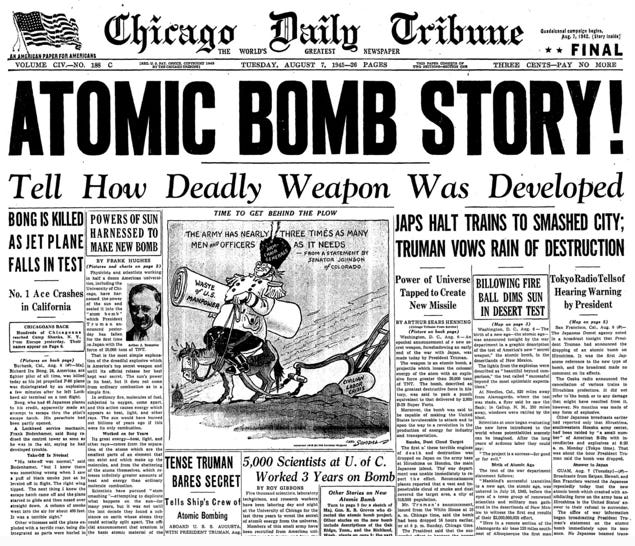
(Front page of the Chicago Daily Tribune from August 7th, 1945)
Several authoritative academics, journalists and commentators — from Stephen Kotkin and Vladislav Zubok to Edward Lucas, Sergey Radchenko and Mikhail Zygar — have plausibly argued the Cold War never really ended.
Given the range and intensity of today’s Russian aggression from Ukraine and Belarus to Burma, Afghanistan and Mali, these analysts certainly have a point. For well over a decade, we have been back in a world where Russia and its main enablers — including China, Iran, North Korea and Pakistan — are seizing territory and demolishing the integrity of major democratic institutions on a grand scale.
Yet this is no longer a cold war. Since 2014 and perhaps even since 2011, when Syria’s democratic movement was beaten back by the genocidal violence of the Assad regime and its backers in Tehran and Moscow, Russia has been waging hot wars to divide and weaken Europe; to occupy Ukrainian territory and destroy Ukrainian sovereignty; and to sponsor coups, repression and subversion worldwide.
In support of Moscow’s kinetic objectives, particularly in Ukraine, the Kremlin’s wire-pullers cultivate online influence and extremism; build economic leverage and corrupt networks to interfere with political decision-making; and put proxies at all levels under their political control on a massive scale.
Their most effective proxies are no longer assorted leftists hostile to capitalism or markets. They are populists and national conservatives who are hostile to democracy, minorities and the rule of law. To be clear, Russia has instrumentalized right-wing extremism before — notably in the 1920s and 1930s, when it built bridges with nationalist German militarists, culminating in the Molotov-Ribbentrop of 1939. But Moscow’s reliance on the hard right has never been as total as it is today.
In other words, the claim that the Cold War never stopped misses two key drivers of Russian behaviour under Putin. The first is the Kremlin’s unreconstructed and seemingly bottomless appetite for violent revenge. The second is the vast range of Kremlin-aligned political and business proxies and partners that corruption, opportunism and self-interest have harnessed to Moscow’s malign purposes.
This quest for payback has two major areas of focus — the destruction of Ukraine and the weakening of democracy in general. In contrast with the Cold War, when Soviet repression was primarily directed inward and Moscow’s outward influence operated primarily through international communist and other leftist networks, today’s Russian revanchism has directed its violence mostly beyond Russia’s reduced borders, primarily at Georgia and Ukraine but also at Syria, where it has sought to maintain leverage over Israel, directly and indirectly sponsor major Islamist terrorist groups, and generate waves of irregular migration to disrupt Europe.
Russia’s aggression in the 1990s and for the 26 years of the Putin/‘Putin’ era exhibits all the classic hallmarks of a quest to restore a lost empire. In Russia’s case, this empire was lost three times in less than a century — in 1917, when the Russian empire collapsed after defeat by Germany; in 1941, when the Nazis invaded; and in 1991, when the Soviet Union was dissolved.
The Cold War broke out only after the Red Army had brutally re-established Moscow’s empire in 1945. The allied response was containment, the creation of NATO and the familiar cat-and-mouse policies of the Cold War, whose proxy wars devastated dozens of countries well outside the Soviet zone of occupation in Europe — in Asia, the Middle East, Africa and Latin America.
After 1991, Russia was so weak that it took almost two decades before first invading Georgia in 2008. In 2014, it set limited objectives in Ukraine. Since 2022, its more ambitious aims have been thwarted by Ukrainian battlefield brilliance, Russian incompetence and growing, even if incomplete and uneven, allied support for Ukraine’s collective self-defence.
In other words, the Cold War was motivated by Russia’s desire to replicate its dominant position in Europe on every continent. It was countered by an allied policy of containment led by the US. Russia’s wars today stem from the revanchism and irredentism of a smaller power seeking to reconquer Ukraine. There is as yet no agreed allied policy to defeat this Russian aggression in its cognitive, conventional, covert, hybrid, irregular or political war-fighting forms.
In this sense, the Cold War was an exceptional case: there are few, if any, historical precedents for Russian dominance over all fifteen Soviet republics, as well as the countries of the Warsaw Pact and other socialist states, which lasted for just over four decades — from 1945-47 until 1989-91. But Russia’s post-1991 quest to enlarge its borders follows a familiar pattern. Almost every major power that lost its empire — particularly those that were never democracies — has at some point sought to retake those former possessions by force.
In addition to Russian neo-imperialism, Turkey and Iran have followed this familiar pattern in recent decades by seeking to build influence and political control in areas once part of the Ottoman or Safavid empires. In this sense, Russia has been engaged since 1991 and more intensively since 2000 not in a new Cold War but rather in full-spectrum revanchist aggression to restore the core of its lost empire.
Since the establishment of the 1999 ‘Union State’ between Russia and Belarus, which effectively brought Minsk back under Moscow’s full autocratic control, Ukraine has been central to this strategy. Ukraine has also imposed the principal setback to date on Russia by defeating its 2022 operation to take Kyiv.
In one important sense, those who argue for the continuing relevance of Cold War frames of reference are profoundly right. The scale of Russian influence, interference and manipulation matches and in some respects even exceeds that of the Soviet Union during the Cold War. We understate today’s challenge at our peril.
But in more general terms, today’s conflict with Russia is not a continuation of the Cold War for four reasons. First, it is a hot conflict, characterized by conventional war on a scale not seen since 1945. Second, it is primarily about reconquering lost territory, primarily in Ukraine. Third, its most dangerous proxies are populist national conservatives, not Moscow-aligned communists or socialists. Fourth, for a variety of reasons, allies have not yet embraced any effective policy to counter this aggression. On the contrary, the institutions founded to counter Soviet influence are still crumbling in the face of these sharper, under-acknowledged threats.
To understand the nature of today’s Russian warfare, we need to reassess how the Cold War ended. We need to review what Russia has been doing (and not doing) since 2008 when it re-launched large-scale wars against neighbouring states.
This is the introductory instalment of an extended four-part essay examining how the Cold War culminated in a smaller Russia, with a massive, vengeful chip on its shoulder. The next essay will analyze an historic 1983 visit to Canada, which is often taken to have set the stage for perestroika and glasnost — terms first publicly used by Gorbachev during a speech he gave on December 10th, 1984.
