


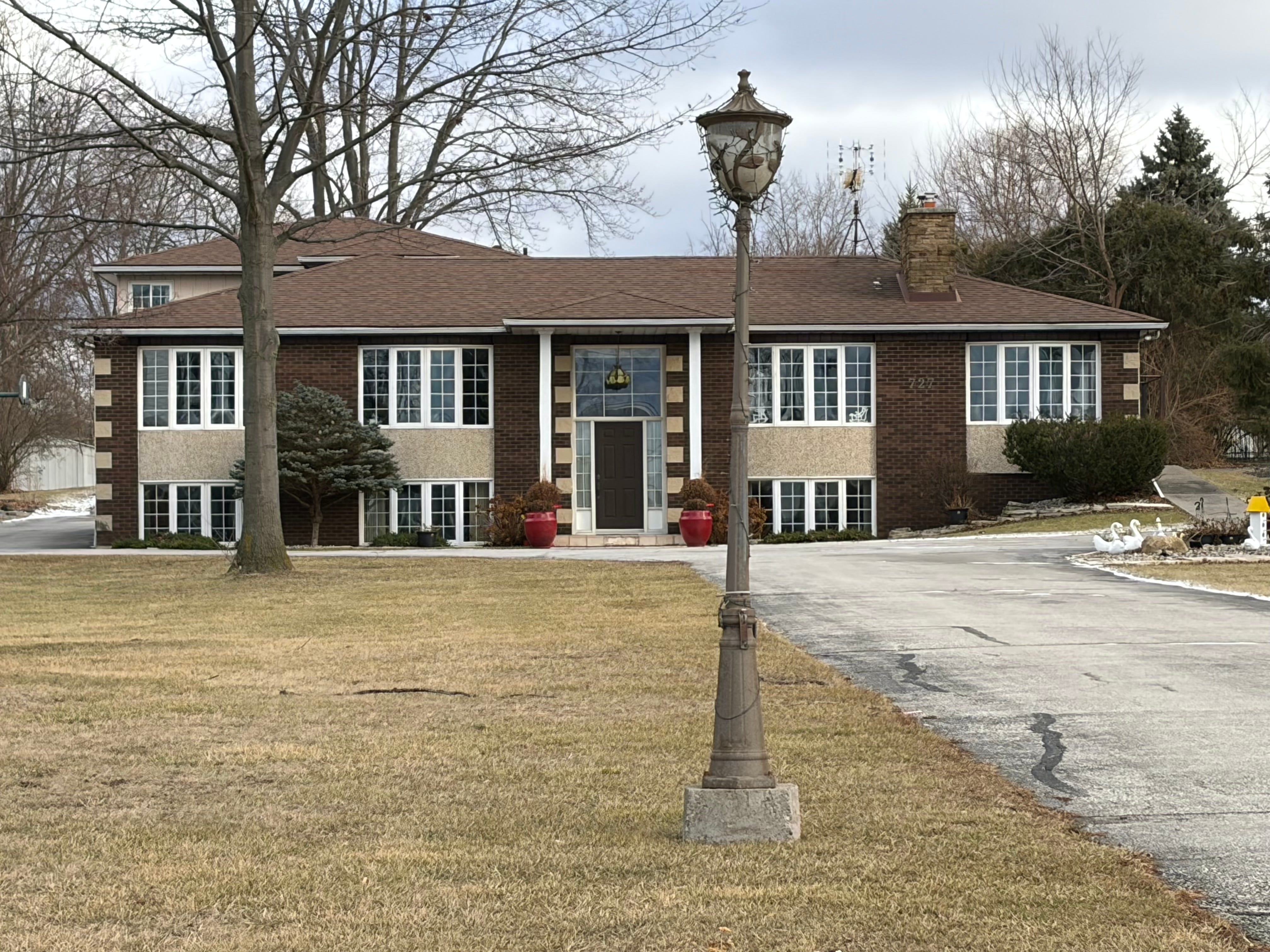
On May 19th, 1983 Mikhail Gorbachev walked up the front drive of this house on Front Road North — then also known as provincial highway 18 — in Anderdon township, just north of Amherstburg, Ontario.
He had been a full member of the politburo, the highest Soviet decision-making body, since 1980. A protégé of long-time KGB chairman Andropov, Gorbachev was already the heir apparent. Andropov had become general secretary only six months’ earlier — in November 1982 — after the death of Leonid Brezhnev (from Kamianske, Ukraine), who had held the post since 1964.
The owner of the house and Gorbachev’s host in Canada was Eugene Whelan, Canada’s minister of agriculture. He had been in that portfolio since 1972 — except for a brief hiatus during the short-lived government of Joe Clark.
By 6 pm Whelan had not yet arrived home. So his wife Elizabeth ushered roughly thirty Soviet and Canadian guests into their basement.
When Gorbachev asked if he could get some fresh air, Liz Whelan showed him out the back door, where an unpaved lane led through a field of corn, soybeans and wheat, amid nearby orchards and woods. The Soviet visitor decided to go for a walk.
With him went Aleksandr Nikolayevich Yakovlev, Soviet ambassador to Canada since 1973 — through most of the Trudeau era. Yakovlev had organized Whelan’s October 1982 visit to the USSR, where both had got to know Gorbachev. When Whelan invited the young Politburo member to Canada, Yakovlev worked with Gorbachev to plan the entire visit, Gorbachev’s first to a democracy.
Cold War tension was on an upswing. Just ten weeks’ earlier, in a speech to the National Association of Evangelicals in Orlando on March 8th, 1983, US President Ronald Reagan had labelled the Soviet Union “the focus of evil in the modern world” and rejected any moral equivalence between the US and this “evil empire”. In the now-notorious televised ‘Star Wars’ address on March 23rd, 1983, Reagan launched the Strategic Defence Initiative (SDI).
Gorbachev and Yakovlev were restless. Impatient with the Soviet Union’s apparent inability to reform itself after decades of stagnation under Brezhnev, they were nervous about where things were headed with the United States now that the pugnacious Reagan was in the White House. Their exchange in the fields of Anderdon, a stone’s throw from the Detroit river, was formative for both.
One account claimed: “The conversation they had then would shape the destiny of the Soviet Union.” Journalist Christopher Shulgan, one of Yakovlev’s biographers, went further, dubbing it “the walk that changed the world.”
Their perambulation probably began between 6:30 and 7 pm. Whelan arrived at 8 pm to host dinner. In the interim, the two were alone, away from the prying eyes of KGB and Canadian minders, for at least an hour. Yakovlev later claimed the chat had lasted three hours, but this seems improbable. Perhaps the frank exchange continued over dinner later? If so, the accounts we have do not mention it. Whatever the reality, an hour — perhaps only 30 minutes — of private candour sufficed. A bond had been sealed that would drive Soviet policy at the highest levels — up to the disappearance of the Soviet Union as an imperial superstate.
What did they say to each other? Memoirs and biographies give us the gist.
In a 1996 interview (that is part of a larger series), Yakovlev had this to say about his bucolic 1983 walk with Gorbachev: “At first we kind of sniffed around each other and our conversations didn’t touch on serious issues. And then, verily, history plays tricks on one, we had a lot of time together as guests of then Liberal Minister of Agriculture Eugene Whelan in Canada who, himself, was too late for the reception because he was stuck with some striking farmers somewhere. So we took a long walk on that Minister’s farm and, as it often happens, both of us suddenly were just kind of flooded and let go. I somehow, for some reason, threw caution to the wind and started telling him about what I considered to be utter stupidities in the area of foreign affairs, especially about those SS-20 missiles that were being stationed in Europe and a lot of other things. And he did the same thing. We were completely frank. He frankly talked about the problems in the internal situation in Russia. He was saying that under these conditions, the conditions of dictatorship and absence of freedom, the country would simply perish. So it was at that time, during our three-hour conversation, almost as if our heads were knocked together, that we poured it all out and during that three-hour conversation we actually came to agreement on all our main points.”
Gorbachev and Yakovlev were laying their cards on the table. In his influential 1994 book Lenin’s Tomb: The Last Days of the Soviet Empire, David Remnick emphasized this emerging trust: “It was in Canada that Yakovlev also forged his relationship with Gorbachev. In May 1983, Gorbachev was a leading member of the Politburo. He came to Canada and traveled with Yakovlev across the country, from Niagara Falls to Calgary, in an old Convair prop plane. They visited farmers and businessmen, but the most important talks they held were with each other. According to both men, they spent hours talking about the disasters awaiting the Soviet Union, the rot at the core of the economic system, the self-crippling lack of openness in the press, the cultural and scientific worlds. ‘The most important common understanding,’ Yakovlev told me, ‘was the idea that we could not live this way anymore.… We talked about absolutely everything, openly, and it was clear to me that this was a new kind of leader. It was a thrilling experience politically and intellectually.’”
While Yakovlev provided the most detail about the conversation, Gorbachev’s biographers also romanticized it. In Gorbachev: Heretic in the Kremlin, Dusko Doder and Louise Branson wrote that: “The most fateful event was private tête-à-tête with Yakovlev on Whelan’s farm near Amherstburg, Ontario. The eighteen-member Soviet delegation arrived before their host at his unpretentious, split-level house across the street from the Detroit River. While they and a dozen local Canadian politicians struggled to make small talk before dinner in a low-ceilinged basement crowded with card tables and folding chairs, Gorbachev and Yakovlev strolled around a nearby field bordered by woods. It was here, Yakovlev recalled, at seven thirty on a lovely evening, with Gorbachev’s guards standing a safe distance away at the edge of the forest, that ‘he [Gorbachev] talked about sore points back home… about the country’s backwardness and the lack of vision in the way it approached serious political and economic problems, about dogmatism, about the need for fundamental changes. I, too, broke free from my chain and talked frankly about how primitive and shameful Soviet foreign policy seemed from Canada.’”
The discussion touched on misguided foreign policy, muzzled media and the sputtering Soviet economy. They agreed on the need for democratic reforms and an overhaul of the legal system: “Dissidents like Solzhenitsyn, whom Yakovlev had been ordered to unmask, were guilty only of thinking differently, he [Yakovlev] said. Canadian trials showed that the Soviet judiciary should be independent. ‘The laws should be changed first,” Gorbachev replied. ‘They should become real laws, not weapons in the hands of individuals or the party.’”
The two men also discussed agriculture, with Yakovlev lamenting low Soviet productivity and arguing that they “should reform their own system to move toward private ownership. ‘Yes of course,’ Gorbachev replied, growing more cautious. ‘But we have to consider the psychology of a collective farmer, and party psychology.’ It was a way to stall Yakovlev. Gorbachev was in favour of radical change in the USSR, but there were limits to what he would support.”
In the end, the conversation covered the ground that Gorbachev’s signature policies, announced soon after he took office, would seek to address. ‘Restructuring’ (Perestroika) and ‘openness’ (Glasnost) were driven by a shared sense of urgency. In his memoirs, Yakovlev recalled a sense of exhilaration tinged by foreboding: “At first, the talk was conventional, but suddenly, we could not contain ourselves, and a reckless conversation began. (…) Even then, he [Gorbachev] understood that what was going on in our country was leading to catastrophe.”
The conversation was a turning point. “For the rest of the trip,” Yakovlev wrote, “we talked to our hearts content. It was as if these conversations sketched the contours of the reforms to come in the USSR.” Years later, in an interview with CBC, Gorbachev reminisced enthusiastically about the thinking that had crystallized in Whelan’s field: “This was a free country, where people feel like people in the conditions of freedom and work in the conditions of freedom… People could show initiative, something that in our country was often punished. And it is from that point of view that our conversation with Yakovlev definitely took place. It was a conversation about the Canadian experience, about using it as an example.”
Yakovlev and Gorbachev spent eight days together in Canada. Within months, Yakovlev had returned to Moscow to take up his old job as propaganda chief. Within nine months of Gorbachev’s visit, Andropov had died. After a short one-year interregnum under the ailing Chernenko, Gorbachev became general secretary on March 11th, 1985. He would be the last person to lead the USSR.
After only six years, he was out and the Soviet Union was no more. Whatever the ambitions of Perestroika and Glasnost, Gorbachev’s caution ultimately prevailed. He and Yakovlev did not dissolve the Communist Party or institute the rule of law. They did not privatize property or state enterprises. Agriculture remained in the doldrums. Corruption was rampant. The only Amherstburg agenda items to be implemented were a partial liberalization of media, which lasted barely a decade, and a refusal to use unlimited force against nationalist movements. As a result, the three Baltic states, Armenia, Azerbaijan, Belarus, Georgia and Ukraine resumed their independence by issuing proclamations over 1989 to 1991. Kazakhstan, Kyrgyzstan, Moldova, Tajikistan, Turkmenistan and Uzbekistan joined their ranks later.
Moscow’s aggression continued. The invasion and occupation of Afghanistan lasted a decade. On September 1st, 1983 — three months after Gorbachev’s visit to Canada and six months after Reagan’s ‘evil empire’ speech — Soviet aircraft used air-to-air missiles to down Korean Airlines flight 007, killing 269 people. On September 26th, 1983, the USSR’s Oko early warning system mistakenly detected a US intercontinental ballistic missile (ICBM) launch, inflaming nuclear tensions further. NATO conducted the Able Archer nuclear response exercise in November 1983.
Over the entire arc of Glasnost and Perestroika, Aldrich Ames, Robert Hanssen and other Soviet spies continued to penetrate the CIA, FBI and Department of Defence, doing untold harm. Andrei Bezrukov and Elena Vavilova — KGB illegals who stole the identities of deceased Canadian infants Donald Heathfield and Tracey Ann Foley — arrived in Canada in the late 1980s and remained at the centre of a large network of Russian illegals operating in Canada and the US up to 2010.
It was left to Yelstin and his team to undertake more fundamental reforms. They broke the Communist Party monopoly on power, re-wrote the constitution, privatized state enterprises and farms, and started to reform the justice system. While Gorbachev had brought Soviet troops home from Afghanistan by 1989, from Czechoslovakia and Hungary by 1991, Yeltsin completed this withdrawal from Lithuania and Poland in 1993, from the former East Germany and Estonia in 1994, and from Latvia, Turkmenistan and Uzbekistan in 1999.
Yet Moscow retained military bases or occupied enclaves in Belarus, Ukraine, Moldova, the Caucasus and Central Asia. While Russia removed its forces from Nagorno-Karabakh in Azerbaijan in mid-2024, it retains a major military base in Armenia, as well as military facilities in Kazakhstan, Kyrgyzstan and Tajikistan even today. In the end, Russian forces never left Belarus. They continue to occupy significant territorial enclaves in Moldova and Georgia, as well as twenty percent of Ukraine, which they have been attacking, invading and destroying, with brutally catastrophic effect, since 2014.
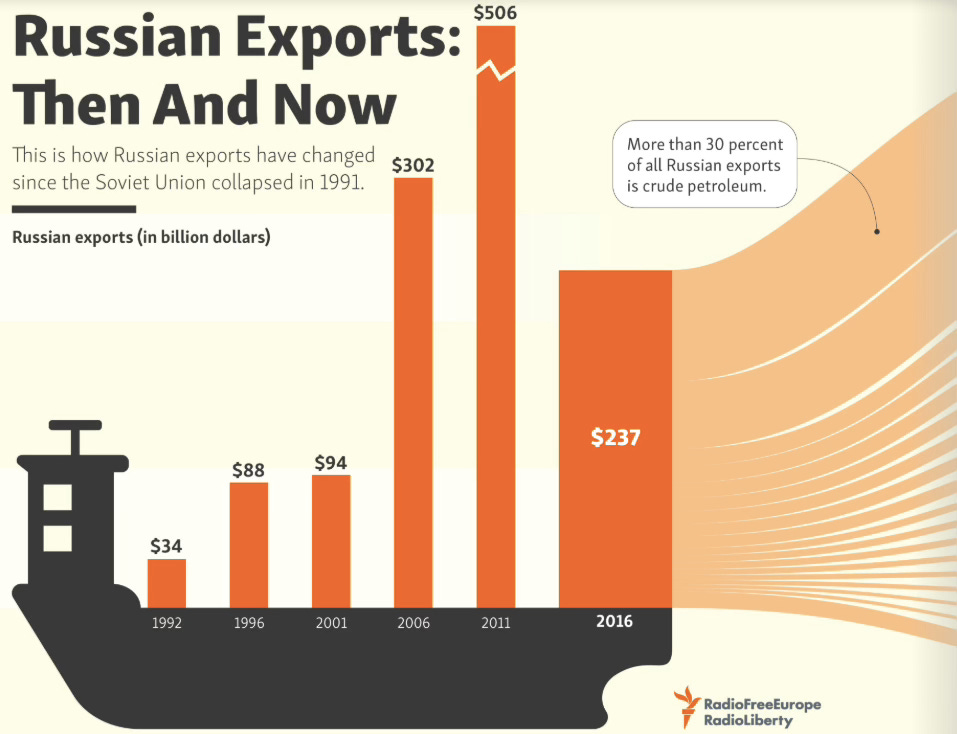
(This table appeared on the Radio Free Europe/Radi Liberty website on November 28th, 2018: visit them here to see the full graphic, which is excellent.)
What was Gorbachev’s legacy? Mainly a reinvigorated Russian export sector, which grew even more rapidly after privatization under Yeltsin. Exports peaked before the 1998 Russian financial crisis, reached a second peak prior to the 2008 global financial crisis of 2008 — then dropped after Russia’s first 2014 invasion of Ukraine. Russia’s vast oil, gas, metal and fertilizer revenues still fund its genocidal war machine, which has been pounding Ukrainian civilians and territory for twelve years.
So did the Cold War really end, or not? Yes, it did — but not in Amherstburg. For Moscow, the Cold War was about protecting a high-water mark of imperial territorial expansion, achieved under Soviet Stalinism in the years after 1945.
For three decades, it was also about winning proxy wars — most notably in China, Korea and Vietnam — and flipping new states from India to Cuba, all facing the uncertainties of decolonization, into the Soviet and Communist camp.
When Moscow sought to go beyond its 1945 territorial high-water mark with its 1979 invasion of Afghanistan, the Cold War was already ending. Nationalism and terrorism were starting to fuel hot new wars — from Iran-Iraq and Lebanon to Angola and Sri Lanka. Defeat in Afghanistan made the Soviet case for reform even more urgent, giving Gorbachev and Yakovlev their mandate. But it also set the stage for more wars fuelled by extremism and irredentism.
By 1992 Moscow’s territorial high-water mark was no more. The Soviet Union and Warsaw Pact had come apart. Moscow’s four-decade-long occupation of central Europe was being painstakingly reversed. Dozens of countries joined NATO and the EU as democracies. Unlike the Soviet Union or post-Soviet Russia, these countries made judicial and market reforms that have stood the test of time.
Russia never became a democracy. It never embraced the rule of law. Freedom of speech and free enterprise were fleeting experiments, at best.
Instead Russian aggression re-tooled under the guise of nationalism, a reactionary ethos that had long been incubating in the USSR in many forms. As early as 1972, Yakovlev himself had written a broadside against chauvinism, national sentiment and Tsarist nostalgia, which had not been well received by Brezhnev’s camp. The resulting controversy was a major cause of his exile to Canada. When they took power in the mid-1980s, both Yakovlev nor Gorbachev were determined to defy the nationalist dynamics unleashed by Perestroika and Glasnost, which had gave renewed traction to ethnic, local, linguistic and national identities that Moscow had sought to assimilate, eliminate or subordinate over centuries. With Yeltsin, the first ‘Russian’ leader to rule from Moscow since 1712, a nationalist turn became inevitable.
In the absence of democratic or judicial buffers, Russia’s new nationalism curdled rapidly into something more sinister. Zhirinovskiy was a harbinger of it in the first Russia parliamentary elections of 1993. Around the same time Yelstin aide Galina Starovoitova gave a radio interview, quoted by Remnick in Lenin’s Tomb, in which she warned of a return to nationalist authoritarianism in Russia: “One cannot exclude the possibility of a fascist period in Russia. We can see too many parallels between Russia’s current situation and that of Germany after the Versailles Treaty. A great nation is humiliated, and many of its nationals live outside the country’s borders. The disintegration of an empire has taken place at a time when many people still have an imperialist mentality.… All this is happening at a time of economic crisis.”
Starovoitova had explicitly warned of a ‘Weimar Russia’. Even in the early 1990s, she and others saw the potential for a regime to emerge in Russia whose obvious parallel would be Nazi Germany, which had whipped the wounded pride of military defeat, economic catastrophe and hyperinflation up into a frenzy of neo-imperial conquest and carnage, including the nihilism of the Anti-Jewish Holocaust.
The scale of Russian aggression today is smaller. Hitler invaded or occupied a dozen countries within only two years. Over a twelve-year campaign, today’s fascist Kremlin has still only managed to occupy only one-fifth of Ukraine.
But the motive and level of ambition are analogous. Hitler wanted to occupy all of Europe, including the UK and the Soviet Union. Today’s Russia is intent not only on destroying Ukraine, but on dividing Europe and consigning democracy and the rule of law as we know them to the dustbin of history.
Soviet and Russian reformers like Gorbachev, Yakovlev and Yelstin have never really deserved the name. They failed to curb this nationalism and retained the vast apparatus of repressive control that feeds it.
Whether known as the Tsarist secret police, the Bolshevik Cheka, the Soviet KGB or today’s fascist FSB/GRU/SVR under Putin and Patrushev, repressive structures define Russia’s identity and set its agenda. They ensure Russia remains a tyranny — one fully committed to imposing its unfreedom on others.
Russia’s Chekists immediately regretted the loss of the Soviet empire, particularly the independence of Ukraine. They remembered Brzezinski’s aphorism: “Without Ukraine, Russia ceases to be an empire.”
With the elimination of communist structures and barriers to foreign markets for goods, services and information, this new elite gained influence, leverage and resources that their Soviet predecessors could not have imagined.
One can plausibly argue the Cold War turned hot when Moscow invaded Afghanistan – a full four years before Gorbachev visited Canada. It turned hotter still with Russian wars in Abkhazia, Ossetia, the left bank of the Dniestr, in Tajikistan, Nagorno-Karabakh and Chechnya – all of which started as the Soviet Union was exiting stage left, long before Putin took office.
The breakup of the USSR added revanche to the mix of motives driving Russian aggression. Under Putin, national vengefulness has become a venomous new creed. Beyond Russia’s campaigns of conquest and destruction in Chechnya, Georgia, Syria, Ukraine and Mali, the Kremlin seeks to use every lever available to disrupt the democracies that worked to contain Russian aggression throughout the Cold War.
Since 1998, Russia’s Chekists have enjoyed a monopoly on power that was never possible within the Communist Party of the Soviet Union. Starovoitova was herself assassinated in St. Petersburg in 1998 for opposing Yeltsin’s nomination of former KGB officer and SVR director Yevgeniy Primakov as prime minister.
Today Putin’s cronies are maneuvering to ensure a KGB princeling remains heir apparent. As early as 2000, Putin’s eminence grise was defending the idea of a ‘new nobility’ drawn from former KGB ranks. Now his son is in pole position.
Were Gorbachev and Yakovlev naïve about the forces they unleashed? Yes. Did they foresee the demise of the USSR or a Russia engulfed in fascist nationalist ideology? Did they anticipate Chekists ruling in perpetuity? Almost certainly not. Did they forecast the catastrophe of Russia’s nationalist war of extermination against Ukraine? Definitely not. They did also little to prevent such outcomes.
By shattering an unreformed empire, Gorbachev and Yakovlev opened the door to aggression, fascism and militarism under their successors — just as the leaders of the German and Austro-Hungarian empires, by leading their countries to defeat in the Great War, prepared the ground for Hitler and his enablers.
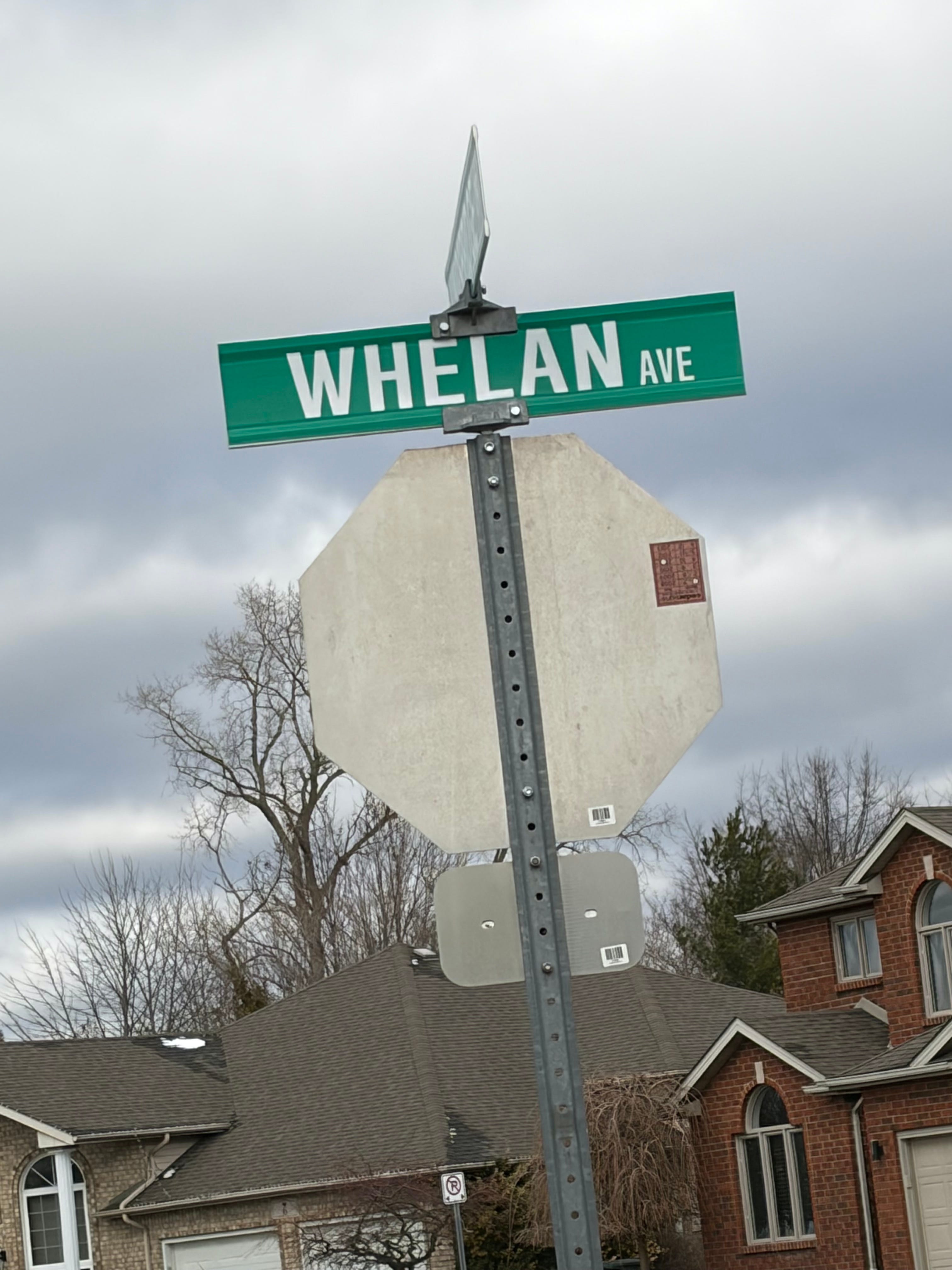
The house on Front Road North still stands. It has new owners. Highway 18 is now Essex county road 20. The whole neighbourhood is today part of an enlarged town of Amherstburg, expanded in 1998 to include the former townships of Anderdon and Malden. The field where Gorbachev and Yakovlev walked has been partly paved over for a new subdivision through which ‘Whelan Avenue’ now runs.
This long-time resident and host of the 1983 visit has been commemorated. The Soviets whose bond fuelled momentous change have not.
Their conversation did not end the Cold War. It brought the end of the Soviet Union and the Warsaw Pact closer. It also helped to end Russia’s hot war in Afghanistan, itself a kind of solvent in which the Communist bloc dissolved.
Russian nationalist aggression continues unabated. Using far-reaching new tools, it has fuelled conflict on every continent, doubled the numbers of displaced people worldwide and undermined every democracy on the planet. Russia’s genocidal war in Ukraine is continuing. Its architects are out to avenge that walk in Anderdon township and the empire it helped to bring down.
Fascinating. Too bad it ended so badly.