


Treaty number 2, also known as the McKee purchase, and the indigenous diplomacy around it kept First Nations of the Detroit area mostly loyal to the crown.
But the arrival of loyalist American and other postwar settlers placed these alliances under immense pressure. According to an article by Rhonda Telford entitled ‘How the West Was Won: Land Transactions Between the Anishinabe, the Huron and the Crown in Southwestern Ontario’, the purchase agreement for the Huron Reserve that resulted in the formation of Anderdon township was preceded by no less than eight previous attempts. These negotiations divided the Wyandot community, notably between the ‘Splitlog party’, a traditional chief often supported by the Clarke family, and the Brown, Warrow and White families, who represented the majority.
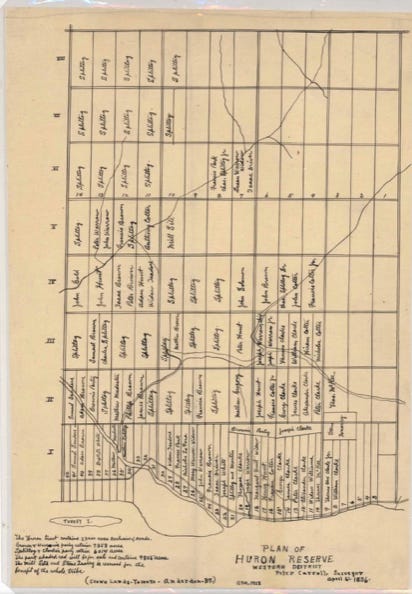
(The 1836 surveyor’s plan of the Huron Reserve, which became Anderdon township, showing names of Wyandot landholders.)
After years of wrangling, treaty number 35 was finally signed in 1833 by Adam Brown, James Gold, Joseph Warrow, Henry and John Hunt and four members of the Clarke family. Two more treaties were concluded in 1836, when Anderdon township was formed. Over the next half century, ten more treaties were signed, transferring remaining land from the 1790 reserve to the new civil township.
The process of enfranchisement and assimilation launched by the crown in 1857 was no less onerous. It resulted in the Wyandot of Anderdon township becoming one of the only First Nations in Canada to lose their formal treaty status.
In 1833, when the process of selling the Huron Reserve began, the Wyandot band had numbered about 150. By 1892, most were ‘enfranchised’ – meaning they no longer had status under the Indian Act. By 1910, many considered the treaty rights of the Anderdon Wyandot to be extinguished, though this finality is disputed.
One of the last to resist the surrender of these indigenous rights was Peter Dooyentate Clarke, the Wyandot author who — in the wake of the crown purchase agreements that began in the 1830s — had patented on November 26th, 1880 sixty-six and one-third acres of lot 16 in the first concession of Anderdon township. This was the farm on which Gorbachev and Yakovlev took their walk.
Peter Dooyentate Clarke was one of at least eight sons of Thomas Alexander Clarke (1768-1840), who had been born in Fort Pitt, Pennsylvania. Thomas Clarke had married two sisters, Mary and Catherine Brown. Their father Adam Brown had been a European captive who became a Wyandot chief with an indigenous wife. Alexander McKee had married Charlotte Brown, a third daughter of chief Adam Brown. As a result, Peter Dooyentate Clarke considered McKee to be his uncle.
Ten years before patenting lot 16, Clarke had published The Origin and Traditional History of the Wyandotts — the book quoted in instalment three of this series — in Toronto in 1870. He fell in and out of favour with his kinfolk and lived for a time in Sandusky, Ohio. But Clarke finished life as one of the last major Wyandot leaders fiercely opposed to enfranchisement.
