


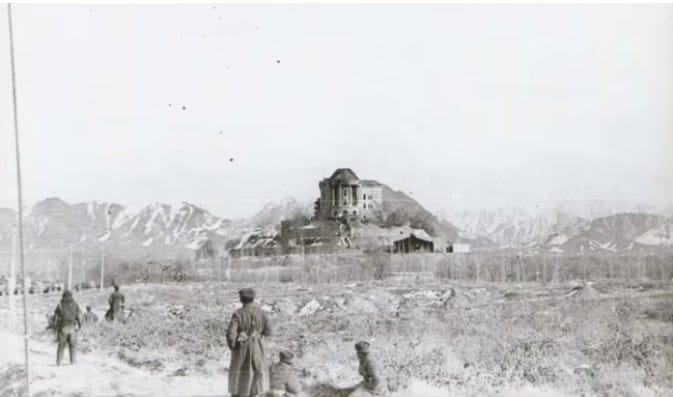
(Soviet forces maintain a perimeter outside the Tajbeg palace in Darulaman near Kabul, Afghanistan on December 27th, 1979)
How and when did the Cold War end? In hindsight, we can reliably say it was over long before Mikhail Gorbachev and Aleksandr Yakovlev had their fateful chat on lot 16 in the first concession of Anderdon township, Ontario on May 19th, 1983.
The policies they chewed over and sketched out amid the cornfields of Essex county — which became Glasnost and Perestroika — brought down the Warsaw Pact and the Soviet Union. But the Cold War had ended years earlier with new hot wars in Angola, Afghanistan and beyond.
It’s an important reversal of perspective. Most believe Gorbachev’s policies caused the dissolution of the Soviet Union and the end of the Cold War. In fact, he came to power because Moscow’s hot wars launched in the wake of the Cold War had not gone well. Gorbachev’s remedies killed the patient, causing the USSR to collapse.
Afghanistan was crucial. Gorbachev took office when this losing campaign was at its midpoint. Soviet forces withdrew only in February 1989 — four years after Gorbachev became general secretary. Even then, Moscow’s Afghan ally Najibullah did not fall until 1992, when armed mujahidin finally took Kabul. Afghanistan’s pro-Soviet regime, subsidized by Moscow, remained intact throughout Gorbachev’s time in office.
The last Soviet leader was no stranger to using force with imperial intent. Gorbachev himself ordered Soviet forces into Georgia in 1989. He promoted separatists in Abkhazia and Ossetia, where pro-Moscow enclaves remain to this day.
Starting in late 1990, Gorbachev’s Soviet Union used its 14th army to support Russian-speaking separatists in Transnistria opposed to Moldovan independence. Gorbachev ordered January 1991 crackdowns in Lithuania and Latvia in a futile attempt to reverse Baltic sovereignty. In August 1991, diehards like KGB chairman Kryuchkov tried to topple Gorbachev — partly because this repression had failed.
Gorbachev used interior ministry and KGB units in 1991 to intervene on both sides in Azerbaijan’s conflict with Armenia over Nagorno-Karabakh. Before the Soviet Union disbanded, Yeltsin sent troops to Grozny in November 1991 in an abortive bid to reverse President Dzhokhar Dudayev’s declaration of Chechnya’s sovereignty.
In other words, as the Soviet Union expired there was a seamless transfer of repressive power from Gorbachev to Yeltsin. The Russian president intervened in Tajikistan’s civil war in 1992. He went to war on a larger scale in Chechnya in 1994. Under Putin, hot wars to prop up allies or assert control became common.
So when exactly did the Cold War end? In Orwell’s October 19th 1945 essay ‘You and the Atom Bomb’ – where he coined the term ‘cold war’ – he predicted that, with nuclear weapons in the hands of only about five powers, none would dare attack another. This pouvoir de dissuasion would underpin an uneasy stasis. In Orwell’s view, generalized world conflict, as seen from 1911 to 1945, was a thing of the past — replaced by “an epoch as horribly stable as the slave empires of antiquity.”
He anticipated nuclear deterrence, a doctrine fully articulated only years later, after the USSR conducted its first nuclear test in Semipalatinsk, Kazakhstan in 1949. Once China joined the nuclear weapons club, as it did in 1964, Orwell foresaw “two or three monstrous super-states, each possessed of a weapon by which millions of people can be wiped out in a few seconds, dividing the world between them (…).”
In the end, the Korean war (1950-53) — in which the US, Canada and other allies fought Korean and Chinese forces — broke out before China had nuclear weapons. China, the Soviet Union and the US subsequently avoided direct conflict.
Large-scale war and revolution would be rare; tyranny and repressive control commonplace. “Unable to conquer one another,” these three empires were “likely to continue ruling the world between them, and it is difficult to see how the balance can be upset except by slow and unpredictable demographic changes.”
Orwell wrote his essay under the influence of James Burnham’s 1941 book, The Managerial Revolution. Burham saw capitalism in decline — to be replaced not by socialism, but rather “the rule of administrators in business and government.” As Orwell put it, “the surface of the earth [was] being parcelled off into three great empires, each self-contained and cut off from contact with the outer world, and each ruled, under one disguise or another, by a self-elected oligarchy.”
For two decades after Korea, this dystopian vision of consolidating, mutually exclusive managerial cliques, studiously avoiding war with one another, seemed to prevail. The only interstate wars pitted Arab states against Israel, Indonesia against Malaysia, India against East Pakistan, and Turkey against Cyprus.
Soviet forces did invade Hungary in 1956 and Czechoslovakia in 1968 — to reassert repressive control within the Warsaw Pact. They did not trigger interstate wars, as hopes of allied intervention were quickly dashed, particularly in Hungary, where Yuri Andropov, the Soviet ambassador who oversaw a massacre, was promoted.
For countless victims of autocratic power, the 1950s and 1960s were not “horribly stable.” They were an unrelieved nightmare. China invaded Tibet, occupied half the Korean peninsula and inflicted on itself the horrors of the ‘Cultural Revolution’ — itself an Orwellian euphemism. The USSR, for its part, suborned the Warsaw Pact, bonded with China and India, and installed proxies from Cuba to Congo.
Orwell’s predictions held up only for about two decades, starting in 1953. Over this period, both Mao’s China and the USSR under Khrushchev and Brezhnev embraced “the kind of world-view, the kind of beliefs, and the social structure [of] a state which was at once unconquerable and in a permanent state of ‘cold war’ with its neighbours.” Major wars and regime-changing revolutions were rare. When one ‘great empire’ took action against another, it was generally indirect or by proxy.
By the 1970s, this pattern was ending. Détente with the Soviet Union in 1969 opened an era of nuclear arms control. US normalization of relations with the People’s Republic of China surprised and perplexed the USSR. In 1975, the fall of Hanoi and Nixon’s humiliating resignation damaged US influence and prestige. Both emboldened Moscow to press for more advantage using proxies in the developing world. Over the next two decades, previously self-contained Chinese and Soviet autocracies scaled up engagement with the US and its allies — Beijing through Deng’s reforms, Moscow through Glasnost and Perestroika.
The 1978-79 Iranian revolution put a definitive end to the Cold War. The spectre of an Islamist takeover informed the Soviet decision, led by Andropov, to invade Afghanistan to prevent the collapse of the Soviet-backed regime. In the decade that followed, the US and USSR scaled up support for Islamic militants — ultimately with devastating consequences for both.
Starting in 1978, interstate warfare returned as a regular feature of international relations. Vietnam invaded Cambodia. China invaded Vietnam. Tanzania invaded Uganda. Following the Soviet invasion of Afghanistan, Iraq invaded Iran in 1980. Argentina took the Falkland Islands in 1982. Iraq invaded Kuwait in 1990. Starting in 1994, Russia invaded Chechnya twice, then Georgia, Syria and Ukraine twice. The US invaded Iraq in 2003. These invasions were all illegal: only the US-led mission in Afghanistan was UN-authorized collective self-defence.
In the late 1970s, hot conventional wars, Islamist revolution and border conflicts returned with a vengeance. The geopolitical brakes that had existed during the Cold War were off. The USSR did not survive its defeat in Afghanistan. Independent Russia soon faced major separatist and terrorist threats of its own. The US recovered from Vietnam syndrome under Reagan only to be struck under George W. Bush by Al Qaida, a terrorist organization founded the year American support for the mujahidin had been cut and radicalized in 1997-98 by Ayman al-Zawahiri after his return to Pakistan following many months in Russian custody.
The Cold War ended with US defeat in Vietnam, prompting an over-confident Andropov to launch a new string of proxy wars, including the invasion of Afghanistan. Defeat there led to Soviet collapse. Since these centrifugal forces were set in motion in 1989, Moscow has waged war continuously — under Gorbachev, Yeltsin, Putin and Patrushev — to regain territory and restore its empire.
In the end, Russia’s superpower status was secure only during the Cold War. With defeat in Afghanistan, loss of half its population in 1991 and defeat again in Ukraine, Moscow has been reduced to the status of a rogue state seeking to compensate for its reversals through sheer ruthlessness. Russia’s economic weight is barely that of a middle power. Yet it retains one long-cultivated, battle-tested capacité de nuisance, which is absolutely central the story of how the Cold War ended. The strategic impact of these dark arts will be the subject of the next instalment in this series.