


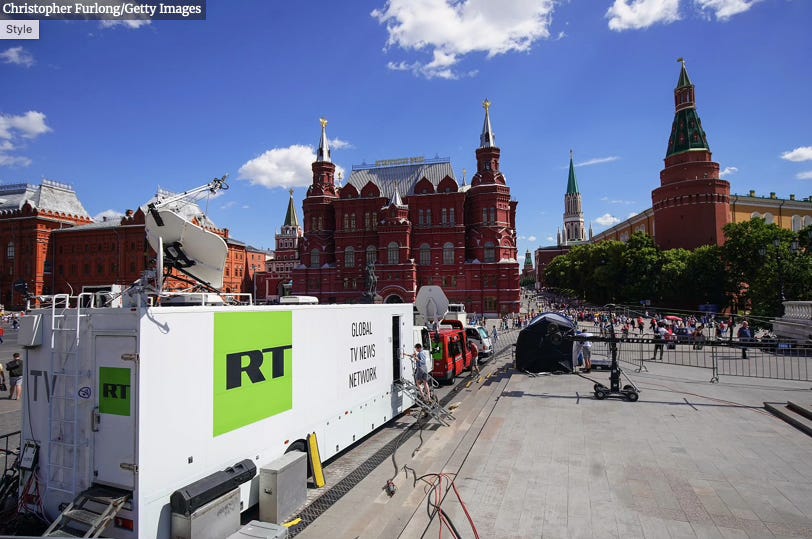
(A Russia Today mobile studio outside Red Square in Moscow)
When this series began, it was meant to run to four instalments: one on how perceptions of the Cold War are changing; a second on the conversation Gorbachev and Yakovlev had in a farmer’s field north of Amherstburg in 1983; a third on that location’s backstory; and a fourth re-answering the initial question. In the event, it took two essays to explain the importance of Anderdon township. Three essays will now answer the question ‘How did the Cold War end?’ — of which this is the second. The series will now feature a total of seven essays.
By the end of 1991, Gorbachev was no longer president or general secretary. The Soviet Union had been decreed out of existence. Yeltsin’s Russia was a truncated, traumatized society, impoverished by hyper-inflation and economic collapse.
But Russia’s ‘self-elected oligarchy’ had a burning ambition to return to great power status. This determination has never wavered. Since Soviet and Russian leaders generally had a well-founded skepticism about their military’s ability to prevail in conventional war, exacerbated by defeat in Afghanistan, they doubled down on asymmetric and irregular war-fighting strategies, building on the ‘active measures’ and proxy conflicts pioneered in the 1960s and 1970s. Glasnost, Perestroika and privatization gave Russia ready access to western governments, markets and expertise. Moscow was keen to use this new leverage against old adversaries.
Active measures were pioneered within the KGB by Ivan Ivanovich Agayants, an officer of Armenian origin. In 1959, he centralized this work in a directorate named ‘D’ for dezinformatsiya, or disinformation. In 1963-66, this became directorate ‘A’ for Aktivka, as active measures were known, in the KGB’s First Chief Directorate, responsible for foreign intelligence.
As KGB chairman starting in 1967, Andropov elevated the status of active measures, making them the ‘heart and soul’ of Moscow’s clandestine work around the world. In his final year of KGB chairman — the year before Gorbachev’s visit to Canada — he issued directive No. 0066, making Aktivka a central task for all officers
What did active measures look like? As early as the 1970s, the Soviet KGB might recruit a sexual predator like Jeffrey Epstein, then dabbling in Russian mafia affairs in Brighton Beach, an emigré enclave on Long Island. Soviet ambassador Dubinin and future ambassador Churkin might arrange for Donald Trump to visit Moscow in 1987 — after which he published Soviet talking points via full-page ads in New York dailies.
Active measures almost certainly included the early 1990s meeting of Epstein – by then a ‘fund manager’ — with Ghislaine Maxwell, who moved to Manhattan in 1991, shortly before the sudden yachting death of her media baron father Robert Maxwell, another longtime Soviet asset. Viktor Bout’s arms smuggling in Africa in the early 1990s benefited from Aktivka, which helped dormant conflicts spark back into flame via the Russia-backed accelerant of cheap guns and ammunition.
In other words, just as Moscow was losing its superpower status, it won massive traction for continuing large-scale global campaigns of asymmetric and irregular warfare. Russia’s active measures toolkit comprises seven major baskets:
