


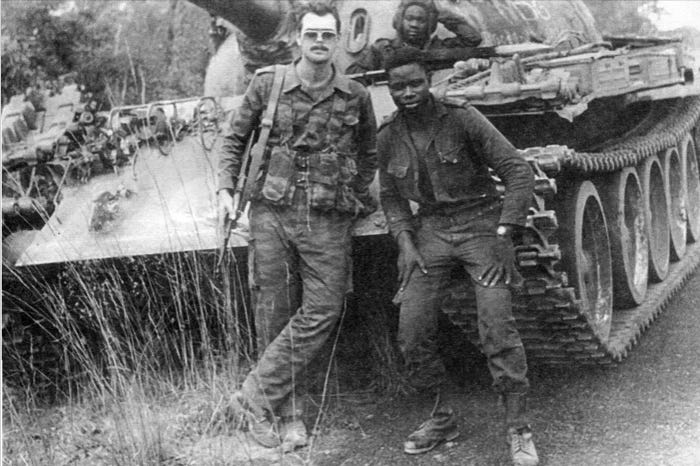
(A Soviet military advisor with MPLA forces in Angola)
The Cold War ended in the 1970s. By the time the KGB’s Alpha group was finishing Amin off on Christmas eve 1979 in the Tajbeg palace — near the site of Canada’s future Camp Julien — that quiescent struggle was long over.
Détente created space for Moscow to replace strategic deadlock with tactical advantage. US normalization with China forced Moscow to be more active and agile. US missteps in Vietnam opened developing countries to Soviet overtures. Iran’s revolution prompted Moscow to double down on partnerships with terrorists.
As outlined in our last essay — the penultimate in this series — Moscow’s return to fighting hot wars came alongside an outsized investment in active measures. This asymmetric warfare had a proven track record of weakening adversaries. When the Soviet Union collapsed, Glasnost and Perestroika opened broad new channels for delivering malign influence. Moscow also had an overarching new reason for pursuing this agenda with conviction: the Kremlin wanted its empire back.
We are only starting to tell the story of how a weak Russia, shorn of much of its territory in Europe and Asia, came to have decisive influence over strategy, policy and politics in so many countries. But it starts and ends with allied failure to track or counter active measures, especially after the USSR disappeared in late 1991.
Along the way many lost sight of what distinguishes democracy from the alternatives. We took a well-informed public for granted. We assumed political parties would govern themselves responsibly. We failed to detect foreign intervention or political corruption in timely ways. We neglected the basics of the rule of law.
In his early thinking about the Cold War that was kicking off in 1945, Orwell was influenced by James Burnham’s The Managerial Revolution, which predicted that neither capitalism nor socialism would prevail in the postwar era. Instead the “rulers of this new society will be the people who effectively control the means of production: that is, business executives, technicians, bureaucrats and soldiers (…).”
This view was the product of — to put it mildly — a mercurial mind. Burnham was an American graduate of Balliol college, Oxford who became a Trotskyite in the 1930s. By the 1950s he was a co-founder, with William F. Buckley, of the National Review. During the war, he admired Nazism. By war’s end, he was keen on Stalinism.
Orwell took issue with Burnham over his claim people would invariably accept direction from a ‘dominant class’. In retrospect, Burnham’s fatalism was echoed in the concepts of ‘Cold War’ or ‘Iron Curtain’ — rhetoric implying half of Europe and most of Asia had been placed in more or less immutable straitjackets. Such thinking denied agency to individuals and governments. It was also hard to square with the defiance and determination that had won the Second World War.
For the victims of armed conflicts such as the Korean and Vietnam wars, or Soviet crackdowns in Budapest and Prague, such tragedies were not inevitable. They had been hot, deadly, highly contingent — and poorly managed by allies. The abhorrent aggressor regimes — Bolshevik, Stalinist, Chinese and Soviet Communist — only endured for so long because allies had made a Faustian Bargain with Moscow in 1941 to team up against Nazism, Italian fascism and Japanese militarism.
In the final analysis, the Soviet Union and Warsaw Pact failed because people do not volunteer to be part of slave empires The Red Army was defeated in Afghanistan, as the Russian army has been defeated in Ukraine, by people who do not wish to live under repressive or fascist occupation. As Iranians, Syrians and Ukrainians have recently shown, given the chance people reject rule by genocidal murderers. Such regimes and terrorist proxies can be defeated, as Israel and Ukraine are proving. Free peoples, sustained by democratic institutions, have greater capacity to resist tyranny and aggression. But when the tyrant’s influence comes disguised as a shiny new podcast or a man pulling pints in a pub, we are all vulnerable.
After toying with Stalinism at the end of the war, Burnham later flip-flopped again, becoming a full-throated champion of Cold War ‘rollback’ — the view that Soviet influence should not merely be contained, as George Kennan and official US policy held, but actively pushed back. In our era, political chameleons like Burnham have become MAGA influencers with regular slots on Tucker Carlson.
When Orwell first used the term ‘cold war’, he was partly under Burnham’s spell. He expected three nuclear-armed, managerial super-states — the US, USSR and China — unable to conquer one another, to avoid direct conflict, parcel up the world by proxy, abandon capitalism and socialism, and retreat behind walls of mutual isolation and hostility. Any wars they waged against neighbours would be only ‘cold wars’.
There is only one problem with this prediction: it never happened. To this day, at least twelve states (including India) still identify as constitutionally socialist. Five more (including China) remain resolutely communist. The supposedly isolated super-states did fight each other. The US and allies were in direct combat with China in Korea. China and the USSR gave decisive military support to North Vietnam to defeat South Vietnamese and US forces over more than a decade. Russia and Iran backed Shia militias and other armed opponents of the US in Iraq.
So did the Cold War really happen? Yes, it did. Despite waves of decolonization, the partition of India and the creation of Israel, the first decades after the Second World War were less violent than the world had been over the previous three decades when Europe, Asia and parts of Africa had been convulsed by unprecedented conflagrations. While it is now common to cite 70-85 million as the number of deaths in the Second World War, the two decades that followed — with the exception of Korea and Vietnam — featured relatively few interstate conflicts and much less loss of life:
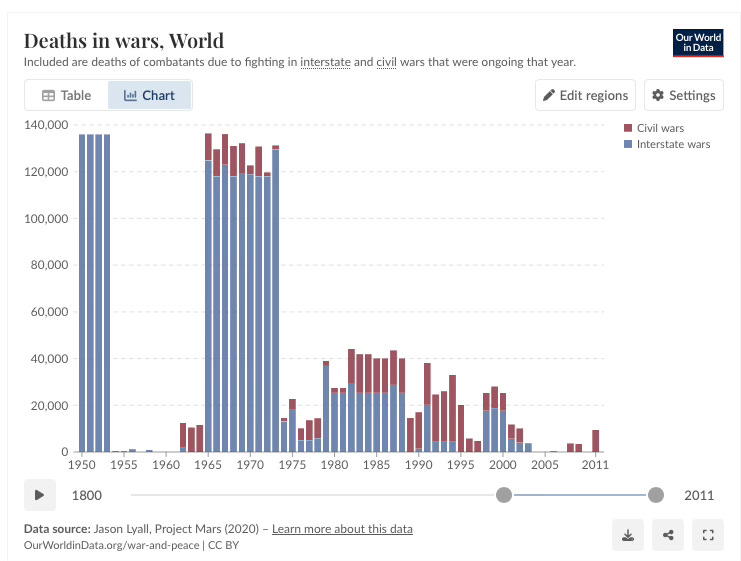
Then things changed. As the US military presence in Vietnam was peaking in 1968-69, Soviet strategists decided US strength was waning. They embraced détente and arms control. They promoted anti-war sentiment in the US and anti-US sentiment worldwide. In the wake of the fall of Hanoi and Nixon’s resignation, they considered the US a strategic lame duck. To exploit US weakness, Moscow went on a proxy war spree in Africa and Latin America. To fund this, they scaled up gas exports to Europe. To reduce their isolation, they enthusiastically signed the 1975 Helsinki Final Act. These were not the actions of the self-absorbed super-state Orwell and Burnham had foreseen. This was outward engagement, with aggressive intent.
Then the Kremlin overreached. When the ambitious Hafizullah Amin arrested (and later killed) Afghan president Taraki in September 1979, he did so without Moscow’s approval. Amin’s actions angered the Soviets who had brought Taraki to power in a coup the previous year.
As Amin Saikal wrote in his article on ‘Islamism, the Iranian revolution and the Soviet invasion of Afghanistan’ for The Cambridge History of the Cold War: “Moscow could no longer trust Amin, who became aware that he was in a vulnerable position. As a consequence, to protect himself from the Soviets, he sought a ceasefire with Hekmatyar, along with a normalization of relations with Washington.”
In a nutshell, the man at the apex of the system of control Moscow had built up in Afghanistan since the mid-1950s was threatening to ditch them. The Kremlin had to choose between salvaging its investment in Afghanistan, or seeing the country fall into the US camp, or take an Islamist turn à la Iran and Pakistan. The Brezhnev doctrine held that Soviet bloc state must revert to US control. So Moscow invaded.
Amin had been an unpopular tyrant, with a picture of Stalin on his desk. Moscow replaced him with Babrak Karmal, a relative moderate, and later Mohammad Najibullah, a firm nationalist. Only two decades after Najibullah’s fall, Russia was supporting the Taliban. In 2025, it recognized their government in Kabul and received a Taliban ambassador in Moscow — becoming the first state formally to do so.
