


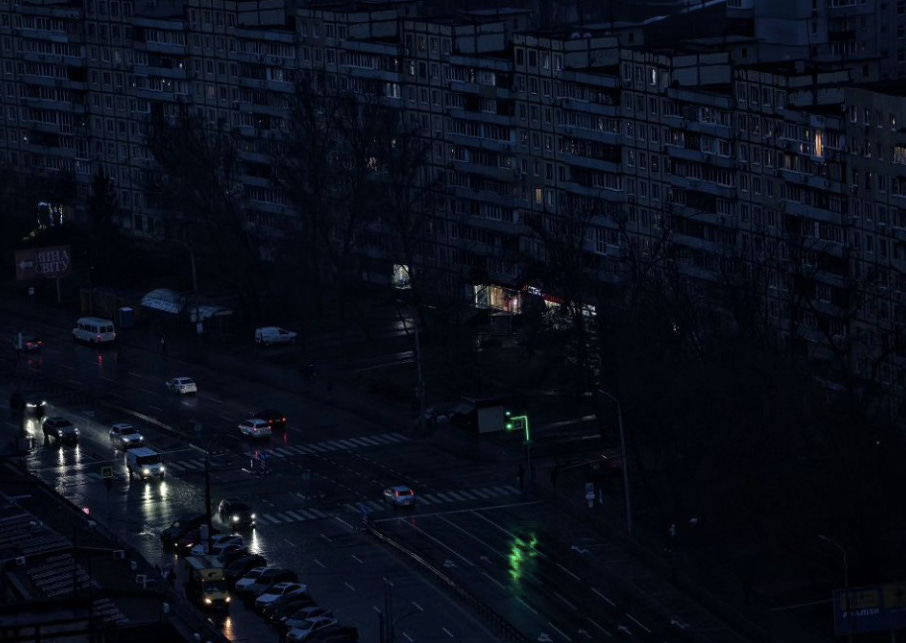
(An evening blackout in Dnipro, Ukraine)
As we entered this New Year, Ukraine saw its power grid devastated. Russian missiles hit generating stations. In another hemisphere and seemingly another dimension, Trump decapitated Venezuela and threatened to invade Greenland.
These headline-grabbing events appear unrelated. But they are intimately linked.
Let me explain.
In a famous 1932 speech, British prime minister Stanley Baldwin struck a note of defeatist resignation about future air wars. In a speech to parliament advocating unilateral disarmament for the UK, he stated that air defence was futile because, as he then believed, “the bomber will always get through.”
In the ensuing years, many countries were indeed bombed — mostly by militaristic Japan, Mussolini’s fascist Italy, Stalin’s Soviet Union and Hitler’s Germany.
Indeed, Japan had bombed Shanghai in 1932 — ten months before Baldwin’s warning. By 1940, Britain itself was under attack. But allies fought back, including with their own extensive bombing campaigns, until victory was won.
For decades after 1945, the bombers did not get through. Attacks were deterred. Smaller-scale bombing campaigns did happen. Korea and Vietnam were major exceptions. But the logic of air defence and deterrence mostly prevailed.
Then came Russia’s full-scale invasion of Ukraine in 2022.
In 2022, Russia launched about 3,000 missiles — yet only about 1,000 drones — against Ukraine. In 2023, this barrage intensified to 3,500 missiles and 3,000 drones.
In 2024, the fascist Russian air war kicked into high gear with 4,000 missiles and 30,000 drones. In 2025, they launched only 1,900 missiles but 54,000 drones.
To this aerial assault Moscow added 40,000 glide or guided bombs in 2024 — and another 44,000 in 2025. In other words, last year Russia launched almost 100,000 air-delivered munitions against Ukrainian targets, many of them civilian.
This campaign reached a crescendo of destruction in late 2025. So far in 2026, Moscow has launched massive ‘packages’ of airborne explosives — on January 9th, 13th and 20th — designed to overwhelm Ukrainian defences. Each attack features 300 to 400 munitions – about ten percent of which are missiles.
Ukraine has been heroic, yet again, in devising innovative air defences. It arguably has the upper hand in the drone war on the front line. It has developed interceptor drones that bring down or redirect a high proportion of Russian aerial attacks.
