


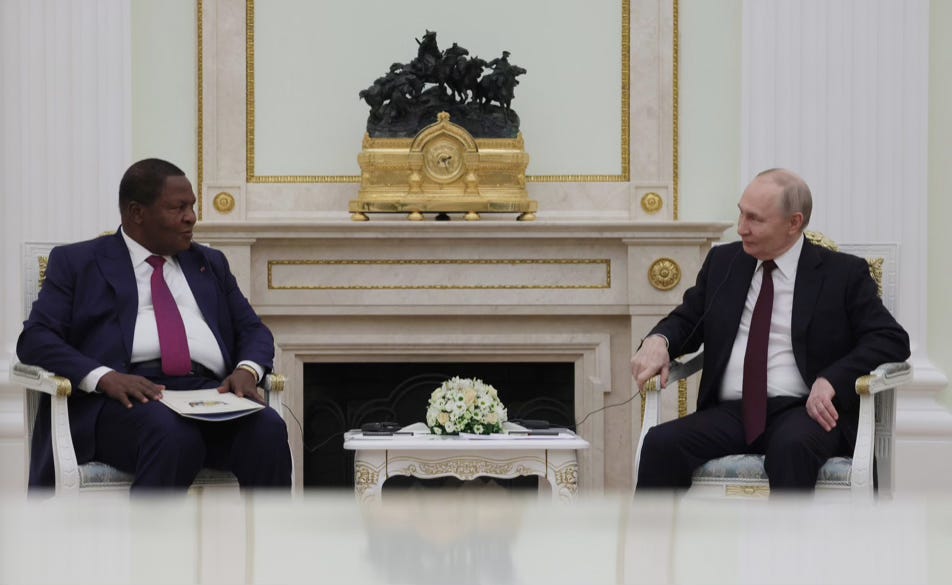
(‘Putin’ meeting today in the Kremlin with Central African Republic president Faustin-Archange Touadéra, who was elected in 2016 and protected from an attempted coup by mercenaries from Russia’s Wagner Group.)
One notable change since the launch of large-scale US/Israeli air strikes against Iran on February 28th: Russia’s usually loquacious leader has been unusually tongue-tied. In fact, he has barely mentioned the only issue that mattered this week.
As you will recall, Putin was a vociferous critic of the US-led invasion of Iraq, culminating in his 2007 speech at the Munich, where he threw down the gauntlet over a US-led ‘unipolar world’ and dared allies to stop him.
Since then, the Russian president has rarely missed any of his many opportunities to skewer the US with regard to any number of military moves and operations — from Afghanistan and Libya to Syria and Ukraine.
Yet since the US/Israeli air campaign kicked into high gear on Saturday, ‘Putin’ has largely skirted the issue. He managed only desultory written condolences on the death of Khamenei whose killing he termed “a cynical violation of all norms of human morality and international law.”
This is, to put it mildly, rich coming from a regime that has poisoned and murdered opposition leaders, pesky journalists, dissident oligarchs, superfluous diplomats, its own wayward officials and of course ordinary Ukrainians on a massive scale.
As we have chronicled, the consolidation of power by Kremlin Chekists under Patrushev may have subjected the Russian president himself to a similar fate.
In his March 1st statement, ‘Putin’ called Khamenei a ‘great statesman’ who had made “a huge personal contribution to the development of friendly Russian-Iranian relations, raising them to the level of a comprehensive strategic partnership.”
Apart from cursory telephone calls to Gulf leaders — whose countries are under attack by Russia’s ally, in some cases with Russian-made drones — the marquee event for the public ‘Putin’ since February 28th was today’s meeting with the president of the République centrafricaine — a longtime host to and client of Wagner and its successors, making his country perhaps Russia’s most reliable remaining ally.
‘Putin’ had a sombre meeting yesterday with Hungary’s foreign minister, whose boss faces electoral Armageddon as the country prepares for April 12th polls. ‘Putin’ also gave a boilerplate address to the Ministry of Interior, again without breathing a word about Iran — something the real Putin would never have done
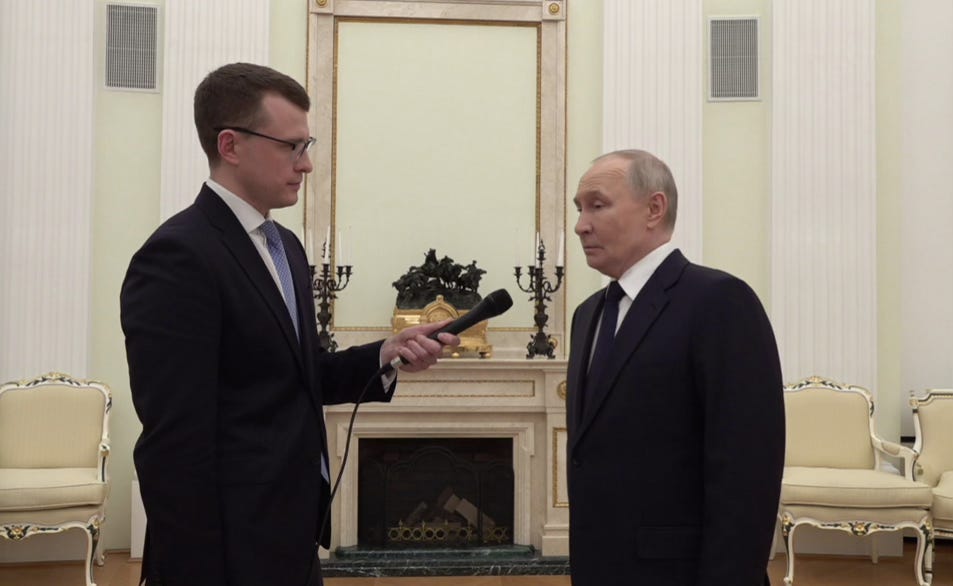
(‘Putin’ with Russian journalist Pavel Zurabin yesterday in the Kremlin)
The Kremlin used the only televised presidential remarks since February 28th — given a full four days after attacks began — to (i) complain about new EU restrictions on Russian gas including LNG; (ii) call a fire aboard an LNG carrier in the Mediterranean a ‘terrorist act’; and (iii) claim Ukraine would attack pipelines.
There was nothing about US or Israeli military action against Iran.
Needless to say, this is not Moscow’s usual modus operandi. It smacked of desperation and heavy improvisation. The Kremlin is clearly non-plussed by this latest war but preoccupied by growing internal financial pressures. They know Russia will not benefit from this week’s spike in energy prices, which markets expect to be temporary. Russia’s budget deficit is skyrocketing, as oil and gas revenues continue to slide.
Most worryingly of all for Moscow, Belgian special forces, backed by France, boarded and seized the Ethera, an oil tanker sailing under the flag of Guinea, in the North Sea on Saturday night. This more proactive EU posture has spooked Politburo 2.0.
But what is really driving ‘Putin’s’ reticence on Iran?
First, the Kremlin is terrified any criticism of US actions might irritate their own irascible poodle, Trump – on whom they count to legitimize their conquests.
Second, Russia is downplaying its role in creating the Shahed/Geran drone menace now shattering the Gulf states’ carefully-cultivated air of invulnerability.
Third, despite a warm relationship with Netanyahu, Moscow has a more complicated one with Israel since 10/7, given Russia’s role in enabling those attacks.
For ‘Putin’ to boast about Russia’s ‘comprehensive strategic partnership’ with Iran while Israeli pilots pummel IRGC headquarters and military installations across the country only discredits Russia further in Israeli eyes.
The usual suspects confidently predict this war will fill Russia’s coffers and drain Ukraine’s defensive stockpiles, as interceptors are redirected to the Gulf.
The truth is the opposite.
Ukraine is now the recognized leader in defending against Iranian drones and missiles. The US, Europe and Gulf allies will scale up these capabilities, making Moscow’s last formidable weapon against Ukraine less relevant.
As Iran’s role in waging proxy war and sustaining autocrats becomes clearer, shadow fleets and sanctions-busting will become less fashionable; seizures and boardings on the high seas will become more feasible and more common.
In short, the dashboard of official Russia is a sea of flashing lights, all signalling weakness, as budgetary, economic, military and political reverses mount.
Worst of all, the Kremlin is stuck with a double literally no one takes seriously.
Fascist Moscow’s oily officials cannot even get to Abu Dhabi, the venue for trilateral talks on which their unrealistic hopes hang, which is under attack by Russia’s ally.
This would be farcical — worthy of a film like ‘The Death of Stalin’ — if Russian and Iranian aggression had not already cost the world so much.
Iosif Vissarionovich Dzhugashvili, as he was born, did in fact die on this day, March 5th, in 1953, aged 74. Putin, apparently born a few months earlier on October 7th, 1952, would have turned 74 later this year. He has not been seen since 2023.
Russia today is headless, friendless and almost penniless. It is also eerily silent. The nightmare Putin loved to recount from his days in Dresden, about a capital that no longer answered as the Soviet Union began to capsize, has come full circle.
But this time the predicament is far worse: Moscow is not just incommunicado. It literally has nothing to say.
As Russia’s crisis deepens, the countries it has directly and indirectly attacked— Ukraine and Israel — are riding high. The Kremlin’s most prized asset is damaged goods, losing steam, unable to deliver on most fronts that matter to Moscow.
No wonder ‘Putin’ and the Kremlin clique have been stumm this week.
Chris, this is an unusually clear and historically grounded analysis of the war.
Your central point — that Western policy has been shaped less by strategy than by successive misreadings of the conflict — strikes me as particularly important. As you note, allied decisions were repeatedly framed by the expectation that Ukraine would lose, by fears of Russian escalation, and by hopes that diplomacy might substitute for military reality.
What has been remarkable is that the war itself has steadily falsified these assumptions.
Ukraine did not collapse in 2022. Russia did not resort to nuclear escalation when Western weapons systems were introduced. And “waiting for peace” has not produced peace.
In other words, the battlefield has repeatedly corrected the political narrative.
Seen from a longer historical perspective, this may explain why the war feels so difficult for Western governments to interpret. For three decades Europe has lived inside a post-Cold-War mental framework in which large-scale interstate wars of conquest were considered almost impossible. Yet Russia’s war against Ukraine is precisely that: a classical imperial war of domination, justified by historical myths about national unity and territorial destiny.
When political frameworks lag behind strategic reality, policy tends to become reactive and hesitant.
Ukraine’s resistance has therefore had two simultaneous effects: it has blocked Russia’s attempt to destroy Ukrainian statehood, but it has also forced the West to confront the return of geopolitical realities many believed had disappeared after 1991.
In that sense, Ukraine is not only fighting for its independence. It is forcing Europe and North America to rediscover the political will that underpins the idea of sovereignty itself.
The question now is whether Western policy will finally align with the logic of the war — or continue to trail behind events.
What makes this analysis uniquely credible, Chris, is that you are not speculating from a distance. You knew Putin personally — you walked with him for two hours, without an interpreter, speaking Russian. You have seen the man up close: his bearing, his instincts, his reflexes. That direct experience gives your observation about the figure now appearing in Kremlin photo ops a weight that no amount of open-source analysis can replicate.
The person in the photograph with President Touadéra does not pass the test. And the silence you document here is, in a way, even more telling than the face. The real Putin — the one you knew — would never have let the US and Israeli strikes on Iran pass without seizing the moment for a sharp, resonant speech. His 2007 Munich address was built on exactly that instinct: to use America's military moves as a platform to define himself as the indispensable counterweight. The absence of that reflex is not caution. It is incapacity.
Your point that Russia is now 'headless, friendless and almost penniless' deserves to be read in every Western foreign ministry. The temptation in diplomatic circles is always to negotiate with whoever is sitting across the table and to paper over the question of legitimacy. But if the Kremlin's principal interlocutor is, as you argue, a stand-in who cannot make decisions and cannot even improvise credibly on the biggest story of the week, then the entire architecture of current ceasefire diplomacy rests on sand.
The Death of Stalin analogy is apt — except that in Iannucci's film, the vacuum was at least visible to the people inside the room. What makes today's situation more dangerous is that the vacuum is being actively concealed, and too many Western leaders are still pretending the room is occupied.
Thank you for continuing to say what others with your knowledge choose not to say.