


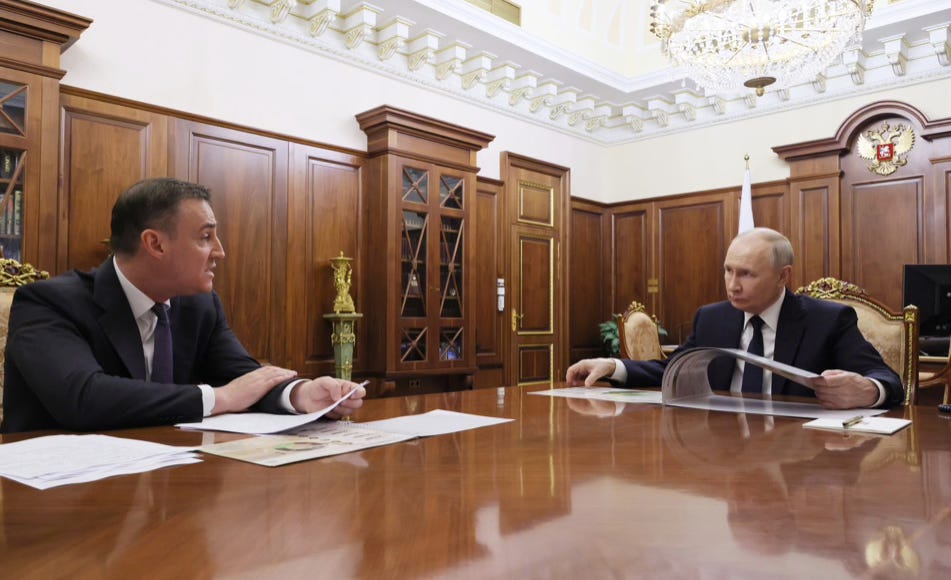
(‘Putin’ yesterday with deputy premier Dmitry Patrushev, who referred to him as Pavel Nikolayevich, not Vladimir Vladimirovich, his real name)
While Ukraine seizes the initiative in the drone war and weakens Russian supply lines with targeted strikes, the inevitable Russian response is already clear.
They are escalating.
In recent days, Russia has attacked civilians in Romania with a drone. They hit central Kyiv with missiles. They are reportedly preparing a major hybrid attack on a NATO member state — possibly Estonia or Latvia, or perhaps elsewhere.
These are indeed signs of desperation, as Moscow runs out of strategic options to end the war on its terms. No one should under-estimate the scale of Ukraine’s innovation-driven achievement in the drone war, which is collapsing Russia’s on-paper numerical battlefield advantages into irrelevance.
But Moscow’s nihilistic posture is hardening. One week ago, US secretary of state and national security advisor Marco Rubio reported that peace talks had stalled and no negotiations were underway.
For the first time in well over a year, the Kremlin cannot count on its prize asset in the White House even to try to impose Moscow’s will on Ukraine or its allies.
If a compliant US cannot deliver, the Kremlin will try increased military force. Mobilization of a million soldiers. Strikes against Ukraine. A hybrid operation to divide NATO. By applying enough pressure, Moscow seeks to bring Europe to heel. They assume that, with the help of online legions, a Trump will be elected in France, Germany, the UK — or all three. Then Ukraine will break.
The Kremlin has always thought this way about this war.
All of them wanted to win back Ukraine by corruption, sabotage and subversion.
Doubting a full-scale invasion would succeed, a hard core tried to talk Putin out of it in late 2021 and early 2022.
Now the same group blames Russia’s ‘loss’ of Armenia, Hungary, Moldova and Syria — plus the weakening of allies in Iran and Venezuela — on Putin’s pig-headed move.
They are determined not to make the same mistake twice.
They still aim to seize remaining areas of Donetsk, Luhansk, Kherson and Zaporizhia oblasts not yet occupied by Russian forces — and ultimately all of left-bank Ukraine and Ukraine’s Black Sea coastline — only after critically weakening Ukraine’s allies and partners as a prelude to defeating Ukraine itself.
These may be pipe dreams, but they animate the Kremlin’s current masters.
This hard core still believes Trump and Xi will save them. They expect pro-Russian Slovakia to be joined by other EU members with pro-Kremlin affiliations. They are confident Khomeinist Iran will prevail because Trump always turns tail.
They are returning to the game they would have pursued if the full-scale 2022 invasion had not taken place: a wide-ranging campaign of sabotage, political corruption and undermining democracy to weaken NATO and its members.
Who are ‘they’?
Nikolai Patrushev and his colleagues in the Kremlin’s long-term Chekist brain trust.
They’ve been running the country for nearly 30 years and aren’t about to stop now.
They are also trapped.
Trapped in delusions about an impending collapse of Euro-Atlantic democracy.
Trapped in lies told by commanders who claim victories for Russian forces on the front in Ukrainian Donbas and elsewhere that have not happened.
Trapped in unrealistic assumptions about the resilience of Moscow’s war economy.
Trapped in complacency about the willingness of Russians to die for a cause most already know is irredeemably lost.
Trapped behind the facade of a double that cannot yet be discarded because peace on Russia’s terms has not been achieved.
