


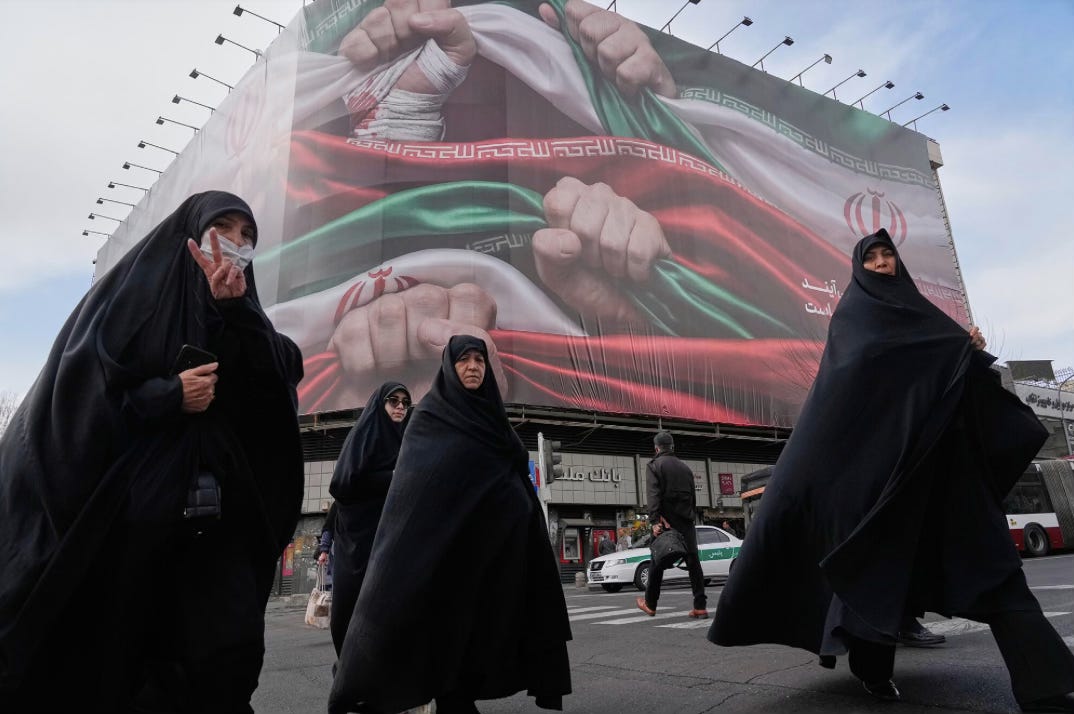
(As US and Israeli airstrikes continue, Iran faces an internet blackout and continuing repression at all levels. [Vahid Salemi/AP Images])
Since the 1979 Islamic revolution, Iran’s aggression against its people, neighbouring states, Israel, the US and other democracies has never stopped. Yet Europe, the UK, Japan, Canada, Australia, the Gulf states and other allies — the famous middle powers of Carney’s Davos speech — appear reluctant to confront the threat to regional security and global commerce that Iran represents. Why is this?
Let’s first recall the Khomeinist regime’s track record:
Revolution and genocide: Iran’s ideological goal is to export its theocratic revolution, eliminate Israel (”the Little Satan”) and damage the U.S. (”the Great Satan”).
Iraq and Syria: After 2003, Shia militias in Iraq killed U.S. and coalition forces. Iranian proxies in Syria triggered massive displacement, destabilizing Europe.
Armed groups: The Islamic Revolutionary Guard Corps (IRGC) and its Quds Force built the ‘axis of resistance’: Hezbollah in Lebanon; Hamas and Palestinian Islamic Jihad in Gaza; the Houthis in Yemen to attack shipping, Saudi Arabia and Israel.
Terrorism sponsorship: The 1983 Beirut barracks bombing killed 241 U.S. Marines: Iran has been on the U.S. state sponsors of terrorism list since 1984. Iran has orchestrated plots against dissidents and Jewish targets worldwide.
Proxy wars and regional subversion: The axis of resistance has not been a dormant force: it has fuelled multiple wars. Iran propped up Syria’s Assad with troops, Hezbollah fighters, and militias; organized, trained and supplied Shia militias to fight U.S. forces in Iraq; and militarized Yemen via the Houthis.
Dissident killings and abductions and direct attacks abroad: For decades, the regime assassinated or kidnapped opponents in Europe and elsewhere. These operations have escalated since 2022 and are now outsourced to criminal networks to maintain deniability. Iran also conducts direct attacks against Jewish sites
Downing of civilian aircraft: In 2020, IRGC forces shot down Ukraine International Airlines flight PS752, killing all 176 on board; most were Canadian citizens, permanent residents or students; Tehran initially denied responsibility.
Support for Russia’s war on Ukraine and Chinese ambitions in southwest Asia: Since 2022, Iran has supplied Russia with thousands of shahed drones and ballistic missiles, with ongoing production assistance and sanctions evasion. Iran imports Russian and Chinese weaponry and supplies energy to China.
Repression and violations of basic rights: Over the past year, Iran has detained over 75,000 political prisoners. It maintains high rates of execution, including of anti-regime activists. The regime comprehensively violates the rights of women and has virtually extinguished basic political freedoms, including freedom of speech.
Cyber attacks and large-scale influence operations: Iran made large-scale cyber-enabled attempts to interfere in the 2024 US elections, which were backed by Russia and China. In fact, the only other states with comparable records of violence, hostage-taking, and hybrid warfare are China, Pakistan and Russia.
Despite this egregious litany of destabilizing actions, large swathes of media, academia, and political debate in our democratic societies treat these facts as secondary or contested. They insist on “contextualizing” them.
Far more often than in the case of Russian aggression against Ukraine, Iran’s wars — including its support for Hezbollah, Hamas and the Houthis — are portrayed as ‘legitimate responses’ to U.S./Israeli ‘provocation’.
Media coverage and policy debates often emphasize the humanitarian impact of sanctions against Iran. Concerns about repression, terrorism or war are subordinated to hopes for nuclear diplomacy. Israel’s responses to attacks by Iranian proxies are given prominence while Tehran’s role in initiating attacks and the scale of its campaign against Israel are soft-pedaled.
In this regard, the October 7th, 2023 Hamas terrorist attacks against Israel were not a watershed. While most Europeans and North Americans condemned Hamas, a high percentage subsequently viewed Israel as having used disproportionate force in Gaza. Younger people tend to see Hamas as a ‘resistance movement’ — not a brutal Iranian weapon aimed at a democratic state. Few European, British or Canadian voters are open to military action against Iran.
It is as if the shocking reality of Iran’s revolutionary goals and violence come wrapped in a blanket of acceptability, rationalization and special pleading.
Our friends at Get Fact see this as a contest of narratives, tradecraft and wills — “the war Iran is winning”. For more background on what Iran is doing to us all, please do give their excellent work a read.
How did Iran pull this off? We will delve into this question in our next essay.
Persian Blanket
For 47 years, Iran has not been held to any standard
Response to Chris Alexander
Chris,
There is a weight to this piece that is different from your last one.
Less about why we fail to see, more about what we keep refusing to total up.
Because what you are doing here is not argument in the usual sense.
You are building a ledger.
And once it is laid out like this—year after year, theatre after theatre— it becomes harder to sustain the idea that this is episodic, reactive, or accidental.
Patterns that persist for decades are not behaviour. They are strategy.
I think that instinct is right.
There is continuity here.
Not perfect, not linear—but unmistakable.
And yet, the reaction you are pushing against—the hesitation, the contextualising, the fragmentation of response—also persists.
So the question becomes slightly different from the one you pose.
Not only:
👉 Why is Iran not being held to account?
But:
👉 Why does a pattern this long fail to consolidate into a single political conclusion?
Because in other cases, it does.
With Russia in Ukraine, the line was crossed.
Clear act. Clear geography. Clear response.
With Iran, as you show, the record is extensive—
but the response remains fragmented.
I think part of the answer lies in something you are already circling:
the difference between accumulation and trigger.
Your list accumulates.
But democracies tend to act on triggers.
And Iran has, over time, operated in a way that avoids producing a single, binding trigger.
Not by reducing activity—
but by distributing it:
across proxies
across regions
across time
across thresholds that never quite force unanimity
So each item in your ledger is real.
But each one is also, politically, contestable in isolation.
What cannot be denied collectively can still be debated piece by piece.
That is not simply narrative failure.
It is structural advantage.
You describe something very precisely with your “Persian blanket” image.
Not concealment.
Not denial.
But a kind of softening layer over hard facts.
I would put it slightly differently:
👉 not a blanket over reality 👉 but a dispersion of responsibility
Because every element you list sits partly in a different system:
terrorism → security policy
repression → human rights
proxies → regional conflict
cyber → information domain
nuclear → non-proliferation diplomacy
And each of those systems has its own logic, its own institutions, its own thresholds.
Which means no single system fully owns the problem.
And when ownership is diffuse, action is delayed.
You also touch on something sensitive but important:
the asymmetry in how violence is interpreted.
Where some actions are framed as:
aggression
and others as:
reaction
resistance
context-dependent
That asymmetry does exist.
But I would be careful about attributing it primarily to indulgence or blindness.
Often, it reflects something else:
👉 uncertainty about escalation.
Because confronting Iran directly has always carried the risk of widening conflict:
regionally
economically (energy, shipping)
politically
So restraint is not always sympathy.
Sometimes it is calculation.
That does not invalidate your argument.
But it changes the nature of the problem.
It is not simply that Iran “gets a pass”.
It is that the cost of full confrontation has repeatedly been judged higher than the cost of partial tolerance.
And that is a very different equilibrium.
Systems do not ignore threats lightly. They rank them—often imperfectly—against the risks of acting.
Your point about generational perception is also worth sitting with.
Because here we are moving from policy to narrative.
You note that younger audiences interpret actors differently.
That is true.
But again, I would frame it less as error—and more as fragmentation.
There is no longer a single narrative authority.
No single framing that consolidates perception across societies.
So the same set of facts produces multiple interpretations simultaneously.
And that weakens collective response.
If I step back, what your piece is really doing is this:
You are forcing a long-term pattern into a single field of view.
That is valuable.
Because it resists the tendency to treat each event as isolated.
But the resistance you encounter comes from the opposite pressure:
systems that are structured to deal with events, not continuous patterns.
And Iran, perhaps more than most actors, has learned to operate inside that gap.
So I would not soften your conclusion—
but I might refine its direction.
Not:
👉 “we have treated Iran too leniently”
But:
👉 “we have not yet built a way to respond coherently to this kind of long-duration, distributed pressure”
That is a harder problem.
And it does not have an immediate solution.
But naming it that way makes your argument more difficult to dismiss—
because it moves from accusation to structure.
And structure, once seen clearly, is harder to ignore.