


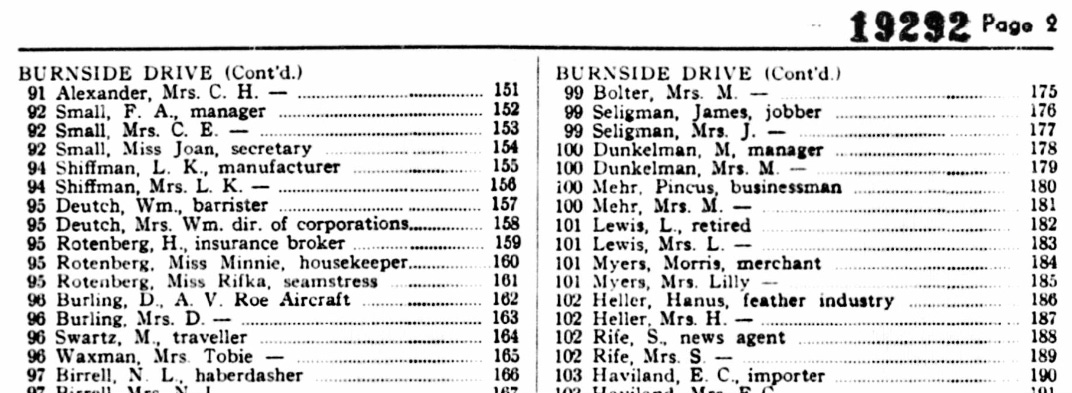
(Part of a Toronto Voters’ List from 1949)
In the neighbourhood where my father grew up in the late 1940s and early 1950s, many families were Jewish.
He would regale us endlessly with stories of his life with this wonderful, warm, caring and successful community, its many memorable characters and the distinguished mark they had left on Toronto, Ontario and Canada. A huge number of these neighbours became lifelong friends. My childhood, albeit on a different Toronto street, followed a similar pattern — filled with bar and bat mitzvahs, seders and vibrant Jewish households.
My father was born only five years after the Christie Pits riot, which took place just six months after Hitler had seized power in Germany. This jolt of violence in a Toronto park showed the reach of Anti-Semitic Nazi ideology in 1933.
Like most Canadians, we grew up celebrating Canada’s role in ending Nazi tyranny — vowing never to allow the hate speech that led to the Holocaust ever to take root again.
My father died a few months’ into the large-scale Russian invasion of Ukraine in 2022. He did not live to see the October 7th, 2023 terrorist attacks that plunged Toronto, Canada and most democratic societies into a dark period of renewed Anti-Semitism, unprecedented since the 1930s.
Very sadly, Anti-Semitism in Europe, North America and worldwide has been on a steady upward trajectory since the late 2010s.
After October 7th, 2023, it spiked almost uncontrollably.
According to B’nai Brith Canada, the number of Anti-Semitic incidents across Canada — including harassment, vandalism, and violence reported via hotlines, monitoring, and other sources — rose from about eight per day in 2022 to 20 per day now.
Statistics Canada and the Toronto Police Service report that hate crimes directed against Jews or Jewish institutions now represent between 70 and 80 percent of all religiously-motivated hate crimes committed in Canada and in Toronto.
Think about what this means. Put aside for a moment your views on the Israel Defence Forces, prime minister Netanyahu or Israeli national security minister Itamar Ben-Gvir, whose appalling antics this week have been rightly condemned.
The cruel and dispiriting reality is that Canadian Jews are facing abuse, harassment and often violence because of the actions of the state of Israel.
No other Canadian community today faces such open and widespread expressions of intolerance. Iran recently killed tens of thousands of civilians. Russia is committing genocide in Ukraine, raining hellfire down on civilians every day. The People’s Republic of China is trampling the rights of Uighurs, Tibetans and other ethnocultural groups, as well as democratic activists in Hong Kong.
Yet Iranian, Russian and Chinese Canadians do not face open expressions of hatred or intolerance on anything close to this level for the crimes of those states.
Why is this? It is far too convenient to cite Anti-Semitism’s long history, and note its resurgence after the October 7th attacks and ensuing conflict in Gaza.
The reality is that hate speech and large-scale hate crimes do not arise out of thin air.
The current wave of virulent Anti-Semitism in Canada and elsewhere is being promoted by online hate propaganda campaigns mounted by Russia, China and Iran, as well as networks of operatives supported by the Khomeinist state.
Canadian governments, national security and law enforcement bodies have not done nearly enough to counter this propaganda, the networks that support it and the false narratives it has been driving.
So long as our inaction continues, the current wave of unchecked Anti-Semitism is likely to grow — forcing Jewish friends and neighbours to confront the dark forces that, in many cases, prompted them to emigrate to Canada in the first place.
Take one example. On October 21st, 1905 Zlynka, a town then part of Chernihiv governorate in the Russian empire, was upended by an anti-Jewish pogrom.
Now in Russia’s Bryansk oblast very close to the Belarusian border, Zlynka had 812 Jews out of a total population of 5,408 as recently as 1897.
After the assassination of Tsar Alexander II in 1881, under the influence of extremists like the Black Hundreds, waves of Anti-Semitic hate and pogroms rolled over Russia. With the publication in 1903 of the infamous Protocols of the Elders of Zion, a conspiratorial Anti-Semitic tract produced by Russian secret police operating in Paris, violence became more frequent. Russia’s defeat by Japan in a major 1904-05 war fed even more Anti-Jewish violence. More Jews decided to flee Russia.
One family that left Zlyatka was that of Judah Schumiatcher. At the urging of his son, Judah and his wife decided to emigrate in 1910 with their children. By 1911, they were in Canada. Judah died in 1922 in Calgary, where he is buried. His passing was lamented by the whole community.
The son in question took the name Morris. Born in Zlyatka on October 17th, 1893, he became Morris Smith in Calgary, famous for launching the Smithbilt Hat Company — operating first in the Beltline neighbourhood, then in Inglewood.
Morris Schimiatcher/Smith served in the Canadian army in the Great War and a reserve unit of highlanders in the second. In 1946, Smithbilt produced the iconic ‘White Hat’ — a symbol of the Calgary Stampede, Alberta and Canadian culture ever since. Morris Smith died in Calgary in 1953.
The Schumiatchers migration from Zlynka was typical for Canadian Jews — most of whom emigrated from the Russian empire between 1880 and 1914.
Before the First World War, the Russian empire accounted for between two-thirds and three-quarters of Jewish emigration to Canada. Austria-Hungary (mostly Galicia) furnished ten to twenty percent. Others came from Romania and Germany.
Jews had never been welcome in Russia. Starting in 1791, they were confined by Catherine the Great to the Pale of Settlement — an area roughly corresponding to today’s Ukraine, Belarus, Poland, Lithuania and eastern Latvia.
Outside that area — including in large cities like Moscow, Riga and St. Petersburg — Jews needed special permission to live and work. Zlynka is one of the rare towns in today’s Russia that had been within the Pale of Settlement.
Before being incorporated into Russia, Jews had flourished for centuries within the Polish-Lithuanian Commonwealth and its predecessor regimes.
In 1750 — over two decades before the first of three partitions of Poland — the Polish-Lithuanian Commonwealth hosted the world’s largest Jewish population, amounting to 750,000 out of a global total of about 1.2 million.
By 1880 there were roughly 7.8 million Jews worldwide — about half of whom lived in Russia’s Pale of Settlement, which had previously been part of Lithuania, Poland and right-bank Ukraine. By 1897, the global Jewish population was well over ten million, with half still living in Russia.
But Jews were leaving Russia. By 1914, about two million Jews, mostly from Russia, had emigrated to the United States and Canada.
Another half million followed in the 1920s and 1930s.
By the time the world’s Jewish population reached its peak of almost seventeen million in 1939, about ten million lived in Europe — one third in independent Poland; about three million in the Soviet Union; the rest in Austria, Hungary, Germany, Romania, the UK, France and elsewhere. Over five million Jews lived in North or South America, mostly in the US, 166,000 in Canada.
By 1939 Zlynka had only 432 Jews. Most were killed in the Holocaust of bullets during the post-1941 Nazi occupation. Only a tiny handful survived the war.
Even with the establishment of the state of Israel in 1947 and the flourishing of postwar Jewish populations in the United States, Canada and elsewhere, the global Jewish population is about sixteen million — one million less than in 1939.
The Holocaust continues to cast a long and awful shadow.
(To be continued)
More on the Christie Pits riot:
https://en.wikipedia.org/wiki/Christie_Pits_riot