


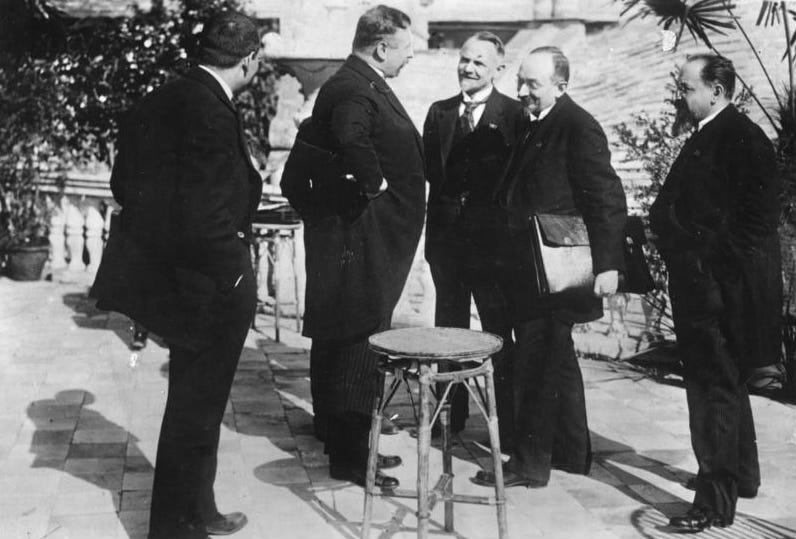
(German chancellor Wirth and Soviet foreign minister Chicherin at the signing of the treaty of Rapallo in April 1922)
Wars of the twentieth century were mostly about ending imperial wars of conquest. One big state did not get the memo: Russia.
In 1900, there were only about 50 independent states with full diplomatic recognition in the world. Twenty-four, including small states like Andorra, Luxemburg, Monaco and San Marino, were in Europe.
Nineteen — including the United States but not Canada, still in the British imperial fold — were in North & South America. Five were in Asia: China, Japan, Persia, Siam and the Ottoman empire. Only Ethiopia and Liberia were in Africa.
Vast territories in Africa and Asia were still colonial possessions. Of the European powers, only Spain had almost fully shed its empire. No fewer than seven European states retained significant overseas colonies in 1900.
After the First World War, two European empires plus the Ottoman and Russian empires were largely disbanded, creating many new states. British and French League of Nations mandates in the Middle East gave them de facto control of formerly Ottoman territories. But decolonization advanced more quickly over four decades after the Second World War. Still more states were created in the 1990s after the dissolution of the Soviet Union and Yugoslavia.
Despite self-determination in the interwar years, the UN still only had 51 members when it was founded in 1945 — showing not much had changed since 1900.
Two of them were Belarus and Ukraine, both totally integrated into the Soviet Union and not in fact independent. Stalin had asked for them to have seats at the UN on the model of British dominions, which had been members of the League of Nations but did not control their own foreign policy until 1931 and even then sided mostly with London. The Soviet Union had been admitted to the League in 1934 but was expelled on December 14th, 1939 for invading Finland.
The number of independent states grew quickly during the decades of global decolonization and after Russia’s partial decolonization over 1989-92.
By the end of 2000, the United Nations had 189 member states — over 50 in Africa, over 50 in Asia, just under 50 in Europe, 33 in Latin America and the Caribbean.
In other words, the number of independent states roughly quadrupled in the five decades after 1945 — averaging nearly thirty new states per decade.
To start this process, allies had to defeat aggressive imperial powers in two world wars. They had to see off the few aggressors that attempted new conquests after 1945. For instance, Kuwait was liberated from Iraqi occupation in 1990; Timor Leste joined the UN as an independent state after years of Indonesian aggression.
There were partial failures. Turkey still occupies part of Cyprus. Only half the Korean peninsula was liberated from communist oppression. There was the occasional total failure: China’s conquest of Tibet in 1950 has not yet been reversed.
Wars of conquest were mostly shown to be unacceptable.
This is what makes Russian aggression in Chechnya, Georgia, Syria, Ukraine, Mali, Sudan and elsewhere so outrageous — and so dangerous.
Russia never gave up its empires voluntarily. Moscow never accepted that the principle of decolonization might apply to it. Above all, Moscow never stopped waging wars of conquest.
Russia was an aggressor in the First World War, aiming to prize Galicia away from Austria, to conquer Polish and Prussian territories from Germany, and to absorb parts of the Ottoman empire and even the Balkans.
Instead Russia was defeated in 1917 by Germany and the Bolshevik revolution. In the ensuing chaos, the treaty of Brest-Litovsk shrank Russia’s territory. After more bloody wars, Poland and the Baltic states regained their independence.
By 1917-18, Russia was an ally of Germany — the power it had attacked. From the 1922 treaty of Rapallo to the 1939 Molotov-Ribbentrop Pact, Moscow helped Germany rearm and defy the Versailles treaty regime.
From 1939 to 1941, the two were allies in wars of conquest that brought the Baltic states and parts of Finland, Poland and Romania under repressive Russian control.
In other words, in the interwar years Soviet Russia was one of the principal powers — together with Nazi Germany, fascist Italy and militaristic Japan — seeking to reverse the post-1918 trend towards self-determination.
Russia was against an aggressor in the Second World War — absorbing large new territories by conquest in return for giving Hitler a free hand in western Europe.
After the Second World War, Stalin treated the states of Central Europe occupied by the Red Army as a new set of colonies. His successors, especially Brezhnev and Andropov, sent Soviet forces further field, seeking to control independent states in Africa, Asia and the Americas by ideology, war or intimidation.
After 1945, Moscow was the principal force operating against freedom, independence and self-determination. But the Soviet and Warsaw Pact empire fell apart in 1991. Moscow has been plotting to get it back ever since.
Moscow is still waging these wars of conquest. Absurdly, any force opposing their aggression is labelled ‘Nazi’ — in an act of state-sponsored amnesia and projection, given that Hitler was Stalin’s principal ally during Moscow’s last major round of wars of aggression in Europe in 1939-41.
What will the world look like if Russia’s wars of aggression rage onward?
Most understand this would be an unmitigated disaster.
Fortunately, Ukraine has already mostly defeated Russia’s latest round of aggression — just as Afghanistan did in the 1980s.
As in the twentieth-century, Russians have acquiesced in this violence. The war of conquest in Ukraine defines Russia’s new identity. There is no meaningful opposition to this war either inside Russia or in the Russian diaspora.
Without total defeat, Russia is likely to keep fighting. With its fascism, lies and mind-warping propaganda, Moscow has convinced itself and the Russian people that continued aggression is a matter of survival for them.
They also find allies abroad, as earlier Russian imperialists invariably did.
Tsarist Russia had made Britain and France allies in the Triple Entente when it set out to conquer Silesia in 1914.
Stalinist Russia was in a pact with Nazi Germany when it launched wars to conquer Poland, Finland, the Baltic states and part of Romania.
Today’s Chekist Kremlin considers the White House its paramount ally. They expect Trump to legitimize Russian occupation of Ukraine; maintain Moscow’s hold on Africa, Cuba, Iran and Venezuela; lift sanctions; and restore ‘spheres of influence’.
Russian fascists are dangerous fantasists.
They have already launched the first major wars of conquest in Europe since 1945.
It’s not just that Moscow seeks to annexe parts of Ukraine. They deny Ukraine’s right to exist. Their aims are transparently genocidal.
Russia has also undermined democracy everywhere and destabilized Africa.
They continue to find allies, mostly of convenience, among those whose commitment to pluralism, freedom and the rule of law is shaky at best.
Our response should be to show, once and for all, that wars of conquest are passé.
We should commit fully to Ukraine’s victory. We should hold Russia to account for its war of aggression. We should pursue a broad-based strategy to liberate Belarus, Georgia and Russian-occupied territories of Moldova and Ukraine fully.
We should also counter Moscow’s malign influence in Africa and break its partnership with Iran. We should not forget Tibet, Chechnya and other territories conquered in the twentieth century and still occupied now.
Wars of conquest have no place in today’s world.
Russia needs to learn its lesson, at long last, for everyone’s sake.
May it be so!