


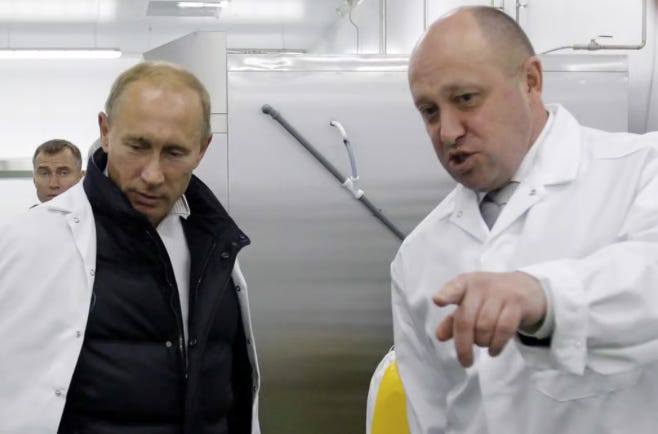
(Putin and Prigozhin at a school lunch factory in 2010)
Despite often frenzied Russian propaganda claiming otherwise, Ukraine has already defeated Moscow — just as Afghans defeated the Soviet Army in the 1980s. As a result, a brutal blame game has been underway in the Kremlin since 2022.
As in the decision to invade Afghanistan, Moscow’s prime impulse to invade Ukraine in 2014 and 2022 came from its Chekists. In 1979, KGB chief Andropov led a small group that convinced a skeptical Brezhnev — overriding reservations expressed by Marshal Nikolai Ogarkov, then-chief of the Soviet general staff.
In 2014 and 2022, the situation was more nuanced. Following Ukraine’s Euromaidan moment, Putin had full support from his security and defence team for hybrid operations in Crimea and Donbas. The only senior Russian who demurred was former spymaster and prime minister Primakov, who endorsed Russia’s illegal annexation of Crimea but publicly opposed military action in Donbas. (Primakov died in 2015.) The success (in Kremlin eyes) of both operations boosted the prestige of new commanders like Alexei Dyumin, the FSB and army special forces officer who became secretary of the largely ceremonial state council in 2024.
Planned for two decades, Putin’s larger invasion hardened into intent during long periods of COVID-era seclusion with Yury Kovalchuk, a St. Petersburg ‘wallet’ himself long obsessed with national reassertion. Defence minister Sergei Shoigu, who vastly over-estimated Russia’s military capabilities, was an early convert.
