


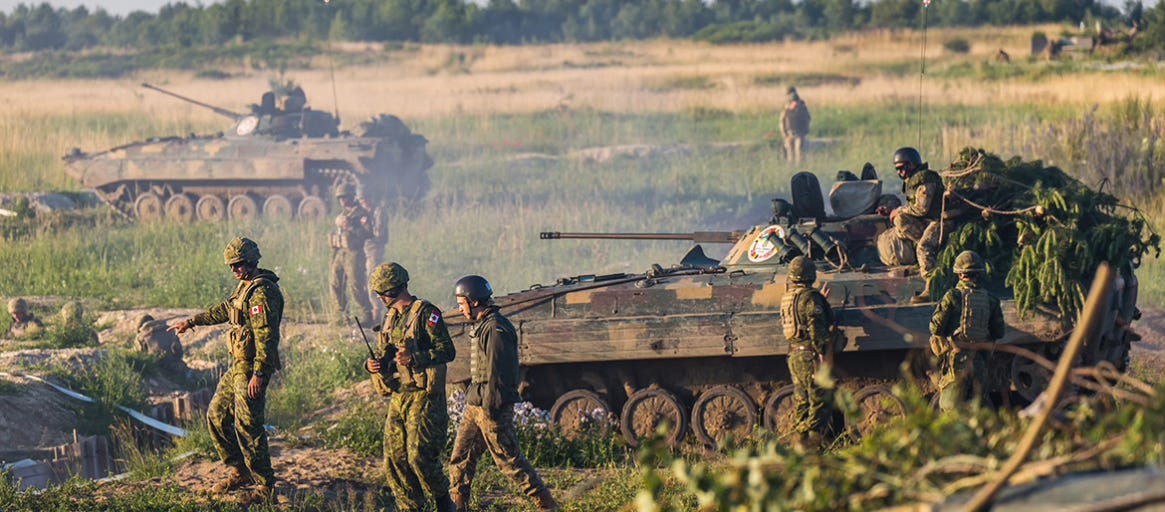
(Canadian Army instructors discuss mechanized infantry defence tactics with their Ukrainian Armed Forces colleagues during Exercise Raid Trident in Starychi, Ukraine on June 30, 2016. Photo: Joint Task Force Ukraine)
When allies very incorrectly expected Russia to steamroll Ukraine in early 2022, Canada, the US, UK and others pulled back training contingents that had been operating in Ukraine since 2015. Now it’s time to send them back.
The first reason is obvious. NATO was created to deter and, if necessary, defeat a Soviet land invasion of Europe. It remains patently absurd and indeed shameful that when that major aggressive land invasion actually happened in 2014 — six years after NATO had withdrawn an invitation to Georgia and Ukraine to begin the NATO accession process — NATO stood aside.
It is absolutely indefensible that today — fully twelve years’ later — the ‘most successful alliance in history’ does not even have an operation of any kind in Ukraine. To remind, NATO currently has at least seven major operations and missions underway in and around Europe, the Arctic and the Middle East — two longstanding ones in Kosovo (KFOR) and Iraq; maritime security missions in the Mediterranean and Aegean seas; air policing over the Baltics and Eastern Europe, as well as Arctic Sentry for the Arctic and High North; and of course the Enhanced Forward Presence on the Eastern Flank, where multinational battle groups are stationed in eight countries, including one led by Canada under Operation Reassurance, which features well over 2,000 military members deployed to Latvia.
Yet in Ukraine, a country now facing a spring offensive from 710,000 Russian soldiers? There is not a NATO uniform in sight.
Fortunately, Ukraine has prevailed to date despite this allied absenteeism.
The NATO workaround, ostensibly to shield our forces from Russian strikes, has been to host Ukrainian trainees at 140 training sites across 34 countries, with major hubs in Poland, Germany and the UK. Canada’s training mission, still known as Operation Unifier, was relocated mainly to Poland and the UK, as well as Latvia.
A few days ago Ukraine’s General Staff announced it will no longer send recruits abroad for basic training. The reason? As veteran company commander Yevhen Dykyi delicately put it, there is now “less that they can teach us.”
In other words, Canada and its allies, which have not seen ground combat for over a decade and have never been in a high-intensity drone war, have little to teach battle-hardened Ukrainian veterans of twelve years of war, whose forces have been adapting, innovating and adding new layers to joint combat arms tactics every step of the way.
As a result, Ukraine is now inviting NATO instructors and forces back to Ukraine —to see how this new war is being waged, and how it can ultimately be won.
We and other NATO allies should take them up on this invitation.
With Russian assets still running the White House — at least for now — we should assume the US will prevent this from being a NATO mission.
Instead we should approach it as a NATO-minus-one mission and ensure every other ally takes part — from across the coalition of the willing and beyond.
We should be open-minded about the mission’s shape and tasks. It should respond to Ukraine’s most acute needs. It should definitely help them to increase the mass and reach of their drone-led operations. It should also augment the density and mobility of their indirect fire and long-range strikes. Most of all, it should include a full air combat mission that protects more Ukrainian civilians, gives Ukraine enduring air superiority, and tilts the balance further in favour of full suppression of Russian missile and drone threats.
It should include logistics and innovative approaches to bolstering ammunition flows. Training should be part of every one of these components — with NATO allies set to learn as much or more than any Ukrainian counterpart.
Russia is still trying to use Trump to force Ukraine to give up four oblasts. Moscow wants to lock in its ill-gotten gains — to whitewash the same monumental crimes for which history continues to indict Hitler and Stalin.
When allies including Canada send their forces back to Ukraine, they should carry a clear political message: the mission is victory. This coalition is committed to victory. Ukraine and its allies will fight until every last Russian soldier is eliminated or withdrawn across the entire territory of Ukraine, including Crimea.
With the financial gift Trump handed Russia by lifting oil sanctions, Ukraine needs all the help it can get.