


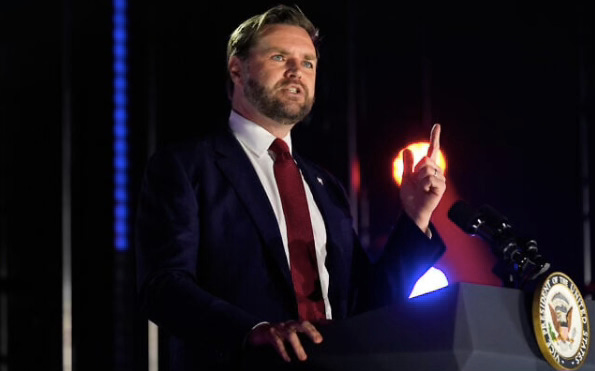
(JD Vance speaking on October 29th, 2025 at the University of Mississippi in Oxford, Mississippi [Gerald Herbert/AP])
We all know the story of the old appeasement that preceded the Second World War. Today’s appeasement is more subtle, more corrosive and more widespread.
On November 21st, US vice president JD Vance tweeted the following: “There is a fantasy that if we just give more money, more weapons, or more sanctions, victory is at hand.” Imagine if our leaders had held this view in 1914 or 1939.
When did the new appeasement start? I would make a strong case for the early 2010s, when allies refused to intervene to prevent Assad from engaging in mass murder of his own population, with massive Iranian and Russian help.
That close-run decision not to take military action in Syria went alongside a failure, led by Obama and the rest of the G7, to follow up military action in Libya with a strong framework for governance that would have prevented the ensuing civil war and political fragmentation, fuelled by chaotic foreign interference.
Since then, the new appeasement has taken at least five major forms.
The first is a refusal to counter the most serious forms of aggression. When Russia invaded Crimea and parts of Donbas in early 2014, NATO barely flinched. A few sanctions were enacted. Putin was thrown out of the G8. But Europe carried on with its energy dependence on Russia – even deepening it with Nord Stream 2. Europe also failed to prevent a major migration crisis, orchestrated by Russia and Turkey, that polarized European politics, while bringing isolationist and pro-Russian views into the mainstream. The UK allowed sufficient Russian interference to trigger Brexit. Far from shunning Russia’s worldview, the US elected Trump.
Canada, the UK and US did start to train Ukrainian soldiers in Ukraine in 2015 but only on a modest scale, while continuing to deny Kyiv sophisticated weapons systems. Even after the full-scale invasion in February 2022, allies refused to do the basic things – embargo, air superiority, massed forces, deep strikes – that their own military doctrine deems essential to winning a war.
The second form taken by the new appeasement has been indifference to the economic foundations of aggression. Russia funds its continuing genocide in Ukraine largely with the proceeds of oil delivered by a shadow tanker fleet operating out of Baltic Sea ports. The Nordic and Baltic states, among Ukraine’s staunchest allies, have sanctioned this fleet, but failed to interdict it. The G7 has not helped them. In other words, Russian revenues used to kill Ukrainian civilians in their beds and drop a suffocating darkness over swathes of occupied Ukraine are generated under our noses, and we fail to act. Moreover, Russia’s main economic and military sponsor – the People’s Republic of China – faces almost no secondary sanctions for fuelling Russian aggression. Since 2022, most states outside the US have barely enacted any new sanctions on China, whose military support for Russia is now out in the open.
The third form appeasement takes nowadays is to see Israel as the aggressor in Gaza and rationalize Islamist terror. It disregards Iran’s long war against the Jewish state. It overlooks the Hamas military machine that was primed to launch terror against Jews over decades. It soft-pedals the October 7th 2023 terrorist attacks against Israel – the largest mass murder of Jews since the Holocaust, launched on Putin’s birthday. In short, it puts aside industrial-scale Anti-Semitism, terrorism and genocidal actions — the whole saga of Iran’s doctrine of forward defence using proxies formed into a multi-front axis of resistance — to focus on ‘holding Israel to account’.
The fourth form of today’s appeasement is media. Far from being galvanized into action by the decline of reliable international, local and national news sources, most democracies — particularly English-speaking ones — seem determined to cede full control over the political narrative that decides the result of elections and policy debates to platforms where disinformation, hostile state-backed influence operations, incendiary falsehoods and straight-up propaganda have pride of place.
Telegram and TikTok need no introduction on this score: their ownership makes these epic flaws a default, not a blip. Facebook, Instagram and YouTube feature uncannily similar soups of extremism, innuendo and malign misdirection. After new revelations, the most reliable estimates today for Twitter/X, the platform still used by most journalists and politicians to level-set their takes on any and all current issues, indicate that up to 50 percent of active news-related and political accounts may be directed by Russia. In other words, their content is generated by bot farms, third-party influence operations, AI factories of falsehood or proxies paid for, inspired or otherwise controlled by Russia’s vast propaganda machine.
The fifth and final form of today’s appeasement is the ultimate product of the previous four: Trump. He’s an unprincipled ultra-isolationist. By doing a depraved deal directly with the Afghan Taliban, he handed a whole country over to terrorists, and is now coddling their military sponsors. He seeks to betray Ukraine in the same way. Far from seeking leverage over Russia, Trump wants to re-engage commercially with this genocidal aggressor: his main envoy to Kremlin talks is a real estate mogul. While taking credit for the ceasefire in Gaza, Trump says nothing about the role of Russia and Iran in triggering October 7th — and still has no coherent strategy to contain Iran. Having thrown his lot in with anonymous bots and extremist actors years ago, Trump spends most days attacking journalists. Far from decrying the waves of propaganda upending moderate debate in every country, he surfs them.
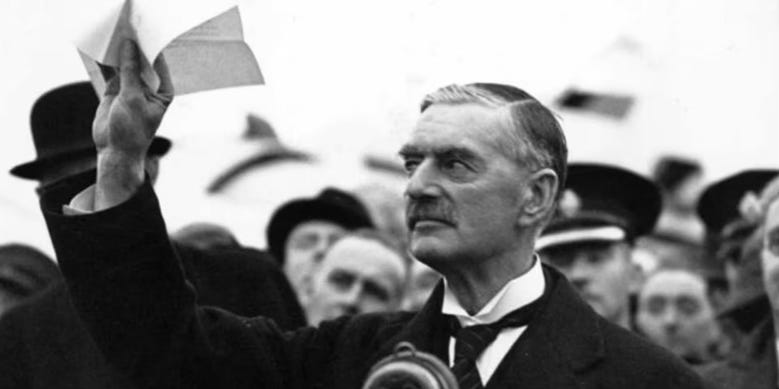
It’s not a pretty picture. Then again, appeasement is like that. Deflection and procrastination are part of our nature as human beings, both individually and collectively. Allies spent two decades appeasing Lenin, Mussolini, Stalin, Hitler and other militarists. We only acted after many countries had gone under the cosh of conquest, or were about to. Only eleven months after Chamberlain returned to London from Munich, Hitler and Stalin formalized their alliance. Nine days after the Molotov-Ribbentrop Pact, Nazi Germany invaded Poland.
Today’s invasions began years ago. But they haven’t yet crossed NATO borders. This is the test for our generation. Will we act in time to prevent a larger war? Will we have the clarity of view and strength of will to throw off this constraining web of appeasement? Let’s see: to find out, we may not have long to wait.
At the end of the tweet quoted above, JD Vance concluded: “Peace won’t be made by failed diplomats or politicians living in a fantasy land. It might be made by smart people living in the real world.”
The truth is the opposite, of course. Trump, Vance and the new appeasers are simply re-hashing the same old fantasies we heard in the 1920s and 1930s — about ‘foreign entanglements’, ‘faraway countries’ and ‘crocodiles that will eat me last.’ By literally ventriloquizing Moscow’s own war aims, this Administration has sunk to new depths. They are now mere merchants of weaponized lies, with plenty of fellow travellers in other countries happy to use American perfidy as cover for ducking difficult decisions. The cost for all of us is already more war. Our challenge now is to move past the agitprop, seemingly compulsive inaction and the appeasers themselves.
I agree with every single word, Chris--and especially agree with the decision to locate the beginning of our moral collapse in Syria. I was in Turkey when the civil war broke out and the refugees began streaming across the border, bringing with them accounts of Assad's industrial-scale torture and murder. I simply couldn't believe it when I realized the United States wasn't going to lift a finger. These days, that wouldn't surprise me: I've adjusted my expectations severely. But then, I still profoundly believed everything we told ourselves about our exceptionalism and our role in maintaining the postwar order--things that were, at that time, still more true than false. We've since degenerated into the outright moral and strategic madness you describe here. But it definitely started in Syria, with that massive moral compromise. Once we decided it wasn't so difficult to avert our eyes to crimes like that, we got a taste for it.
I'd love to cross-post this, if you'd consider taking off the paywall. I completely agree with this assessment--not one word seems to me out place.
Good if discouraging summary.