


Why does Moscow continue to escalate its war against Ukraine and democracy?
It’s not because the Kremlin thinks they’re winning on the battlefield. It’s because Russia’s Chekist dictatorship thinks they’ve made allies incapable of defeating them.
Remember: under Trump, US support for Ukraine dropped to almost zero.
In a recent piece in The Times, Edward Lucas termed the current national mindset in the UK “squishy” on hard issues of strategic policy and collective defence.
A recent poll by Ipsos found 48 percent of Britons would be unwilling to take up arms to defend the UK under any circumstances — a far cry from previous eras.
Lucas puts this down to reluctance to face up to the reality of Russian aggression — assassinations on British soil, acts of sabotage, undersea cable-cutting.
“Our muddle-headedness and timidity stem from years of deceit,” as he puts it.
But cover-ups and official reticence are only part of the problem.
Russia is dominating an unseen front, where democracies have lost the upper hand.
In a statement released on July 4th — the 250th anniversary of the US Declaration of Independence — prime minister Mark Carney quoted the following famous statement from president Franklin D. Roosevelt, which he made in 1936, the same year Nazi Germany hosted both the winter and summer Olympic Games:
“The noblest monument to peace and to neighbourly economic and social friendship in all the world is not a monument in bronze or stone, but the boundary which unites the United States and Canada.”
For most of two centuries, Canada’s undefended border with the US was a testament to the power of vibrant commerce, free politics and military alliance.
Today the principal threat to our ability to act decisively as a sovereign democracy is not from across that border — despite new risks emanating from there.
It comes from the information frontier.
We do not even know, in hard terms, to what extent China, Iran and Russia are dominating and manipulating today’s online platforms.
A recent report entitled ‘Britain Under Strain’ found Russia and Iran to be exploiting divisions to seed extremist narratives, often with devastating consequences.
Twitter/X is known to be a keystone of Russian influence worldwide.
Since 2023, TikTok and other platforms have disseminated Anti-Semitic, Anti-Zionist and Anti-Israeli narratives on an industrial scale, in the most provocative forms.
Such online influence has real-life consequences.
In the UK, no major political party yet endorses rejoining the Common Market or the European Union — even though most Britons now realize Brexit (heavily backed by Russia online) was a mistake.
In the US, the current president — twice elected with Russian help — regularly threatens or sues tech platforms and media that displease him.
In Canada, Alberta separatism has become a ballot question — mostly because MAGA and other Russia-directed online assets gave it a boost.
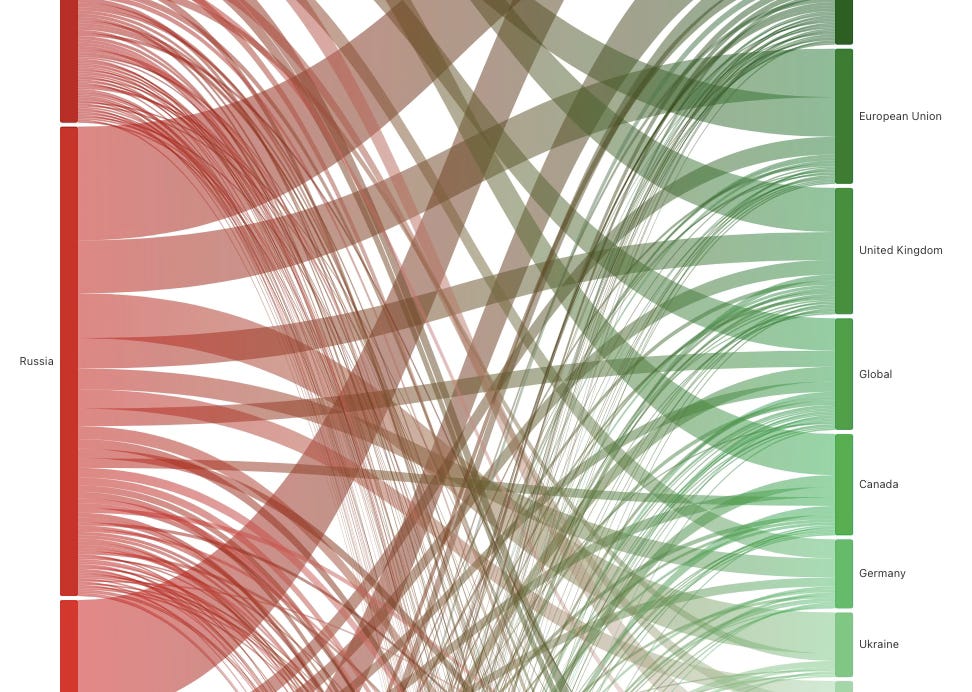
(‘Foreign Interference Incident Flow — Source -> Target’, July 8th 2027 from the Centre for Foreign Interference Research)
As this flow chart shows, Russia devotes massive efforts to so-called ‘active measures’ — complex influence operations that include huge and growing online assets that are agile, focussed and global. China is equally prolific, but its priorities often track Moscow’s. Iran and other hostile autocratic states also dedicate substantive resources to generating online, institutional and political influence. The US, EU, UK and Canada — in that order — remain the top targets for this combined foreign interference onslaught.
Cognitive, information, political and psychological warfare — whichever term you prefer — is not a fringe issue. Democracies lose when citizens no longer find their footing in well-informed, fact-driven, diverse, lively and relevant debate.
Extreme and hateful views introduced by malign actors are subtracting more heavily from this equation today than we realize.
Canadians spend on average about 20-minutes per day with edited journalistic news sources. They spend about two-and-a-half hours on social media.
So long as Russia, Iran and China have decisive influence over the latter (as we know they do), we will be in serious trouble. We’ve effectively out-sourced part of our national conversation to authoritarians.
What are these people really like? On June 15th, Putin advisor Nikolai Patrushev gave a chilling interview entitled ‘When war is on the doorstep’. In it, he tried to draw an improbable and indeed outrageous parallel between the 1941-44 Nazi siege of Leningrad and Ukrainian drone attacks on St. Petersburg refineries today.
His underlying purpose was almost certainly to prepare Russian readers for a potential hybrid attack on the Baltic states — one which may happen as early as this summer and would certainly be blamed by Moscow on Ukraine or NATO in a transparent attempt to divide allies.
Patrushev is deeply deluded, as Putin was before him. But today’s Chekist-dominated Kremlin remains confident Russia will prevail in its aggressive war mainly because it still expects and is making elaborate arrangements to ensure Moscow’s cognitive influence campaigns tip France, Germany, Italy, the UK or other allies into their camp — via Le Pen, the AfD or other like-minded leaders.
We can hope the Kremlin is wrong about this. But many thought Trump could never be re-elected — until he was, with devastating consequences for Ukraine.
Under the influence of the current online ecosystem, with its heavy daily dose of malign foreign influence, “a third of Britons said they believed capitalism had failed and that a ‘communist revolution’ was necessary,” according to the same report.
Russians themselves have bought into even more extreme beliefs.
Here is what Patrushev thinks about Ukraine, victim of the genocidal war of conquest, invasion and occupation that Russia launched in 2014 and enlarged in 2022:
“The majority of Ukrainians do not want to fight and do not view Russia as an adversary, yet they have no say in the matter. Neo-Nazi gangs, sponsored by London and Brussels, keep the population in a state of fear and exercise complete control over Zelensky. In essence, we are currently carrying out a mission in Ukraine to rescue our brothers who have fallen under neo-Nazi occupation. Naturally, the heirs of Goebbels habitually turn everything upside down, spinning tall tales about Moscow supposedly seeking to conquer Ukraine.”
Hitler made similarly unhinged arguments about the countries he invaded. In a full democracy or any reasonably normal country, someone who made such crudely baseless statements would be dismissed as a crackpot.
Even today most Russians — heavily imbued as they are with the toxic influence of ceaseless propaganda — would still have a low level of conviction around the notion that Ukraine is run by ‘neo-Nazi gangs.’
Yet coming from Patrushev, we have to take this official lunacy as what it is — the deeply-held ideology of a very radicalized authoritarian state.
Given this backdrop, gasoline shortages alone are unlikely to divert today’s Kremlin or today’s fascist Russian society and state from the path of aggressive war on which they remain embarked — especially when they fully expect their information war edge to continue to drain allied resolve to oppose them.
Russia will not be defeated so long as its propaganda is silently taking us unawares on this undefended front.
We have not taken strong enough action to support Ukraine because we haven’t told ourselves the full story of what’s happening.
Our democracies are stumbling and even failing on these issues because public opinion remains squishy — sodden under a continuing waterfall of deceit.
In the 1930s we moved to protect information space with public broadcasters, broadcasting acts and strong action against state-backed foreign propaganda.
We need the same level of serious action today — to defend a digital information frontier that is very different but no less important.
Today’s Russia is confident of its online superiority to the point of over-confidence. Patrushev’s interview will have pleased Kremlin zealots but his scrambled fabrications about history and Ukraine are vulnerable to exposure and demolition.
Revealingly, in this long interview Patrushev did not once mention his career-long comrade Russian president Putin — whom he has effectively succeeded for now as top dog in the shrinking but still shadowy corrupt circle that runs Russia.
To take this sputtering crew out for good, we need to make the information front work for democracy once again — preferably quickly.
I had no idea about how active Russia was on the propaganda front until I read this series:
https://olgalautman.substack.com/s/active-measures-series
Many things clicked into place: why I was seeing certain bizarre ideas over and over.
Olga is great!