


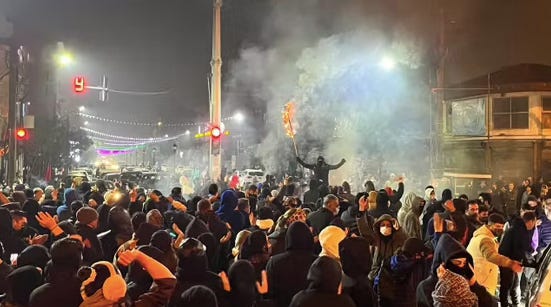
(Protesters in Bandar-e-Anzali, northern Iran, on January 8th, 2026)
For nineteen days starting on December 28th, 2025, Iran was in the grip of massive anti-regime protests. This was a genuine, large-scale uprising against an abhorrent ayatollah-led autocracy that sponsors proxy war and terrorism on a massive scale and retains ambitions to develop nuclear weapons.
Yet these protests were put down in a brutal wave of state-backed repression. No ally took decisive action to prevent this horrendous crackdown. In fact, as our June 18th, 2025 essay on ‘Dealing with Iran’ pointed out, the only country that has recently taken effective steps to curb the threats represented by Iran has been Israel.
The US claims to be pursuing a policy of ‘maximum pressure’. But recent US-Iranian talks in Geneva are aiming only for a deal on Iran’s nuclear programme — repeating the strategic mistakes of the 2015 Joint and Comprehensive Plan of Action (JCPOA), or ‘Iran nuclear deal’, which lifted many sanctions and partially normalized relations with Iran, while doing nothing to curb Iran’s aggression across a wide region.
Iran has been seeking nuclear weapons since at least 1998, when Pakistan tested its first nuclear device. Iran has been funding terrorist and other proxies in Iran, Lebanon, Gaza and other countries on a large scale since 2002-04, when it launched its so-called ‘axis of resistance’ in response to Bush’s ‘axis of evil’.
Iran was buoyed by the early success of Shia militias in Iraq, who began to inflict devastating losses on US and other forces following their 2003 invasion.
When allies failed to intervene to stop Assad’s post-2011 genocide against the Syrian people, Iran expanded support for Shia militias, terrorist proxies and armed groups across Syria, Lebanon and Yemen. It scaled up support for Hamas in Gaza.
When the 2015 JCPOA relaxed the UN-brokered sanctions regime against Iran, Tehran had new resources with which to fund regional aggression.
Iran’s oil exports fell sharply when the US withdrew from the JPOA in 2019 but have risen sharply since 2020, returning to three-quarters of their 2000-11 levels, when Iran’s nuclear ambitions and support for terrorism went unaddressed.
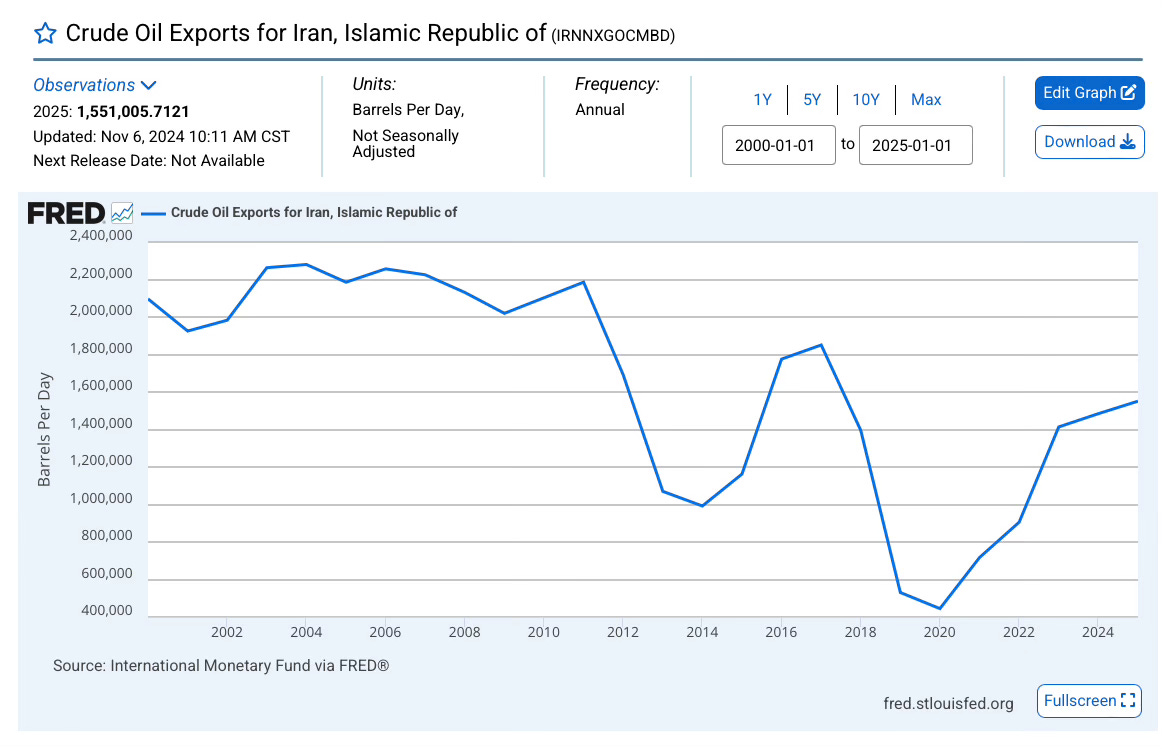
Most of Iran’s oil exports today go to China. Since 2020, little has been done to disrupt this sanction-busting. Like the Russian shadow tanker fleet, Iran uses black-market channels and other evasive techniques. As with Russia, interdiction has been spotty and ineffective. Even after UN snapback sanctions and tougher US action, Iran continued to export 1.5 to 1.6 million barrels per day in January 2026.
