


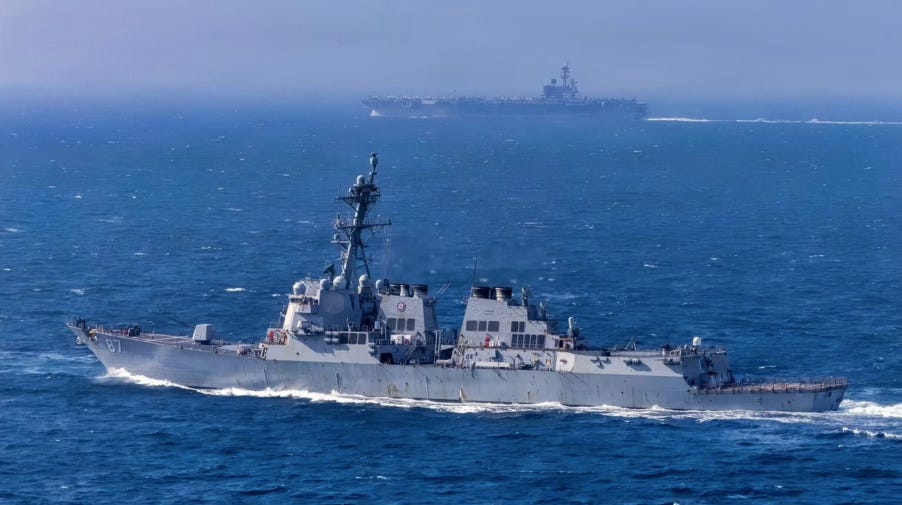
(Arleigh Burke-class guided-missile destroyer USS Mason (DDG 87) alongside Nimitz-class aircraft carrier USS George H.W. Bush in the Atlantic, Feb. 21, 2026. [U.S. Navy photo by Mass Communication Specialist 2nd Class Jayden Brown])
(Continued from a previous essay, published earlier today)
Moscow is hoping this new phase of war against Iran redirects allied attention away from Ukraine even further. While attacking Iran, the US continues to be unbelievably soft on Russia, which remains Iran’s principal defence partner. Washington is still trying to impose territorial concessions on Kyiv, as our essay (‘Withstanding Pressure’) noted on the eve of the first joint US/Israeli strikes.
By cutting off military support for Ukraine and blocking Ukraine’s use of confiscated Russian assets, Washington is in effect helping Russia wage its war against Ukraine — ignoring the reality that this theatre of war turned Iranian drones into a global threat that is now hitting US allies across the Gulf.
By neglecting Russia’s intimate ties with Iran — which run from defence and intelligence-sharing to nuclear energy and support for terrorism — the Trump Administration is undermining prospects for democratic regime change in Tehran. The Trump Administration says its military operations against Iran will be disruptive for China, but makes no mention of the 20-year Comprehensive Security Partnership Treaty that Moscow signed with Tehran only last year.
By remaining indifferent to Moscow’s wide-ranging ties with Iran and enabling Russian aggression against Ukraine, Washington is also downplaying international law — a framework the US and its allies fought two world wars to establish. As Italian prime minister Giorgia Meloni put it: “A crisis in international law is inevitably the result of the war in Ukraine. When a member of the UN Security Council deliberately attacked its neighbor, it was inevitable that it would lead to a season of chaos.”
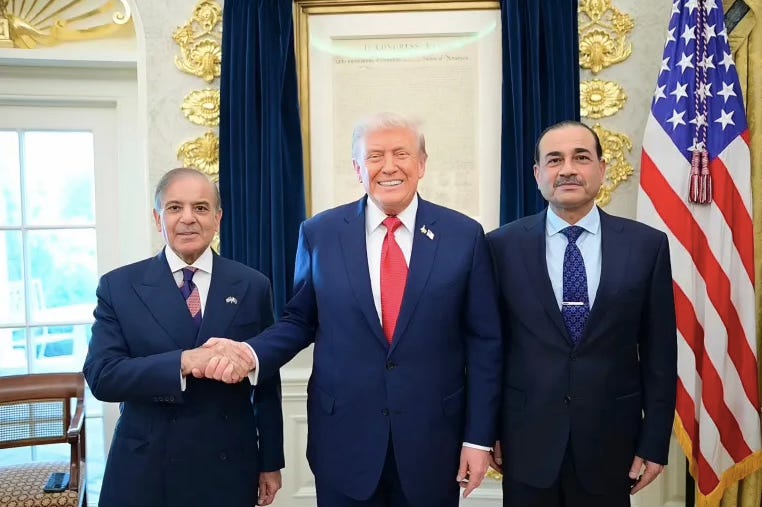
(Trump at the White House in September with Pakistani prime minister Shehbaz Shari [on the left] and field marshal Asim Munir [on the right], who is also Pakistan’s chief of the army staff. [Handout/Government of Pakistan])
The Trump Administration also seems indifferent to the longstanding solidarity among jihadist regimes in Afghanistan, Iran and Pakistan. In fact, Trump’s 2020 deal with the Taliban was instrumental in returning terrorists to power in Kabul. Pakistan’s current chief of the army staff, field marshal Asim Munir, has reportedly visited the White House four times since June 2025, becoming perhaps the most unexpected and improbable of Trump’s new chums.
