


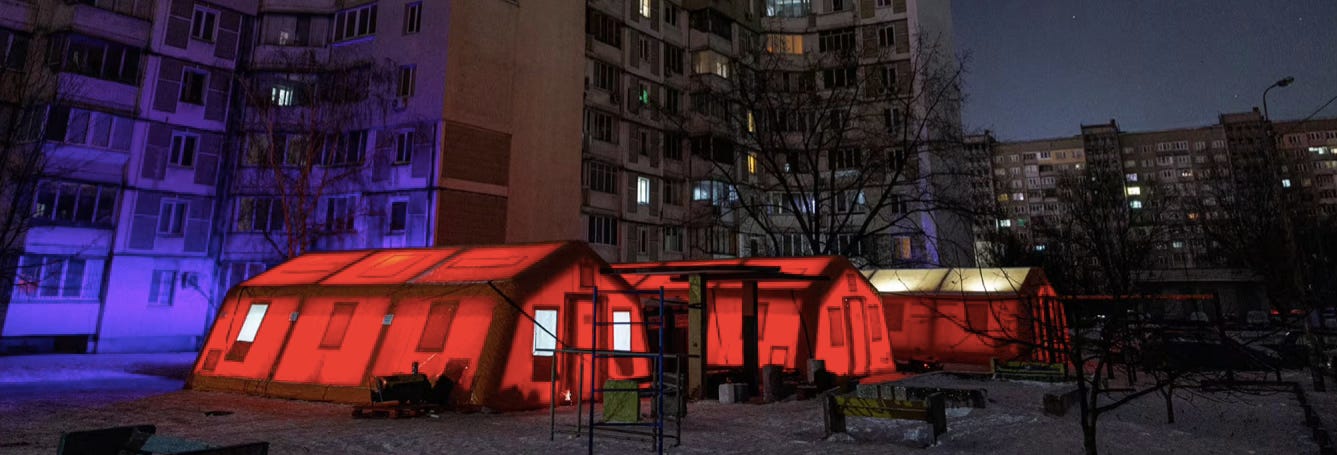
(Warming centres in Kyiv this week. [Valentyn Ogirenko/Reuters])
Amid all the recent reporting on Greenland, Iran and Venezuela – where the outcome still hangs in the balance – as well as one the future of democracy in America, one great drama is still playing out that will shape our present and future in profound ways. The fate of Ukraine is not just another war – a sign of the return of great power, might-is-right politics. It is a barometer for freedom’s prospects in this digital age.
First, let’s recall the scale of this conflict. In just four years, Russia has lost around one and a half million men. Most have been killed on the battlefield. No European state has squandered so many lives in conflict since 1945. In the case of fascist Russia, they have been sent to their deaths in a losing cause: far from taking Kyiv and destroying Ukrainian statehood, as Putin had aimed to do, Moscow has still not even managed to occupy a single entire Ukrainian oblast.
To be clear, Ukraine has 24 oblasts, plus the Republic of Crimea, now entirely occupied by Russia. It also has two cities with separate administrative status – Kyiv and Sevastopol. The latter is also temporarily occupied by Russia.
The second key point to recall is how inadequate, in the circumstances, allied support for Ukraine has been. Our governments have still not recovered from the defeatism of 2021 and early 2022; from self-deterrence under Biden from 2022 to 2024; or from Republican moves to spike US military support for Ukraine partly in late 2023 and fully under Trump starting in February 2025. Of course, European allies, Canada, the UK, Japan, Korea and others have been staying the course on military support – even continuing to scale up their commitments to compensate for US wobbles and outright abandonment of Ukraine.
But we have not done nearly enough.
As we have argued in previous essays, no ally has yet publicly advocated levels of support for Ukraine that would constitute normal conventional war-fighting. Let’s be honest: allied support for Ukraine has never aimed for victory. It has been calibrated to ensure Ukraine does not lose. The NATO mission in Afghanistan had air power, naval power in the Persian Gulf, full on-the-ground training programmes for the Afghan national army and police. In Ukraine, we had training missions for the Ukrainian army up to early 2022, but the US, UK and Canada – the first country to deploy in 2015 – left before the full invasion and have not returned.
Why?
In a recent edition of the Financial Times, US-Europe foreign affairs correspondent Amy Mackinnon put this question to William Burns, who was CIA director under Biden.
“America’s warnings about Putin’s plans” – she writes – “proved to be startlingly right. Their expectation that the Russians would rapidly overwhelm Ukraine was not. Why was the US so off-base about how the war would unfold?”
“’We expected them to be much more effective,’ [Burns] says of Putin’s army.”
There it is. Allies withdrew their training missions and denied Ukraine much-needed military support because, led by the US, they expected Ukraine to lose.
To Burns’ credit, the CIA remained in the country, as the same article makes clear. But US and other allied support for Ukraine since they turned the Russian tide in early 2022 has remained stingy, at best. Ukraine continues to face heavy aerial bombardment, almost every night, forcing Kyiv and other cities to brave frigid temperatures without light or heat.
After Ukraine defied CIA and broader allied expectations of a rapid defeat in the first half of 2022, why did we not step up to provide air and naval power, and a land force large and potent enough to roll back and destroy Russia’s occupying army completely?
The answer is deceptively simple. For the first year, Moscow played on Biden’s fear of nuclear war to ensure he would not deploy key capabilities, including air power. For the second year, they used a Republican Congress to undermine lend-lease and US military support for Ukraine more generally. Since the start of 2025, Moscow has had an ally in Trump. Yet instead of rushing to provide unlimited military support for Ukraine – to deliver the capabilities Biden and Trump failed to deliver – allies have spent a year waiting for Trump to deliver ‘peace’.
In other words, we withdrew our military support for a democratic ally in early 2022 because we believed they would lose. Then we spent two years fearing tactical nuclear strikes by Russia and fretting over Russian influence over congressional Republicans. For eleven months, allies have been hoping Trump – a Russian asset – will deliver a workable ‘peace deal’ that ends Russian aggression and safeguards Ukrainian sovereignty.
At every major turn, we have made the wrong assessment about this war.
In 2022, we believed Ukraine would lose.
In 2023, we feared Russia would take the suicidal decision to use tactical nuclear weapons if western main battle tanks or fighter jets were deployed.
In 2025, we held our breath in the hope that Trump would deliver a ceasefire.
In the meantime, the war has taken its own course.
In strategic terms, Ukraine has already won.
They defended their capital and sovereignty. They took back most of Kherson oblast and, for a significant period, occupied parts of Kursk and Belgorod in Russia. They have disabled Russia’s Black Sea Fleet. They are pummeling Russian refineries and shadow tankers. As a result of the Ukrainian drone threat, Moscow airports have been operating intermittently at best.
With Trump as their proxy, Moscow expected Ukraine to be compelled to give up territory and Europe, the UK, Canada and others to live sanctions.
This is not happening.
So as Russia continues to fight, its economic prospects darken further. Even if its demands had been fulfilled, Russia was almost certainly planning to continue its aggression.
For Kremlin fascists, Trump has never been a potential peace-maker. They see him as a lever to be exploited to achieve their war aims, which remain centred on destroying Ukraine.
Why have we – even for a second – self-deterred, acquiesced in Russian escalation, believed their nuclear blackmail or pinned hopes on fake diplomacy?
Much of the answer to this lies in the continuing influence of Russian disinformation and active measures, which hit us from all angles – on social media platforms, via amplified proxies, through cultivated extremist voices. This steady barrage limits the scope for action by our leaders, as well as the space for genuine deliberation from which good policies emerge.
In other words, we have mostly missed our cues – so far.
This is not to dismiss what the coalition of the willing has done over the past year or what the US did before 2025 – and continues to do on a much-reduced scale.
But we have so far failed to our full weight into the balance of history, when it would count for so much by delivering a decisive result. As should be blindingly obvious to any well-informed citizen, this war is not like Afghanistan or Iraq. The first was a military mission in collective self-defence of the United States, which succeeded for twenty years but was abandoned by Trump and Biden because no ally had the stomach or political will to end Pakistan’s three-decade-long state sponsorship of the Taliban and Al Qaida. Iraq was a misguided misadventure, like Vietnam on a much larger scale before it.
The only postwar conflict that is remotely analogous with Russia’s failed attempt to conquer Ukraine in 2022 is the 1950-53 Korean war. But that conflict was essentially a continuation of the Second World War, with Communist-led China seeking to settle scores after decades of Japanese militarism on the continent.
Russia’s war of aggression in Ukraine, which began in 2014 and became a full-spectrum, high-intensity conventional war in 2022, is something altogether different.
It is a Ukrainian war of independence and liberation.
It is a campaign of heroic self-defence to end three-and-a-half centuries of Russian domination, occupation and repression extending back as least as far as the Pereyaslav agreement – Переяславська рада in Ukrainian – which led to the Pereyaslav treaty, also known as the March Articles, which were signed by the Zaporizhian Cossacks under Hetman Bohdan Khmelnytsky in 1654.
As Kremlin propaganda and Putin’s infamous debasement of the historical record have made clear, Russian fascists believe 1654 was the year that Russians and Ukrainians became ‘one people’ – that Ukraine as a culture, language and state ceased to exist.
They have used this chauvinistic and genocidal article of faith to justify violence against their principal neighbours in Europe ever since.
They eagerly partitioned Poland with other European powers in the eighteenth century in the hope that neither Poland nor Ukraine would ever again have an independent existence.
Throughout the nineteenth and most of the twentieth centuries, the frustration of Polish and Ukrainian national aspirations was the leitmotif of Russian foreign policy.
After the revolution, Poland regained its independence, while Belarus and Ukraine saw theirs extinguished. In 1939, Stalin allied with Hitler to see Polish independence once again crushed and Polish territory carved up. In 2022, Putin, Patrushev, Kovalchuk and their retinues of brain-washed, hollow nihilists believed they would do once again to Ukraine what Hitler and Stalin had done to Poland in 1939. How wrong they were. The only part of this war they have won, so far, has been the battle to prevent allies from providing the military support Ukraine needs to finish the job by liberating its entire territory.
This war is about a free Ukraine. It is also about opening a new era of freedom for dozens of countries across Europe, the Caucasus, Central Asia, the Middle East, Africa and Latin America whose national aspirations have been thwarted by Russia’s revanchism, its aggression, its subversion and its other active measures.
From Belarus to Georgia, from Iran to Venezuela, people are looking to Ukraine for the signal that they too will soon be free. We owe it to Ukrainians, to history and to ourselves to put our weight fully into the balance on the side of defending independence and sovereignty aagainst brutal aggression.
Good summary, but several typos.