


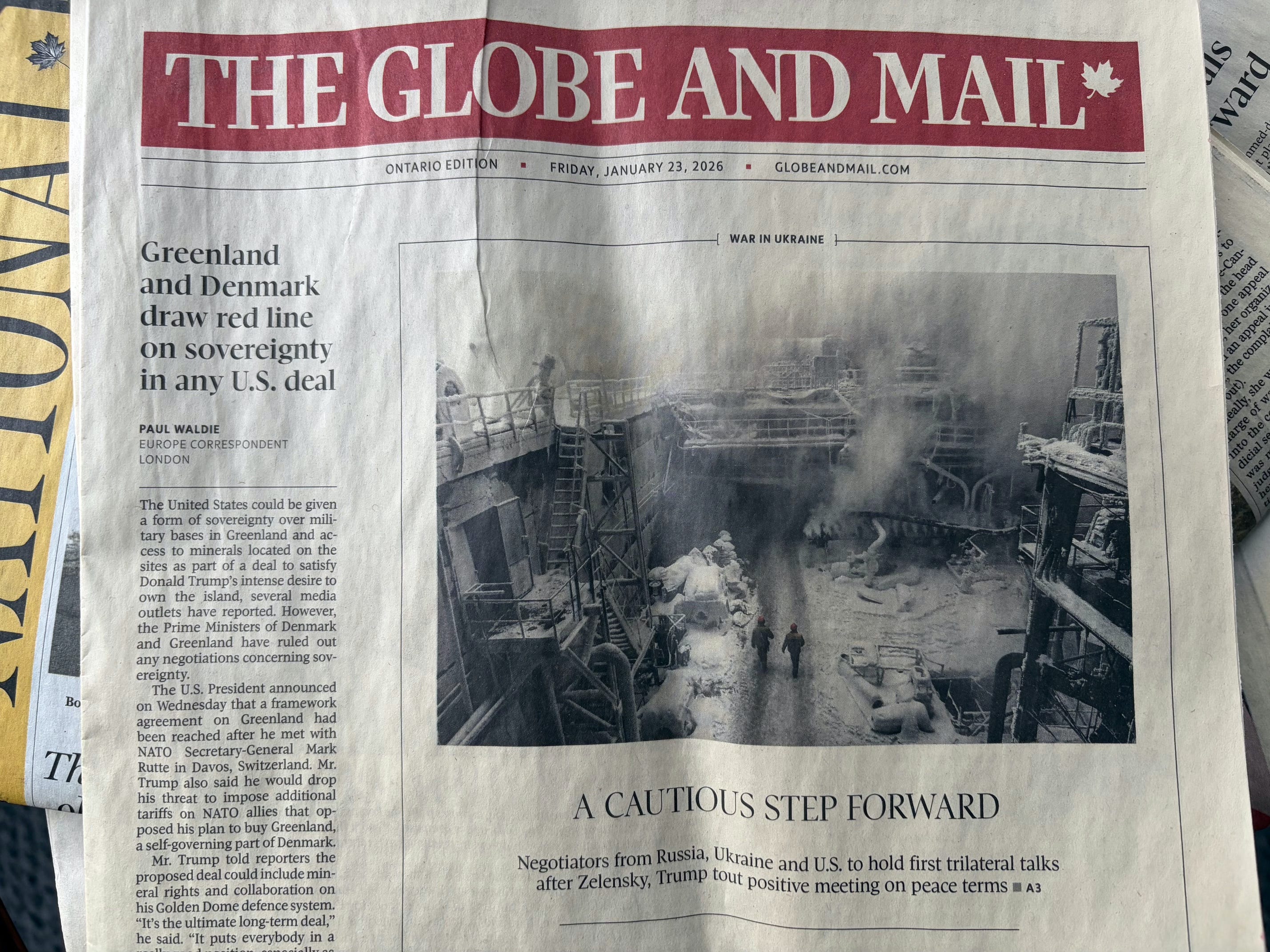
(Front page of the Toronto Globe & Mail on January 23rd, 2026)
Don’t believe the headlines — at least not the one about ‘trilateral talks’ to hammer out ‘peace terms’. The reality is that Ukraine is under immense pressure to accept a total Russian occupation of Donbas. Allies are under pressure from populists, often supported by Russia, who prioritize domestic needs over foreign commitments.
This pressure is first and foremost military. Russian bombs pummel Ukrainian civilians and energy infrastructure almost every night, making this the most miserable winter in living memory. Russia’s hybrid campaign of deniable sabotage, cable-cutting, killings, cyberattacks and fear is at full throttle in Europe and beyond.
Moscow’s goal is twofold: damage Ukraine’s resolve to fight; and push Europeans to keep weapons at home, not send them to Ukraine.
This pressure also comes in toxic political form. Around the EU table, Hungary and Slovakia speak for Russia. Meloni, Starmer, Macron, Merz and others privately fret about Russia-aligned parties that compete with them in elections.
At the NATO table, Hungary and Slovakia are joined by the US, whose current administration slavishly and unapologetically parrots Russian propaganda. By blocking use of confiscated Russian assets or ‘bone-crushing’ congressional sanctions, Trump and his team have become Moscow’s principal battering rams.
Yet this pressure has failed. Ukraine fights on, regaining 300 square kilometres of territory in recent weeks in one of its most effective counter-offensives of the war. With external military support totalling €34 billion in 2022 and nearly €39 billion in each of 2023 and 2024, Trump’s 99 percent cut was a strategic gut punch. Yet others rallied, providing €32.4 billion in military aid for Ukraine in 2025.
To achieve this, European countries collectively raised military support for Ukraine by 67 percent over the average of previous years. The three largest Scandinavian countries (Sweden, Denmark and Norway) collected provided about €10 billion. Germany contributed €9 billion; the UK allocated €5.4 billion. Even Canada, previously a laggard averaging only €1 billion in annual military assistance prior to 2025, boosted its contribution by 180 percent to €2.8 billion — though the Kiel Institute still wonders whether this was all military spending.
This has helped Ukraine withstand a year of unprecedented pressure. It has not yet protected Ukrainian airspace, interdicted the shadow tanker fleet, or hit Russian launch sites or drone factories with heavy strikes.
Withstanding pressure does not win wars. It lengthens and perpetuates them. Our military support for Ukraine so far has been a remarkably small price to pay for preserving the principles of collective self-defence, international law, self-determination, sovereignty and territorial integrity that have kept democracies safe since 1945. Victory would be priceless.
In the end, peace will only come to Ukraine when all Russian forces leave every inch of Ukraine’s territory, including Crimea and the areas of six oblasts they still occupy. The document Moscow and Trump are trying to impose on Kyiv will not bring stability — only, at best, a pause in hostilities. As Ukrainian president Zelenskyy said in a recent interview: “We don’t need a pause. We need the end of the war.”
How does this war end?
