


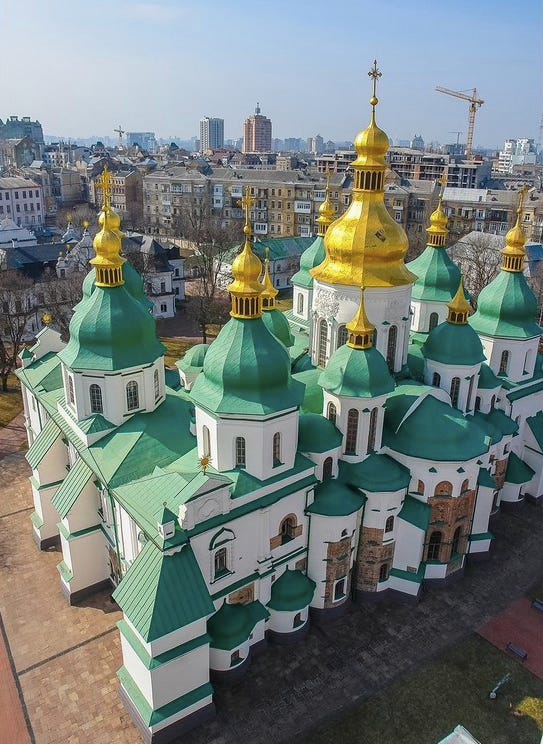
(St. Sophia Cathedral in Kyiv built in 1011)
For Moscow, lies are weapons of war.
For several years after 2014, Russia pretended it was not invading Ukraine. In 2022 feeble fibs about NATO and ‘Ukrainian Nazis’ presaged a larger onslaught.
Only a dwindling number of people — including Bulgaria’s next prime minister — still believe such fabrications. They aim to deflect, distract and exhaust.
The reality is that the Russian empire conquered territories now constituting Ukraine starting in the mid-seventeenth century. By the time of the third partition of Poland in 1795, Moscow had absorbed left- and right-bank Ukraine (including the Cossack Hetmanate), Volhynia, Crimea and southern coastal areas. Only Eastern Galicia, Bukovina and Transcarpathia remained under Austrian control.
Even under Russian and Austrian suzerainty, Ukrainian, Crimean, Polish, Galician, Ruthenian, Jewish, Belarusian, Greek, Romanian, Cossack, Transcarpathian Hungarian and other identities still flourished. But sovereign control of Ukraine lay mostly in Moscow and, after 1712, in St. Petersburg.
After 1815, Russia’s tsar became king of Congress Poland.
Ukrainians, Poles, Belarusians and others rose up against Moscow at regular intervals over two centuries of domination.
In 1917, Ukrainians proclaimed an independent republic. In 1991, they regained full independence, which they have been defending ever since.
Moscow is embarrassed by this tortured history. So they try to re-write it. In July 2021 — less than a year before the full-scale invasion — Putin published a pseudo-intellectual ‘article’ on “the historical unity of Russians and Ukrainians.”
This fascist manifesto was meant to cloak his obsession with reconquering Ukraine in a veneer of historical respectability. As with all tracts by autocrats bent on retaking lost territories by force, it is a load of cliché-ridden, propagandistic palaver.
Its vacuousness also explains why Ukraine is winning. Putin claims Ukraine is predestined by culture, ethnicity, language and religion to be subordinate to Russia. He ascribes all moments of Ukrainian autonomy to foreign hands — Europeans (usually Poles, Lithuanians or Germans), or after 1991, Americans.
These claims are just another deceitful confection.
They are anchored in one central assertion, which has a very long provenance. As the Kremlin ‘article’ puts it: “Russians, Ukrainians, and Belarusians are all descendants of Ancient Rus, which was the largest state in Europe.”
So what was ‘Rus’ — or Київська Русь in Ukrainian?
It was a principality founded by Norse/‘Varangian’ traders from what is today Sweden who settled at Novgorod before making Kyiv their capital around 882.
Under Grand Prince Sviatoslav, Kyivan Rus conquered the Khazar Khaganate, whose rulers were Jewish with a capital near Astrakhan, around 965.
Under Grand Prince Yaroslav the Wise (978-1054), who ruled for 35 years, Kyivan Rus had a claim to be Europe’s largest state.
Kyiv was one of Europe’s largest cities. Yaroslav’s daughters married kings of Norway/England, Hungary and France. Over two centuries, members of the Rurikid clan entered over 60 marriages with European royal households.
Agatha, another daughter of Yaroslav, probably married an exiled member of the English royal house of Wessex in Hungary. She became the mother of Saint Margaret of Scotland — ancestor to every subsequent Scottish monarch save one.
These ties are detailed in ‘The Ruling Families of Rus’ – a 2023 book by Christian Raffensperger and Donald Ostrowski. It builds on a 2013 work by Raffensperger — ‘Reimagining Europe: Kievan Rus’ in the Medieval World, 988-1146’.
For obvious reasons, today’s Kremlin fascists have a hard time accepting that Kyivan Rus became a major European power before Moscow was even founded. In 880, ‘Rus’ was a group of Norse warriors; by Yaroslav’s time, it was a Slavified state — decades before Moscow was hewn out of the boggy forest.
In Kyivan Rus, Moscow had no role. Less than a century after Moscow’s founding, it was sacked by the Golden Horde — as were cities like Vladimir and Kyiv itself.
Kyiv regained its freedom relatively quickly, when Grand Duke Algirdas of Lithuania defeated a Tatar force in 1362-63.
Moscow continued to pay tribute to the Mongol state until 1476 and faced down Tatar military power in 1480 under Ivan III. Even then, Crimean Tatar khans sacked Moscow again in 1521 and 1571. In the sixteenth century, six other major attempts were made to take Moscow and four more in the seventeenth century.
Moscow only started to become a force in European history after the Golden Horde and the Crimean Tatar Khanate had been defeated.
Moscow launched its conquest of Siberia in the 1580s; by 1598, it controlled most of western Siberia. By the 1630s it had reached Yakutia and the Pacific.
These conquests are memorialized in the St. George’s Hall of the Great Kremlin Palace. Some territories were lost in 1917 but — by allying with Hitler and steam-rolling Churchill and Roosevelt — Stalin expanded Soviet territory.
When the USSR fell apart, and Ukraine, Belarus and other states resumed their independence, many in Moscow expected another restoration to follow in due course within the framework of the Commonwealth of Independent States (CIS).
When this did not happen, Moscow used Chernomyrdin to turn economic screws. When Ukraine still chose Europe in 2004-05, Moscow fed oligarch-led corruption, eventually installing their placeman Yanukovych in 2010.
When Yanukovych tried to eviscerate Ukraine’s cooperation with Europe in 2013, he was ousted. Moscow invaded in 2014 and again in 2022.
Only a hardened ideologue could still see ‘historical unity’ between invading Russians and the Ukrainians who have been defeating them at such great cost.
In fact, Moscow is not an heir to Kyivan Rus but rather to the Golden Horde. Moscow’s military success under Ivan III came with — in the words of the great British medievalist John Fennell — “cultural depression and spiritual barrenness. Freedom was stamped out within the Russian lands. By his bigoted anti-Catholicism Ivan brought down the curtain between Russia and the west.”
Towards the end of the 360-year era of Kyivan Rus, Galicia-Volhynia in the west and Vladimir-Suzdal in the east vied for influence, as did Chernihiv and Smolensk.
Moscow was not a factor. Free Kyiv joined the grand duchy of Lithuania. When Crimeans sacked Moscow, Kyiv was in the Lithuanian-Polish Commonwealth.
Yet when Ivan IV made himself tsar in 1547 and Peter the Great emperor in 1712, they claimed to rule “all Russia” or “all the Russias.”
The very word ‘Russia’ implied Moscow and Kyiv were one, as Putin absurdly argued. This claim to the Kyivan Rus legacy is both retrospective and fraudulent.
They are not one. British monarchs may have a stronger claim to be kings of France.
Moscow’s only path to Kyiv is invasion and violent irredentism. National freedom, self-determination and the rule of law are with Ukraine and Kyivan Rus.
To defeat Moscow’s aggression, Ukraine needs more support, as a decorated Canadian army officer has argued today. It should have been invited to join NATO years ago.
We need to see Kyivan Rus as a European and Ukrainian story — one that has often required defending against invaders from the east.
What a wonderful tour de force on the history of Kingdom of Kiev and Ukraine Chris. As Scandinavian it is very special to travel back to the time where Scandinavian long ships ruled the waves and the rivers of what is now Russia all the way to Constantinople now Istanbul. We claim that the Vikings founded Kiev.