


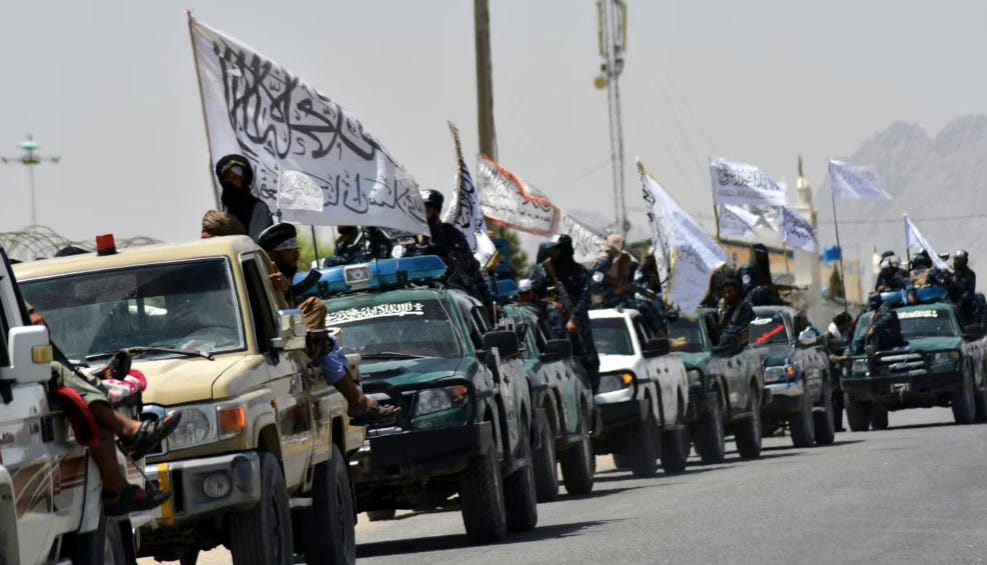
(Taliban fighters in Kandahar, September 1st, 2021/AFP)
Tomorrow it will have been five years since Pakistan launched the final phase of its campaign to reconquer Afghanistan.
They did not carry out this campaign with regular forces. They did it with deniable, irregular troops belonging to listed terrorist groups.
The Pakistani army is organized into nine corps — five of which are based in Punjab, facing India. I Corps is in the northern areas of Kashmir, which have been occupied by Pakistan since partition. V Corps is based in Sindh.
XI Corps is based in Peshawar in Khyber Pakhtunkhwa province, facing Afghanistan. XII Corps is in Quetta, Baluchistan, also facing Afghanistan.
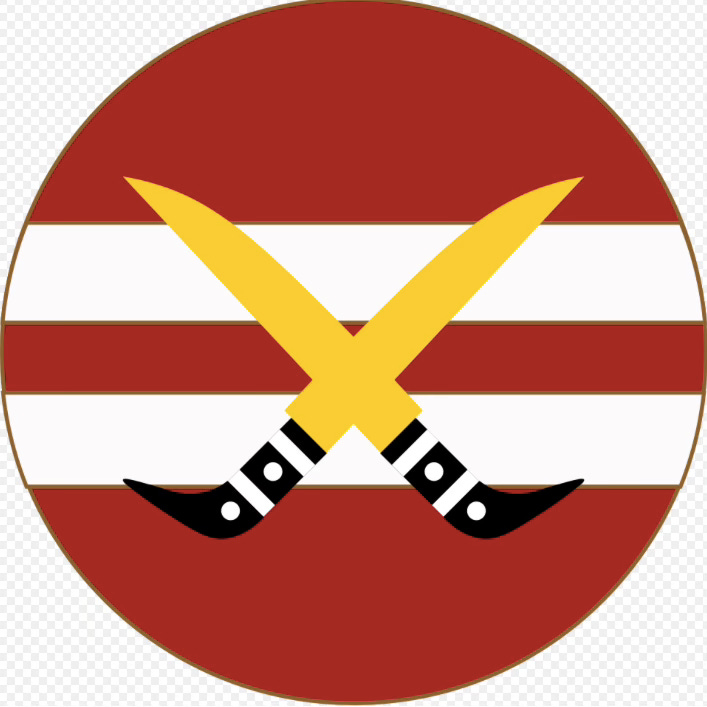
(The badge of Pakistan’s XII corps, based in Quetta)
But there is another silent, unacknowledged corps. It does not wear a uniforms. It wears shalwar kameez. It carries a mixed bag of weaponry. It is not in the formal chain of command. It includes the Taliban and other terrorist groups.
These unacknowledged units report through Directorate S of the Inter Services Intelligence (ISI), Pakistan’s hydra-headed equivalent of the the Soviet Union’s KGB, to the chief of the army staff (COAS).
They are the covert action arm of Pakistan’s armed forces, supporting terrorist proxies engaged in continuous combat, subversive and terrorist activities in Afghanistan, Kashmir, India, elsewhere in South Asia, the Middle East and around the world.
Five years ago this week, these assets were poised to begin their march on Kabul, violating almost every major term of a disastrous UN-supervised agreement the Taliban had signed with the Trump administration in 2020.
We should not have been surprised that this was happening. We were told at the time what was about to happen by the architect of strategic depth, Pakistan’s policy of large-scale support for terrorist proxies in Afghanistan and elsewhere to compensate for a brutal defeat by India in what is now Bangladesh in 1971.
These are the words General (r) Mirza Aslam Beg wrote in a column in The Nation, a Pakistani daily, on April 20th, 2021:
“If the foreign troops do not leave by May 1, 2021, the Taliban in any case, would launch an all out offensive to consolidate their hold over the held territories, forcing the Afghan government under siege, in towns and cities.”
And so they did, with their Pakistani sponsors (who go unmentioned by Mirza, but are very much implied in everything he writes) in full support. On May 1st, 2021 the Taliban, Haqqani network and other groups backed by Pakistan’s army controlled much of Afghanistan’s rural hinterland. But the cities were still under the formal control of Afghan government forces numbering in the hundreds of thousands. As late as February 2021, over 9,500 NATO troops remained in the country. Afghanistan had and still has 34 provinces: as late as the end of July 2021, not a single provincial capital had fallen to the Taliban or other proxies of Pakistan’s Directorate S.
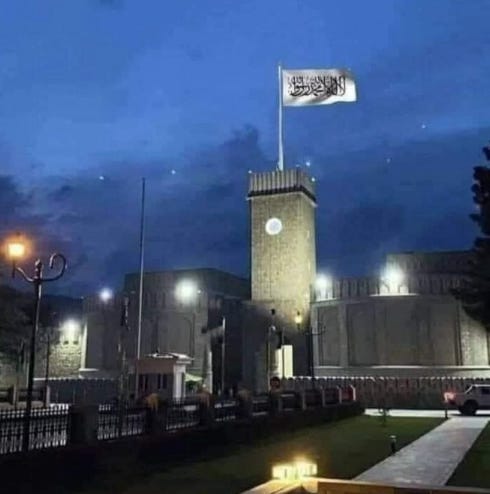
(The Taliban flag over Kabul’s presidential palace, August 15th, 2021)
Then on August 6th Zaranj in Nimroz fell. By August 12th-13th, the Taliban were in Kandahar. On August 15th, Kabul fell to the Taliban.
On September 4th, the director general of ISI Lt. Gen Faiz Hameed — who was responsible for Directorate S and the operation as a whole — visited Kabul where he took tea in the Serena Hotel and assured the world that ‘everything would be fine’.
Why did Pakistan and its proxies succeed? Because the US was cutting off air and logistical support to Afghanistan’s national security forces. Because policy-makers in Washington and chanceries around the world stubbornly believed that a moderate Taliban would emerge, ready to engage in power-sharing with Afghanistan’s legitimate government — a legacy of twenty years of regular voting and a parliament whose lower house was over one-quarter female. Because there was no strong political pressure in Europe, North America or anywhere on governments to change course or take a strong stand against these trends. Because, to be brutally honest, allied political leadership and public support for Afghanistan and for using armed force to defend political freedoms and basic human dignity had evaporated.
The result is that, as we noted in a previous essay, we lost. Allies lost. The US lost. NATO lost. Afghans lost — almost overnight — the fragile gains of two decades.
The result has been a series of denials. The US Special Inspector General for Afghanistan Reconstruction alleged in November 2023 that the Taliban were diverting large amounts of US humanitarian funding, as well as military equipment left behind by US forces, to support their regime, including its violent reprisals against members of the previous government.
There are persistent rumours of a secret US deal with Taliban by which Washington continues to make payments to them in return for assurances that Afghanistan will not be used as a training ground for international terrorism and that groups associated with the Taliban will not target US assets or personnel.
Given that Al Qaida’s current leadership has been inviting terrorists from around the world to train in Afghanistan, any confidential assurances given in 2020-21 would appear to have been as worthless as the paper on which they were written — like the US-Taliban agreement itself, which both Pakistan and the Taliban shredded.
None of this has prevented Trump from becoming a ‘pal’ of Pakistan’s current COAS, himself a former DG ISI for a previous phase of Taliban recovery.
Of course, to keep up appearances Pakistan has court-martialled Faiz Hameed and given him a stiff prison sentence, ostensibly for helping Imran Khan. General Bajwa, COAS as the Taliban returned to power, is apparently in poor health. The new regime is playing up the threat to Pakistan from the Taliban, TTP, ISIS in Khorasan and other terrorist groups based in Afghanistan — as if Pakistan had had nothing to do with their genesis or with sixty years of terrorist sponsorship across the region.
The Taliban regime in Kabul remains Pakistan’s proxy – just as or even more so than Assad, Hezbollah, Shia militias in Iraq, the Houthis and Hamas have been Iran’s proxies in the axis of resistance for over two decades.
