


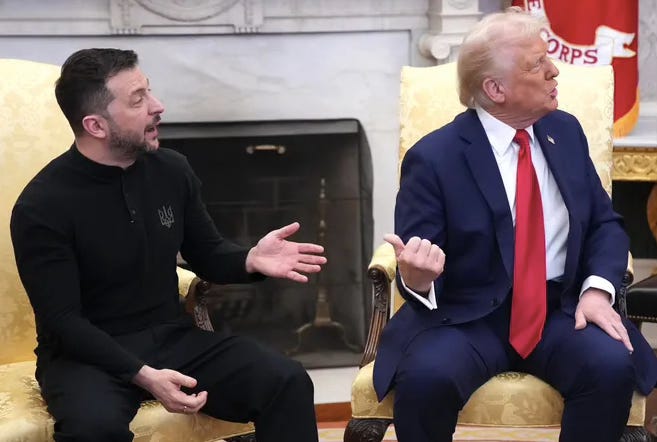
(Zelenskyy and Trump in the Oval, February 28th, 2025 [Andrew Harnik/Getty Images])
Our first essay appeared the day Ukrainian president Zelenskyy upset Trump and Vance by speaking the truth in the Oval Office. Since February 28th, 2025, we have have published 122 essays, managing a pace of nearly one every three days — or between two and three per week, which had been our goal.
This note is to thank you all, our readers and subscribers: we are grateful.
The Diehard Optimist has covered a wide range of topics, with several recurring themes. Thirty essays have tackled Canadian subjects, including a ten-part series on foreign interference in our 2025 federal elections. Twenty focussed on Ukraine, twenty-two on Russia and thirteen on Trump’s United States. We have declared the Putin era over; found new meaning in George Grant’s Lament for a Nation 60 years’ later; pushed for the coalition of the willing to become a coalition for victory in Ukraine; and profiled the Kremlin’s Chekist masters.
A seven-part series on how the Cold War ended touched on Ukraine, the US, Canadian indigenous history and of course the demise of the Soviet Union. Unlike most histories, we concluded the Cold War was winding down over 1965-75 and had ended by the time Soviet military advisors were deploying en masse to Angola. Moscow has been engaged in large-scale, hot irregular warfare, massive influence operations and other active measures against NATO allies ever since. It is vital not to conflate the dissolution of the USSR and Warsaw Pact with the end of Russia’s active forever war, which they continue to wage at full tilt.
We have also tackled issues from Libya, Greenland and Moldova to Afghanistan and China’s balance of trade. Our objective is not to compete with headlines you read every day, but rather to take a step back from the news cycle — to provide deeper insights that put today’s conflicts, the fortunes of our democratic institutions and the policy choices that will make or break our futures into broader context.
Many platforms today are brimming with quality material. Our goal is to provide analysis and commentary you will not find anywhere else. Democracy, free speech and the peace we once took for granted are under concerted attack. This new wave of aggression started at least two decades ago, as yesterday’s essay pointed out. To restore hope for the future, to retake the initiative and re-open the door for more countries to become stable, free societies, we need to understand the sources of this aggression and the moves required to defeat it.
One year later, Ukraine has survived its most difficult winter since Russia’s full-scale onslaught began in 2022 — in fact, the worst of the twelve since Russia first invaded in 2014 on the very day Canada’s women won gold in hockey at Sochi.
It has been a brutal year for Ukraine and its allies. With a Russian asset in the White House, everything has gotten harder. Zelenskyy bounced back quickly from that awkward February 28th meeting, showing that bowing to bullies never pays and speaking the truth remains a powerful weapon. When we appease or coddle autocrats, as many have done in recent decades, or when we simply pretend they are something else, we only dehumanize, dishonour and weaken ourselves.
These lessons are eternal, but they must seemingly be re-learned in every generation. Zelenskyy and the Ukrainian people inspire us because they are the principal force and main voices reminding the world today that freedom and peace were won by the sacrifices of those who defied and defeated tyranny.
We are close to another one of those watersheds. The peace broken by Russia, Iran, Pakistan and others will not be restored without much greater effort and, yes, sacrifice by allies. We will advocate for these exceptional commitments, explain why they are needed, and aim to remain among the voices shaping and charting this difficult path forward. Thanks again for being part of this conversation.
Congratulations on your first year, Chris — and thank you for it.
In a media landscape that too often mistakes noise for analysis, The Diehard Optimist has done something rarer and harder: it has provided context. The distinction you draw between the dissolution of the USSR and the continuation of Russia's active, irregular war against NATO is one that most Western commentators still fail to make — and the cost of that confusion is visible every week in the headlines.
Your framing of Zelenskyy's resilience after the February 28th Oval Office meeting as proof that speaking the truth remains a powerful weapon struck me as exactly right. There is a tendency in diplomatic circles to reward flexibility and penalize candour. Ukraine's example is a standing rebuke to that instinct.
The ten-part series on foreign interference in Canada's 2025 elections deserves a wider audience than it has likely received. Canadians are still, by and large, reluctant to reckon with how deeply these operations have penetrated our institutions and our political conversation. Your willingness to name that clearly, from a position of direct experience, is a genuine public service.
Keep going. Freedom does still require sacrifice — including the sacrifice of comfort and convenience that honest analysis demands. Your readers are grateful.