


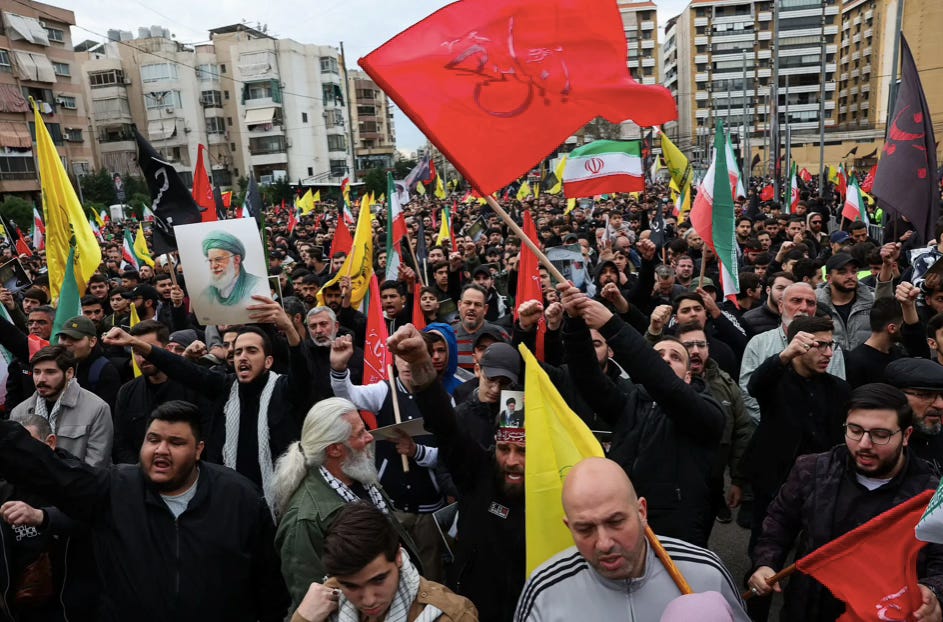
(A Hezbollah rally in Beirut on March 1st, 2026 [Mohamed Azakir/Reuters]))
As we watch US and Israeli strikes, and counter-attacks by Iran and its proxies, we need to see Tehran’s terrorist, proxy war and nuclear threats as part of a wave of aggression that has been building for over twenty years.
One milestone was 9/11. Al Qaida attacks triggered twenty years of further conflict in Afghanistan. But Al Qaida, Haqqani and Taliban bases in Pakistan went untouched — except for the 2011 elimination of Bin Laden himself.
In 2020, the Taliban did a deal with Trump. In 2021, Biden let Pakistan and the Taliban plunge Afghanistan back into terror-fuelled isolation, poverty and tyranny.
Seeing the US and its allies never moved against Pakistan, Iran filled the vacuum left in 2003 by the liquidation of Baathist state structures in Iraq.
This invasion was a boon for Iranian aggression across the Middle East.
When allies did not counter these aggressive proxy wars, the Taliban restarted large-scale attacks on Afghan and NATO troops in 2005.
With Iran’s help, Hamas took over Gaza the same year.
In 2006, Russian journalist Anna Politkovskaya was murdered — on Putin’s birthday.
With the US bogged down in Iraq, Putin issued an ultimatum in his February 2007 speech at Munich: by saying he viewed a US-dominated world as “unacceptable” he signalled his intent to use armed force and dared the world to stop him.
We did not.
Instead US ambassador to Moscow William Burns, in a private February 2008 letter to Condi Rice, argued “Ukrainian entry into NATO is the brightest of all redlines for the Russian elite (not just Putin),” predicting that “today’s Russia will respond” to any move to integrate Ukraine into Euro-Atlantic structures.
This bow to Russian neo-imperial designs destroyed any deterrent value security assurances given in the 1994 Budapest Memorandum might have had. Georgia and Ukraine were consigned to a strategic grey zone — Moscow’s sphere of mischief — making them vulnerable to further Russian aggression.
In the spring of 2008, allies denied Ukraine and Georgia paths to NATO membership. By summer, Russia was invading Georgia, stopping short of the capital, Tbilisi.
When NATO used armed force to overthrow Gaddafi but decided not to challenge Assad in Syria, Moscow escalated its aggression. In 2014, they used the Sochi Olympics as cover for an operation to take Crimea. Then the GRU, FSB, Wagner Group and Russian special forces occupied parts of Donbas.
Up to 2011 or even as late as 2016, the US and NATO responded to some aggression — in Afghanistan, Iraq, Libya, even ISIS threats. But Russian invasions, a bolstered Russian military footprint in Syria and Iranian proxies in Gaza, Lebanon, Syria and Yemen were largely ignored.
Obama withdrew the last US forces from Iraq on October 21st, 2011. NATO ended its lead role in combat operations in Afghanistan in 2014. When ISIS filled the resulting vacuum in Iraq, the US and some allies launched a campaign of limited air strikes in 2014, which peaked in 2016-17. Beyond this, NATO member states have not used force to counter Iranian, Russian, Pakistani or other terrorist aggression since 2014.
Over the past twelve years, the only states to strike back hard against aggression have been Ukraine and Israel — for whom it was a matter of survival.
They had considerable external support — in Ukraine’s case, from the US (until early 2025), Europe and other allies including Canada; in Israel’s case, mostly from the US. But Ukraine and Israel have done almost all the fighting themselves.
Until now.
The US operation that began February 28th aims to “destroy Iranian offensive missiles, destroy Iranian missile production, destroy their navy and other security infrastructure, and they will never have nuclear weapons.”
If the US and Israel achieve these goals, Iranian aggression may be blunted in Iraq, Syria, Lebanon, Yemen and Israel itself. If they do not, Iran may seek to widen the conflict — in partnership with Russia, Pakistan or even China.
Air campaigns can hit nuclear research facilities and missile factories, curbing such strategic threats. But air power alone is notoriously ineffective at promoting regime change, which requires popular movements to become more powerful than the repressive machinery of the state.
Iran’s security apparatus has been building a tiered KGB-style surveillance state for 47 years. In January, it killed tens of thousands of its own people in cold blood. Barring major defections, it will cling to power with all of its might. China, Pakistan and Russia will work to cement its hold.
When allies last used force on a large scale, it had perverse consequences. In Afghanistan, we ignored enablers and hubs for terrorism in Pakistan. In Iraq, the US empowered Iranian militias, then left a vacuum which ISIS filled. In Libya after the fall of Gaddafi, allies failed to make a serious effort to stabilize the country, which was subsequently devastated by civil and proxy wars.
By turning a blind eye to Iran and Pakistan as sources of aggression; by repeatedly failing to counter Russian invasions and coups; by not ensuring that Afghanistan and Libya became stable countries, allies invited larger-scale conflict.
We cannot act everywhere. But it was reckless to allow so much aggression to do unanswered, for so long. Strategic and decisive actions, taken jointly by allies and partners, can deter aggressors and save lives.
Chapter VII of the UN Charter provides for measures to be taken to respond to “threats to the peace, breaches of the peace and acts of aggression.” Those who lived through the Second World War knew international law, peace and stability would not survive large-scale acts of war that went unanswered.
For too long, we allowed aggressors to tie us in knots. Iran, Pakistan, Russia and other belligerents, while intensifying their attacks, used proxies and propaganda to polarize and paralyze democratic politics and prevent concerted action. They convinced many that any serious response would itself be illegal.
The reverse is true. Aggression is a crime under international law. Individual and collective self-defence are legal. When aggression begets aggression, acts of self-defence should engender decisive joint action to defeat aggressors.
The current US and Israeli operations against Iran have two major weaknesses — the same ones that plagued the 2003 US-led invasion of Iraq.
First, they were not launched jointly with allies, as part of a common strategy to isolate the regime and empower alternative political forces. Second, they lack clear objectives and a credible plan for achieving them.
If these shortcomings are not addressed, this military action to punish an aggressor may yet beget more aggression. In a world at war, we are still under-reacting or acting incoherently — meaning most aggression still goes unanswered.
What I’m afraid of is that the US & Israel will fail to dislodge the regime. They’re really dug in, with big, well-armed paramilitaries. The citizens aren’t armed at all.
I don’t think it’s accurate to say the objectives are unclear. They’re not clearly stated to the public which has been upsetting for Congress (authority usurped), and for most (not all) Democrats. That doesn’t mean that the objectives are unclear to Bibi, Trump, or the people around Trump that successfully lobbied him for this war. I don’t think this idea originated with Trump in any case. 3 confluences here:
1. State and Nat Sec Advisor combined in Rubio
2. Hegseth’s 12 century tattoo
3. Trump’s son-in-law’s longstanding goals viz a viz Israel and the Middle East.
4. Iran tried to murder Trump at least once before making him more sway-able on this one perhaps
Aka: there was a lot of energy behind this from a lot of different directions.
Tulsi has been long-ago relegated to the C team, hence the need for Rubio to play Cardinal Richelieu in this drama.
Now you throw in deepening of technical military ties between Iran, Russia and China and you start to see that there’s a window here for getting this done among the Pentagon planners AND IDF planners. I’m not party to private conversations but they almost certainly independently reached similar conclusions and unlike the Gulf War felt 0 need to bring the public in on this one. In their minds, it’s impossible to explain this level of complexity to the US public in any case: so why bother other than the “they were going for nukes” standard explanation.
In the case of the US, the biggest risk as always is China and restricting China’s ability to wage war on the US and our first island chain allies in the future. For IDF Chinese technical support of Iran becomes potentially existential: interests aligned here.
Also, Trump’s political operating system is extremely simple: announce objectives after success, not before. In a high-risk operation, that prevents the possibility of visible failure which matters to him as a politician and as a narcissist. If you declare the objective beforehand and fall short, you lose. If you wait and define the objective after the fact, every outcome can be reframed as success.
From that perspective, the ambiguity we’re seeing is not necessarily confusion, it’s risk management, tailored to Trump’s personality and political instincts.
At the strategic level, however, the direction seems fairly obvious. Whatever language is used publicly, this is functionally a regime-change war. The real question is what kind of regime change emerges, if any.
The cheapest outcome for Trump would be an internal deal within the existing 2nd tier Iranian elite; something like the Venezuelan scenario, where elements of the ruling structure cut a bargain with Washington and stabilize the situation. That would allow him to declare victory quickly and avoid a long occupation or nation-building project.
I think that’s unlikely and so plan B will be provoking an uprising by arming Kurds, Baluchis etc. Or maybe threatening to do so in order to achieve plan A by scaring the new leaders into negotiating.
Trump’s attempting a surgical regime modification as the lowest cost, highest ROI way to defang Iran and move them out of Russian and Chinese orbit. I can’t say whether or not it’s going to work but it is too soon to say that there is no plan and that the Pentagon has not learned from Iraq. I mean, the Pentagon has not come across as particularly incompetent of late, let’s be honest.
The biggest risk I see now is a strategically shallow outcome. If the long-term objective is to pull Iran away from Russia and China and gradually reintegrate it into the Western system, then a simple elite reshuffle inside the current power structure might not actually accomplish that. Then again, even that kind of failure preserves option value for later, so if it does not work, you can come back in 12 months and have another crack at it.