


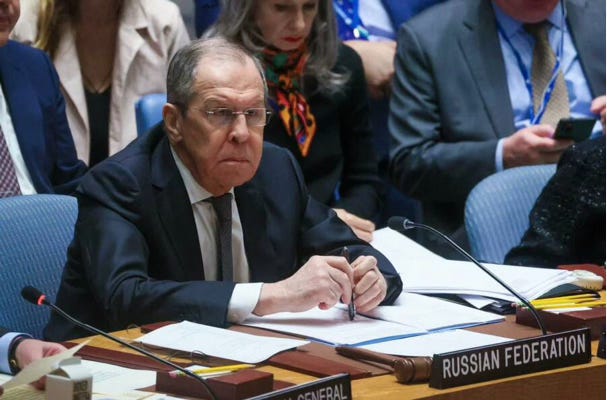
(Russian foreign minister Lavrov chairing the UN security council on April 24, 2023 — exactly fourteen months after his country launched a full-scale invasion of Ukraine.)
We know who has been attacking the rules-based order for the past three decades. Last week we examined how their aggression has gone virtually unanswered. Now we need to look more closely at what could be done to salvage what remains of the rulebook established at such great cost in 1945.
The United Nations remains central. After all, its first purpose, as listed in the UN Charter, is “to take effective collective measures for the prevention and removal of threats to the peace, and for the suppression of acts of aggression or other breaches of the peace.” For over a decade, little or nothing has been done to prevent, remove or suppress threats or acts of aggression by Russia, Iran and Pakistan.
This failure to come to grips with aggression has left the UN paralyzed and powerless — in the kind of disarray that swept over the League of Nations in the 1930s. Chapter VII of the UN Charter is entitled “Action with Respect to Threats to the Peace, Breaches of the Peace, and Acts of Aggression.” It is the longest part of the UN’s founding document, detailing enforcement measures to be authorized when diplomacy and other peaceful approaches to dispute resolution fail.
Yet when Pakistan supports the Taliban to recapture Kabul, when Russia launches an invasion of conquest in Ukraine, or when Iran arms the axis of resistance and seeks nuclear weapons to destroy Israel, the UN has mostly stood aside. Why? The UN has been immobilized in large measure by a fatal flaw baked into the Charter from the start. When breaches of the peace or acts of aggression occur, there is no provision for removing the aggressors themselves from Security Council deliberations concerning actions to be taken to enforce international peace and security.
As a result, Russia, China and Pakistan are members of the Security Council today — able to take full part in debates concerning Ukraine, Afghanistan and Gaza, where they have committed or enabled acts of aggression. As permanent members, Russia and China have veto power which they wield to shield aggressors from accountability and reinforce their impunity.
Iran chaired the UN Human Rights Council in 2023 and just last month was elected vice chair of the special committee on the UN Charter. For one month almost every year, Russia chairs meetings of the Security Council where its genocidal and illegal occupation of Ukraine is an agenda item. This Orwellian anti-utopia would be farcical if the consequences for millions of victims and hundreds of millions of displaced people were not so grave and often deadly.
With aggressors blocking action, the UN has failed to respond effectively in Syria, Ukraine, Africa, Afghanistan or Iran. Conflicts have spiralled out of control as escalating aggression by Russia, Iran and Pakistan, supported and enabled by China, North Korea and others, goes unchecked.
The League of Nations Covenant was more rigorous on this score. Its article 16 provided for the following: “Any Member of the League which has violated any covenant of the League may be declared to be no longer a Member of the League by a vote of the Council concurred in by the Representatives of all the other Members of the League represented thereon.”
In other words, aggressors were removed from League deliberations. The League’s members agreed to submit major disputes, including acts of aggression, to judicial settlement, arbitration or decision of the League’s assembly in which parties to the dispute would not vote. As a result of these provisions, Japan and Nazi Germany withdrew from the League in 1933; fascist Italy withdrew in 1937; Spain in 1939. The Soviet Union was expelled by a 7-0 vote of the League’s executive council in December 1939 for invading Finland in the Winter War. Only four months’ later, the League assembly voted itself out of existence amid the chaos of the Second World War.
The League also provided for measures beyond arbitration and expulsion, often more honoured in the breach. These included sanctions and virtual embargo: “Should any Member of the League resort to war in disregard of its covenants under Articles 12, 13 or 15, it shall ipso facto be deemed to have committed an act of war against all other Members of the League, which hereby undertake immediately to subject it to the severance of all trade or financial relations, the prohibition of all intercourse between their nationals and the nationals of the covenant-breaking State, and the prevention of all financial, commercial or personal intercourse between the nationals of the covenant-breaking State and the nationals of any other State, whether a Member of the League or not.” In 1935, Canada was involved in an unavailing effort to impose penalties on Abyssinia, which Mackenzie Kind notoriously reversed.
In the deliberations over the UN Charter, which country do you think was most adamant that no provision similar to article 16 be included in the new founding document? Which country instead that aggressors be able to take part in deliberations over their own acts of aggression? This was of course the Soviet Union, which has been expelled from the League in 1939. In negotiations over the UN Charter, Stalin insisted on preserving the ‘Yalta formula’ for the resolution of disputes, meaning the great powers — Moscow, Washington and London — should decide strategic matters, as they had done at their famous 1945 summit in Crimea that had left Europe devastated and divided for nearly two generations.
For well over a decade, this outdated model, which protects the impunity of aggressors, has left the UN on the sidelines. The Security Council has been unable to take decisive action, while Russia, Iran and Pakistan have escalated their aggression in Ukraine, the Middle East, Afghanistan, Africa and elsewhere. Sanctions and other measures have mostly been agreed outside UN structures.
Ukraine and Israel have acted in self-defence, with the support of partners, but allies have so far failed to invoke the inherent right of collective self-defence that is confirmed in article 51 of chapter VII of the UN Charter.
This is unfortunate. The original united nations were formed, not in 1945, but rather in 1939 and again in 1941 as a coalition of democracies fighting Nazi and Japanese aggression to free Europe and Asia from conquest and occupation.
Today’s aggression also needs to be fought. This can be done outside UN structures, by fully invoking the principle of collective self-defence.
But it can also be done within UN structures once Russia is removed from the Security Council, as richly deserves to be. Some have argued this is impossible, as Russia would veto its own removal. This misses the obvious point that the Soviet Union, which no longer exists, was given a permanent seat, not Russia. There are workable plans for Russia’s removal, including this one. All that has been lacking so far is the political leadership and political will to implement them.
The history of the twentieth century showed that if collective action is not taken, the current storm of aggression is likely to worsen, as it did in the 1930s. If China blockades or invades Taiwan, a truly global conflict is likely to ensue.
One way or another, aggressors must be defeated, Further aggression must be prevented, and international peace and security restored.