


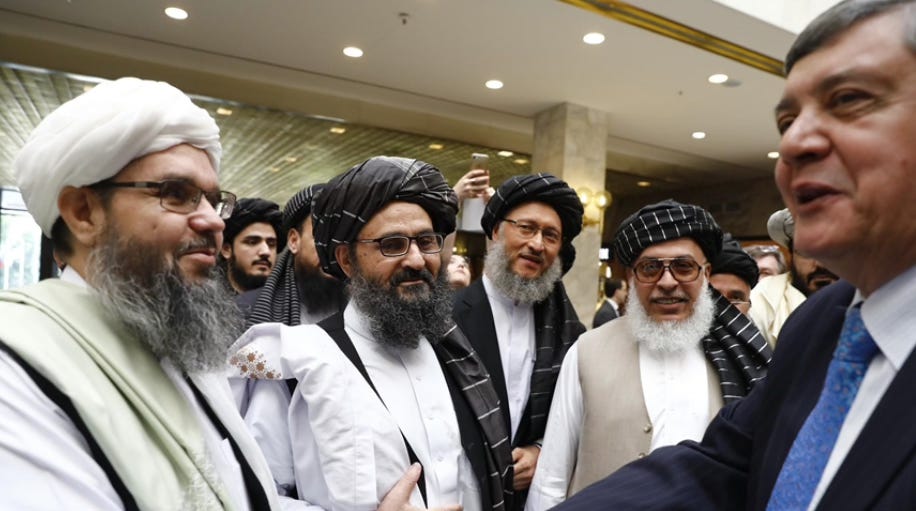
(Taliban leaders Mullah Abdul Ghani Baradar (centre), accompanied by then head of political office Sher Mohammad Abbas Stanakzai (second from the right) meet Russian diplomat Zamir Kabul (right) on May 28th, 2019 in Moscow. Baradar is now deputy prime minister and Stanakzai deputy foreign minister in the illegal and illegitimate Taliban terrorist regime that took Kabul by force in 2021.)
As the US and Israel continue their air campaign against Iran, whose outcome we cannot fully or reliably predict, let’s remind ourselves which states have been attacking the rules-based order most aggressively in recent decades.
What do we mean by ‘rules-based order’? To be relatively straightforward, let’s define it narrowly as institutions, laws and practices established to uphold the “dignity and worth of the human person” — in the phrase of the preamble to the UN Charter — and to prevent wars of aggression and invasions.
This rules-based order is generally held to have survived the Cold War, including the Korean and Vietnam wars. But it was seriously and continuously undermined after 1945 by Soviet and Chinese communist repression at home and abroad. In fact, the crackdowns, genocide, interventions, occupations and proxy wars undertaken by these states were the principal factor curtailing postwar human dignity.
A full accounting of aggression over all 81 years since 1945 would be a monumental task, far beyond the scope of this essay. To summarize, the international community avoided world wars but not regional, proxy or civil wars — often with devastating consequences for national populations. The number of forcibly displaced persons, including refugees, has risen steadily from 2.1 million in 1951 to a projected 136 million this year. Persistent civil conflicts in Africa, the Middle East and Latin America drove much of this displacement.
Instead of reviewing the entire track record since 1945, let’s pinpoint the primary sources of aggression in the world since roughly 1990 — the year just after the massacre on Tiananmen square (June 3-4th, 1989) and destruction of the Berlin wall (November 9th, 1989) but before the disbandment of the Warsaw Pact (July 1st, 1991) and dissolution of the Soviet Union (December 26th, 1991).
To understand this contemporary era of conflict, we need to recall that, starting in the 1960s, the Soviet Union shifted its focus, as we discussed in our series on the end of the Cold War, from sponsoring worldwide communist revolution to partnering with Islamist, left-wing and nationalist groups, including terrorists, as well as long-term active measures to disorient, polarize and disempower the politics and societies of democratic allies. Russia scaled up these practices after 1991.
The 36 years of aggression after 1990 break down into five main threads:
The first was violence related to the collapse of the Soviet Union and Yugoslavia, as revanchists tried to hang on to territories by force. This led to armed conflicts in which both Gorbachev and Yeltsin sought to retain control of enclaves in roughly half a dozen states that were previously part of the Soviet Union. Moscow also waged two brutal wars in Chechnya. Belgrade launched wars in Croatia, Bosnia and Kosovo. Russian and Serbian nationalists were the main aggressors in each case.
