


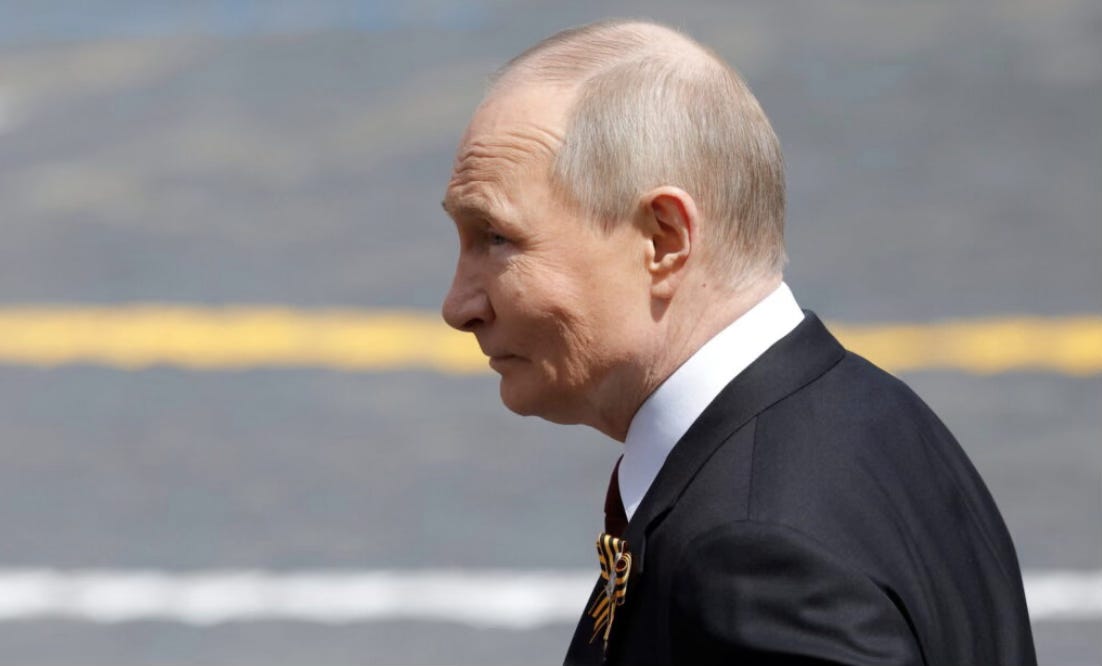
The only real debate behind the scenes in Moscow is about who will take over from ‘Putin’ — the exhausted lookalike who never really filled the space left by Putin but was a convenient placeholder for feuding factions over three years.
All signs indicate this interregnum is coming to an end.
What are those hints? The public profile of ‘Putin’ is in sharp decline. He said very little about the US-Israeli war against Russia’s ally Iran, or Trump’s naval blockade. Russia lost its main proxy in Europe. Moscow’s Afrika Corps is playing defence in the Sahel. Ukraine’s deep strikes are decimating Russian refineries and ports. Rumours of bunkers and coups, likely stoked by the Kremlin itself, are back.
The double’s schedule is thin. Since the start of this month, his only public appearances have been with a truck plant director and the head of Mordovia, an impoverished republic of 800,000 in the Volga basin.
On the last day of April he was ‘busy’ interviewing candidates to run Dagestan, an even poorer republic in the Caucasus decimated by recent floods. In a sign of the times, Moscow’s choice fell on yet another ethnic Russian.
‘Putin’ is not even allowed to speak himself about his regular chats with Trump, which are instead summarized on the Kremlin website by an aide.
The Soviet Union went through a period of gerontocracy in the early 1980s under a series of ageing leaders — Brezhnev, Andropov, Chernenko. Fascist Russia is now in an analogous period, as the Putin brand fractures and dilutes.
None of this means change is imminent. No Gorbachev is waiting in the wings.
But autocratic Moscow is at an impasse. One major obstacle continues to block the transition to a new government, and eventually a new president.
This is Ukraine’s heroic resistance to the pressure it has been under for over a year from Trump and his team, acting as conduits for Kremlin’s attempts at coercion. In a nutshell, Ukraine has refused to give up the parts of Donbas it still controls — the so-called ‘fortress belt’ — because it knows from bitter experience and centuries of history that such concessions would only feed further Russian aggression.
The Kremlin succession was supposed to happen after the war ended on Moscow’s terms. Trump’s arm-twisting and cutting of virtually all US military assistance to Ukraine was supposed to deliver this result.
Yet Trump has not delivered. Instead Ukraine has taken the initiative in the drone war, has damaged energy and military infrastructure across Russia, and is now helping Gulf states defend themselves from Iranian attacks.
As a result, any new Russian president would take office in conditions of growing domestic penury and repression. The Russia internet has been heavily restricted. Bank accounts are facing confiscation. National mobilization to cover battlefield losses may see over 300,000 young men conscripted as early as this month.
All of this has led to a new ‘battle under the carpet’ — a Russia idiom widely used to refer to power-brokers scrambling for advantage behind closed doors.
