


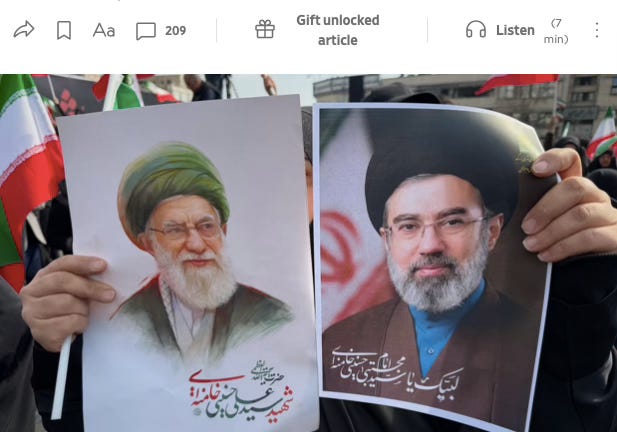
(Posters of new Iranian supreme leader Mojtaba Khamenei, who today promised to retaliate for every death, and his deceased father in Tehran on March 9th, 2026.)
In one of our two March 10th essays (‘The Rules-Based Order: How to Save It?’), we recalled how, when the United Nations Charter was being drafted, Stalin insisted on the ‘Yalta formula’. According to this principle, permanent members of the Council would have a veto over any and all military action by the UN. This effectively meant that, if one veto-wielding power was committing acts of aggression, that state would nevertheless continue to sit in judgement over itself — at the very table where decisions were being made over how the UN should respond.
This arrangement was less of a problem so long as the Permanent Five were not engaged in wars of aggression or territorial expansion. With the launch of Russia’s fascist wars of conquest, starting with Georgia in 2008, it has been almost fatal to the organization. Russia’s veto has meant the UN has been unable to respond to these wars and proxy wars of aggression. A Chinese military operation to subjugate Taiwan by force would make this terrible situation far worse.
The solution to this difficulty in the League of Nations covenant had been to give members of the League Council the power to vote unanimously to expel any member, permanent or non-permanent. The member targeted for expulsion was not allowed to vote. This is exactly what happened to the USSR in 1939 by a vote of seven to zero. Stalin’s insistence on the ‘Yalta formula’ was born of this experience. In 1945, he was seeking complete impunity. By getting this League provision dropped, he both gave Moscow a veto and ensured it would never be expelled again.
That did not prevent allies from circumventing Moscow’s veto, as when a key motion regarding the Korean War was passed in June 1950, while the Soviet delegate was boycotting the Council. Membership in the UN Security Council is also far from absolute. In the same March 10th essay cited above, we noted that there are workable plans for removing Russia from it. (They have not yet been attempted.)
In the meantime, with Russia and its allies (including Iran) committing so many egregious acts of aggression in recent years, generally enabled by China, how does one get around the ‘Yalta formula’ to ensure such aggression does not go endlessly unaddressed? The solution is the “inherent right of individual or collective self-defence” which we discussed at some length in an essay published last October 25th and mentioned briefly at the end of yesterday’s piece.
This provision of international law was not created by the UN Charter. Self-defence was explicitly identified as a just cause for war as early as 1625 in De Jure Belli ac Pacis (The Law of War and Peace), the landmark treatise by Dutch humanist, diplomat and jurist Hugo Grotius. It was part of customary law for centuries before that. But article 51 of the UN Charter explicitly recognized and reaffirmed the right of self-defence — a provision that had gone unmentioned in the League of Nations covenant.
The inclusion of self-defence was a very deliberate effort to counter-balance the ‘Yalta format’ veto power enshrined in the Security Council. The reference to collective self-defence was pushed by Latin American delegations who, prior to the San Francisco conference, had adopted the act of Chapultepec in March 1945 at the Inter-American Conference on Problems of War and Peace.
This act established a regional collective self-defence principle that NATO would later follow: an armed attack against one American state was considered an attack against all, authorizing joint defensive measures. The Latin American delegations feared the Security Council might override these arrangements.
In debates on the UN Charter, the Colombian delegate in particular emphasized that the term ‘collective self-defence’ was meant to preserve systems like the Inter-American one. On May 12th, 1945 the US delegation, led by secretary of state Stettinius and then-advisor John Foster Dulles, circulated a draft to the future permanent Security Council members that included reference to the ‘inherent right’ to self-defence in case of aggression.
That language became the basis for article 51 of chapter VII of the UN Charter. In today’s cases of aggression, where Russia is either itself the belligerent or a main ally or enabler of aggressor states such as Iran, article 51 is the primary legal basis for action to counter acts of aggression and breaches of the peace.
Since 1979, the Islamic Republic of Iran has committed itself to Israel’s destruction repeatedly. Over several decades, it established the axis of resistance as a multi-state platform from which to attack Israel. It systematically sponsored terrorist groups and sought to develop nuclear weapons with the express goal of attacking Israel, as Hamas set out to do on October 7th, 2023.
No country today has a more clearly inherent right to defend itself against external aggression — except perhaps Ukraine.
