


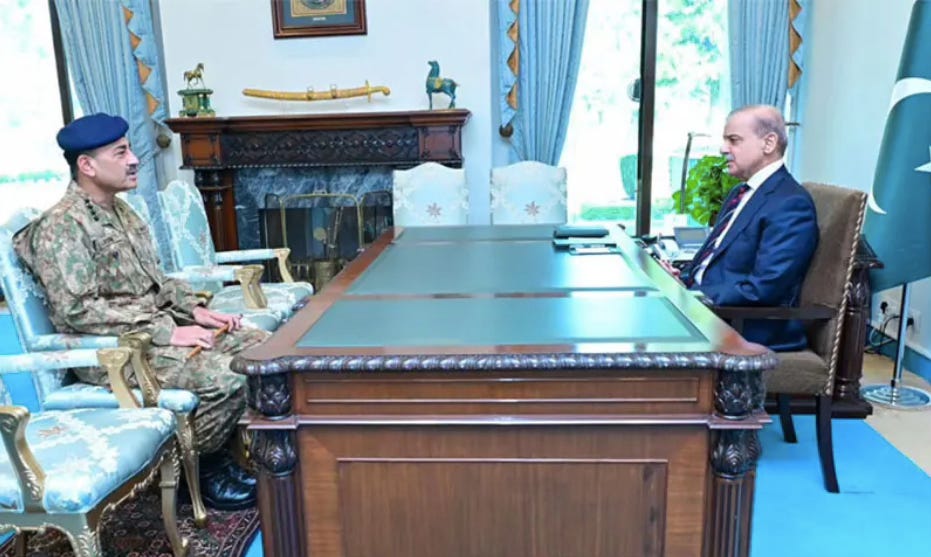
(Field Marshal Asim Munir, who is Pakistan’s chief of the army staff, calling on Pakistani prime minister Shehbaz Sharif in November 2025.)
As the US vice president heads to Islamabad for talk with Iran, the strategic contradictions that beset this military operation from its start on February 28th are coming home to roost.
The failure of the White House to bring allies onside in advance has now led to an open breach, which will not be easily mended.
Even as American bombs rained down on Tehran over 40 days, Trump and his team remained utterly besotted with their Kremlin friends, batting away hard evidence Russia provided intelligence to help target US service members and Gulf energy infrastructure. Far from being embarrassed, the Administration is doubling down on its backing for Russia’s genocidal occupation of Ukraine.
The Iranian people, who have suffered in countless ways since 1979, seem no closer to ridding themselves of the repressive regime that massacred thousands of them in streets and hospitals in cold blood in January.
With little to lose, the remains of the Khomeinist machinery of repression seem determined to hold international commerce hostage in the strait of Hormuz and threaten Gulf neighbours.
Given the current ceasefire does not apply to Lebanon, where Hezbollah has been in breach of UN resolutions for two decades, Israel has been engaged in air strikes on targets there for two days — in addition to a ground operation that began on March 16th, which took the IDF as much as ten kilometres into Lebanon. They have almost reached the Litani river, north of which Hezbollah was required to withdraw by the terms of UN security council resolution 1701, adopted unanimously on August 11th, 2006 in a bid to end the Israel-Lebanon war of that year.
While Iranian military capabilities have been damaged, the regime’s obdurate obsession with continuing its proxy wars remains undiminished.
Lebanon is a virtual Iranian protectorate. Hamas still exists. The Houthis are still hurling anti-Israeli hatred and violence at the world from Yemen.
As we have argued before, there will be no Middle East settlement — no peace around the Persian Gulf — until Iran’s aggression against Israel and other states is ended.
What are the prospects for success in Islamabad? In short, nil.
Iran has made unacceptable demands. The US has put forward a wish list of laudable goals with no prospect of being achieved — even in part.
JD Vance opposed the military operation against Iran from the start. With Trump, he is the flashing red light signalling this White House’s de facto alliance with Iran’s ally Russia, having just visited Budapest to help Hungarian autocrat Viktor Orban, the Kremlin’s top stooge in Europe, remain in power.
The host country for these talks embraces a virtual carbon copy of Iran’s playbook. In fact, they invented it years before the Iranian revolution took place in 1978-79. In Pakistan’s case, the main prize for decades of state sponsorship of terrorism, proxy wars and genocidal occupation has been Afghanistan, which Trump and Biden combined to gift to Islamabad in 2020-21. Islamabad is also China’s most important and most obsequious strategic ally.
To top things off, Pakistan’s defence minister recently posted this:
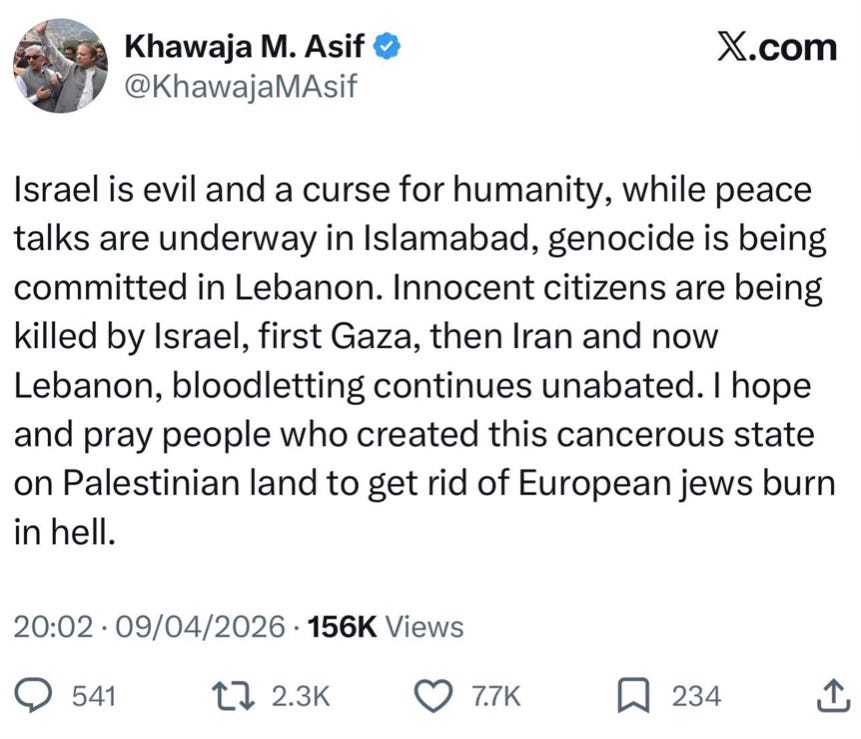
This tweet is all we need to know about prospects for peace this weekend,.
By agreeing to meet in Islamabad — the country that backed Iran’s terrorism project most staunchly since 1979 — the US is showing more strategic weakness. In the end, Pakistan was only chosen as a mediator and venue because of its army chief’s headlong, calculated effort to ingratiate himself with Trump over the past year, which we highlighted at the start of the US/Israeli air campaign against Iran.
Does the choice of Islamabad show that, as ever, Trump always chickens out (TACO)?
Yes, quite possibly.
But if Iran is an exception to the TACO principle — as Trump’s statements about Iran since the 1980s lead some to believe — then a resumption of military strikes and even operations to open the strait of Hormuz is also entirely possible.
Either way, the economic pain of Iranian blackmail in the strait of Hormuz and Iran’s hostile designs on the Middle East will remain.
Some including a former Israeli foreign minister writing in today’s Globe and Mail have gone so far as to conclude that, by repealing the principle of a Clausewitzian ‘centre of gravity’, rogue states like Iran are bound to have endless success with their asymmetric war-fighting.
The truth is more prosaic and more concrete. The Iranian regime is now enfeebled. They will only stay in power by continuing massive internal coercion. Their economy is vulnerable, with no windfall or saviour in sight.
States like Iran, Pakistan and Russia need trade. They need weapons. They depend on partners. They crave financial flows. They require technology to continue their wars of conquest and occupation in Lebanon, Afghanistan and Ukraine.
Sanctions, embargo and enforcement actions can tip the balance against them.
All that is required is political will and unity among allies.
Both are now in short supply. But we should not give up on the only formula for responding effectively to situations of great gravity that is known to work.
Ever true to form, Ukrainian president Zelenskyy has seen this clearly. In Ukraine’s efforts to share their world-beating drone defence systems with Gulf states, in its call for more decisive to pull economic levers that would end Iran and Russia’s ability to project aggression, there is the outline of real strategy.
For now, most allies are not even naming the problem correctly.
Macron’s knee-jerk condemnation of Israel for defending itself against attacks from Lebanon — and the French president’s refusal to be remotely coherent on Iran over the past five weeks — are just the tip of the iceberg.
The vitriolic hate speech by a Pakistani defence minister, inciting the same violence Iran has been meting out for nearly half a century, will not be denounced by any allied political leader or UN official. Most media are ignoring it.
Only Pakistan army chief Asim Munir apparently had the presence of mind and clout to oblige his minister — technically Munir’s superior — to delete the offending tweet. But the damage done by waves of Anti-Semitic rancour remains.
While allies are blinded by prejudice, the US is grounded by incoherence.
While attacking Russia’s ally, this Administration sides with Moscow. When seeking an off-ramp for military operations, they turn to Pakistan — with Iran, the most intractable state sponsor of terrorism in the world today whose occupation of Afghanistan Trump eagerly facilitated in his first term.
For now, the doom loop of incoherence and under-reaction continues.
I agree that Lebanon is a distraction. But I am discouraged by how intractable the Iran problem seems to be.
They’re now charging a toll for tankers in the Strait of Hormuz. Mind you, they still appear to be only letting tankers carrying Iranian oil through.
Only single digits getting through. But at $2 million per tanker, they’ve got a new revenue stream.